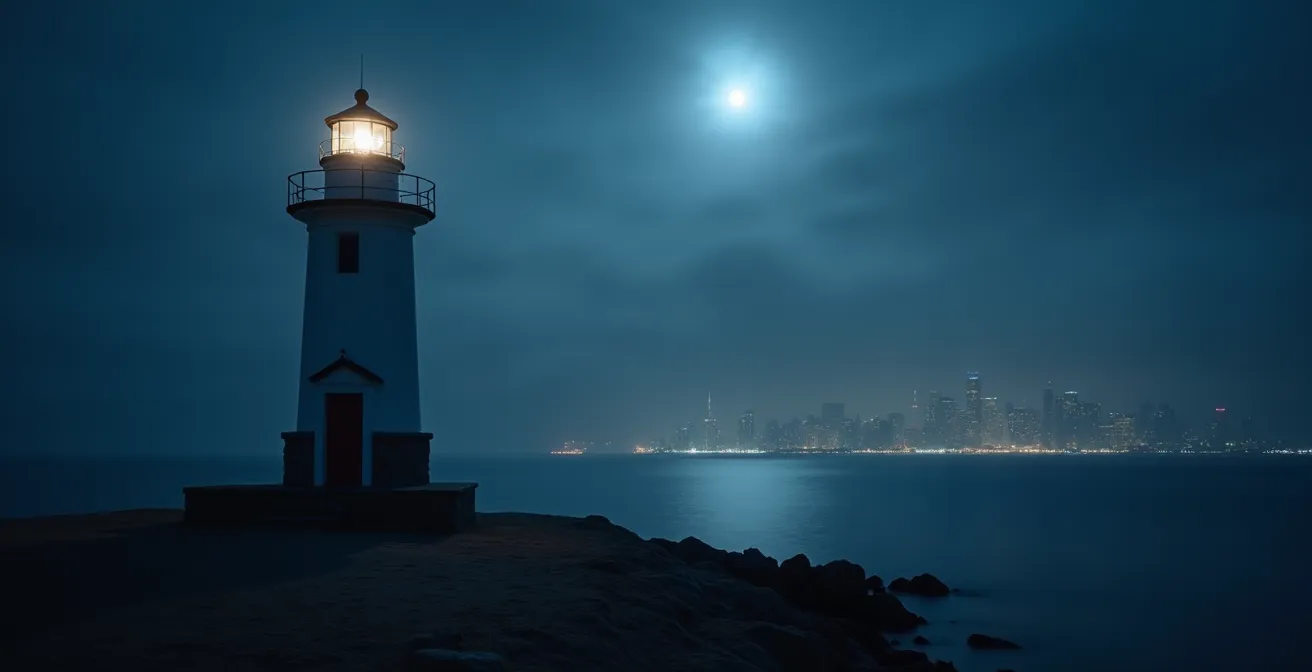
The key to a successful encounter at Toronto’s most haunted site isn’t luck; it’s treating the visit like a paranormal investigation with a solid, pre-planned mission.
- Logistics are your primary challenge, as the Toronto Islands ferry schedule is unforgiving and dictates your entire operation.
- Proper gear, especially a red-light headlamp and offline maps, is non-negotiable for navigating the unlit paths safely and effectively at night.
Recommendation: Your objective is observation, not infiltration. Respect the lighthouse’s status as a locked, protected heritage site at all times.
The air on the Toronto Islands changes after dusk. The daytime laughter fades, replaced by the rhythmic lapping of Lake Ontario against the shore and the rustle of unseen things in the dense woods. For those who seek it, another presence lingers here—a spectral sentinel tied to the oldest building on the island: the Gibraltar Point Lighthouse. Many have heard the ghost stories of its first keeper, J.P. Radanmuller, murdered within its stone walls. They might tell you to just “take a walk” and see if you feel anything spooky.
But that approach leaves you unprepared for the island’s logistical traps and blind to the subtle clues a true investigator looks for. This is not a casual stroll; it is a paranormal mission. The real challenge isn’t finding the ghost, but mastering the environment. Success depends on understanding ferry schedules as extraction deadlines, knowing the terrain, and recognizing that you are entering a protected historical site, not an abandoned ruin. Forget the vague campfire tales. This guide is your operational briefing, designed to equip you with the strategic knowledge to navigate the island at night, conduct a proper observation, and return to the mainland with your story—and not become a permanent part of the island’s folklore.
This detailed briefing will cover every phase of your mission, from the historical basis of the haunting to the critical logistical details that ensure a successful and safe investigation. Explore the sections below to prepare for your night at Gibraltar Point.
Summary: Your Mission to Investigate Toronto’s Haunted Lighthouse
- Why Is J.P. Radanmuller’s Ghost Said to Haunt the Lighthouse?
- How to Navigate the Island Paths to the Lighthouse at Night?
- Gibraltar Lighthouse vs. Mackenzie House: Which Is Toronto’s Most Haunted Spot?
- The Trespassing Risk of Trying to Enter the Locked Lighthouse
- When Do the Haunted Island Walking Tours Operate?
- The Schedule Mistake That Leaves You Stranded on the Island
- Why Was Only Half of 54 1/2 St. Patrick Street Demolished?
- How to Navigate Toronto Islands Logistics for a Stress-Free Day?
Why Is J.P. Radanmuller’s Ghost Said to Haunt the Lighthouse?
Every paranormal investigation begins with the “case file”—the history that fuels the haunting. The story of John Paul Radanmuller is not mere folklore; it’s a grim piece of Toronto’s early history. As the first keeper of the Gibraltar Point Lighthouse, he was a solitary figure in a remote outpost. The legend, passed down through generations, claims that on a cold winter night, soldiers from the nearby Fort York garrison visited Radanmuller, seeking a share of his home-brewed beer. An argument erupted, and the soldiers murdered him, dismembering his body and hiding the remains around the lighthouse. Since that day, his spirit has been tied to the stone tower, forever searching for his missing bones.
For decades, this was just a story. But the line between legend and reality blurred significantly with a chilling discovery. The tale gains its disturbing credibility not just from eyewitness accounts of moans and a spectral figure, but from physical evidence unearthed at the site.
Case Study: The Discovery of Skeletal Remains at Gibraltar Point
The legend received a major boost in 1893. George Durnan, the lighthouse keeper at the time, was digging near the tower when his shovel struck something solid. He unearthed fragments of a coffin and, most disturbingly, part of a human jawbone. As detailed in historical archives, this discovery was widely believed to be the long-lost remains of Radanmuller, lending powerful, tangible weight to the ghost story that had been circulating for nearly 80 years. This event transformed the narrative from a simple ghost tale into a potential unsolved murder with a restless victim.
This historical and archaeological context is the foundation of your investigation. You aren’t just visiting a spooky place; you’re stepping into a 200-year-old crime scene where the victim is said to still be present, forever bound to his post.
How to Navigate the Island Paths to the Lighthouse at Night?
Your approach to the lighthouse is the first phase of the mission. Forget well-lit city streets; the Toronto Islands at night are a different world. The paths are unlit, the signage is sparse, and disorientation is a real risk. To reach the lighthouse from the Ward’s Island ferry dock—your optimal landing point—you must traverse a winding 2 km path through dark woods and quiet residential lanes. This journey is part of the experience, a descent into the island’s eerie psychogeography that primes your senses for what’s to come.
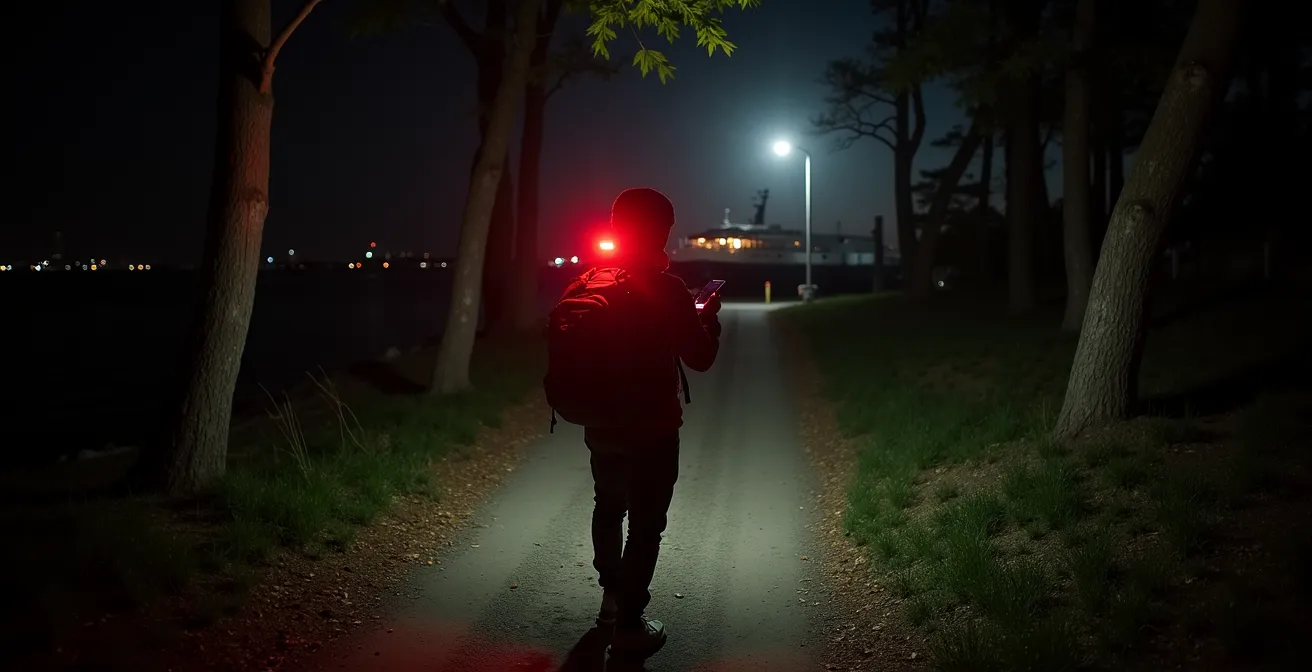
As you can see, moonlight offers some natural illumination, but it’s unreliable. The path twists through dense trees that create pockets of near-total darkness. Navigating this requires preparation, not just bravery. Your phone’s GPS can be unreliable under the thick tree canopy, and its bright screen will ruin your night vision, making you blind to your surroundings. An offline map application is not a suggestion; it is a necessity. The goal is to move with quiet confidence, preserving your awareness for any potential paranormal phenomena, not stumbling in the dark.
Your Essential Night Investigation Kit: A Checklist
- Navigation: Download the Toronto Islands map on an offline app like Maps.me or AllTrails. Do not rely on a live data connection.
- Illumination: A headlamp or flashlight with a red-light function is mandatory. Red light preserves your night vision, allowing your eyes to remain adapted to the darkness.
- Power: A fully charged portable power bank (minimum 10,000 mAh) for your phone. Your phone is your map, camera, and emergency lifeline.
- Safety & Visibility: A reflective vest or armbands. While you want to be stealthy for ghost hunting, you need to be visible to any security patrols or cyclists.
- Emergency Tools: A loud emergency whistle and a basic first-aid kit for minor injuries. You are in a remote park area.
This gear isn’t for a simple walk; it’s the standard loadout for an investigator entering an unpredictable environment. Being prepared allows you to focus on the mission, not on survival.
Gibraltar Lighthouse vs. Mackenzie House: Which Is Toronto’s Most Haunted Spot?
To understand the significance of the Gibraltar Point haunting, an investigator must contextualize it within Toronto’s broader paranormal landscape. Is it truly the city’s most active location, or does it have rivals? The primary contender for that title is undoubtedly Mackenzie House, the downtown home of Toronto’s first mayor, William Lyon Mackenzie. While the lighthouse offers a tale of brutal, isolated murder, Mackenzie House presents a different flavour of spectral activity, often described as more poltergeist-like and interactive.
Paranormal researchers have spent countless hours at both locations. The activity at Mackenzie House is often reported as more overt: a piano playing on its own, the clatter of a printing press in the basement, and the apparition of a sad-looking woman. It’s a classic urban haunting, contained within the four walls of a historic building. The Gibraltar Point haunting is, by contrast, a more elemental and atmospheric phenomenon. The reports are of a more sorrowful nature: eerie moans carried on the wind, a lonely light appearing in the lantern room, and the fleeting figure of a man in archaic clothing walking the shoreline. It’s a landscape haunting, tied to the wind, the water, and the stones of the tower itself.
Mackenzie House is arguably the most infamous structure in Toronto if not Canada that is reportedly haunted.
– ParaResearchers of Ontario, ParaResearchers Investigation Report
So, which is “more” haunted? It’s a question of quality, not quantity. Mackenzie House may offer more frequent and direct phenomena, making it a hotspot for classic ghost hunting. But Gibraltar Point Lighthouse presents something deeper: a powerful, residual haunting steeped in tragedy and isolation. It doesn’t perform for visitors; it simply exists, a wound in the landscape. For the patient investigator, the experience at the lighthouse can be far more profound and unsettling.
The Trespassing Risk of Trying to Enter the Locked Lighthouse
This is the most critical rule of engagement for your mission: you are an observer, not an intruder. The romantic image of climbing the spiral staircase to the lantern room is a fantasy that will end your investigation before it begins. The Gibraltar Point Lighthouse is not an abandoned relic; it is a protected heritage site under the care of the city. The main door is securely locked, the windows are barred, and the area is monitored.
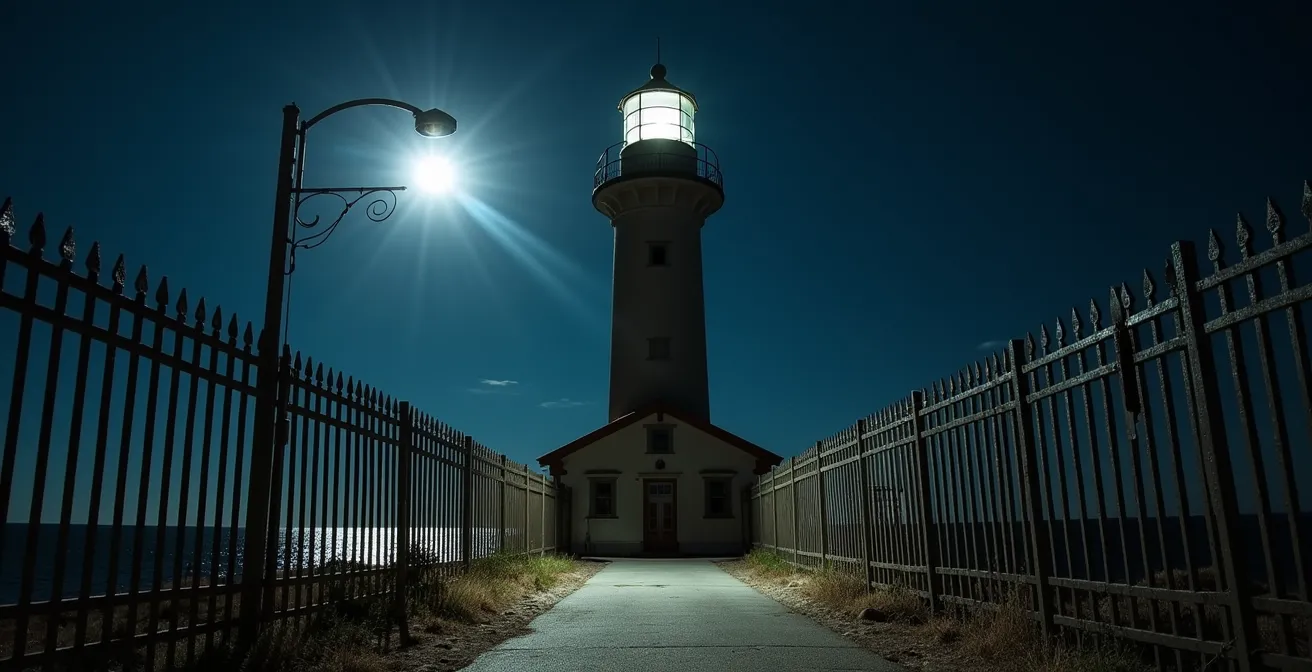
Attempting to force entry is not only illegal but also counterproductive to any serious investigation. It constitutes trespassing and vandalism, which can result in fines and a permanent ban from the island. Furthermore, it contaminates the site. Any noise you make trying to get in will be mistaken for paranormal activity, rendering any data you collect useless. A true investigator respects the location. The haunting is associated with the entire area, not just the interior. You can conduct a full and effective observation from the grounds surrounding the tower.
The lighthouse has a specific legal status that all visitors must understand. According to historical records, while the light was deactivated in 1959, the structure itself is Toronto’s oldest standing building and a designated heritage property. As one of the most comprehensive databases on lighthouses notes, this designation requires special permission for any access to the interior, which is rarely granted. Your mission is to document what happens *around* this historic structure, not to break into it. The real evidence lies in the cold spots on the lawn, the disembodied sounds from the shoreline, and the feeling of being watched from the dark windows above.
When Do the Haunted Island Walking Tours Operate?
If a solo night mission feels too daunting, or if you prefer a curated experience, several guided tours offer a gateway into Toronto’s haunted history, including the story of the lighthouse. These operations provide the legends and atmosphere without the logistical stress of self-navigation in the dark. However, it’s crucial to understand what they do—and do not—offer. Most tours tell the lighthouse’s story from a distance, either from the mainland or from the deck of a boat. They are story-telling experiences, not on-site paranormal investigations.
The market for these tours is seasonal, peaking dramatically in the fall. This is both a blessing and a curse. While there are more options, the crowds can disrupt the spooky atmosphere you’re seeking. A self-guided mission allows you to operate in solitude, a key condition for subtle paranormal observation. The choice between a guided tour and a solo expedition depends on your objective: are you seeking entertainment or a personal experience? The table below outlines your primary options for a guided encounter.
This comparative data, drawn from sources like the primary provider of harbour tours, helps you weigh the cost, duration, and level of access for each option. Notice that direct, on-site access to the lighthouse at night is not a feature of standard tours.
| Tour Provider | Season | Price | Duration | Lighthouse Access |
|---|---|---|---|---|
| Haunted Harbour Boat Tour | May-October | $49 adult/$39 youth | 90 minutes | Boat viewing only |
| Self-guided night visit | Year-round | $9.11 ferry fare | Unlimited | Exterior viewing only |
| Ghost Walks Toronto | May-November | $25-35 | 75-90 minutes | Stories from shore |
| Private paranormal investigation | By special arrangement | $200+ per group | 2-3 hours | Potential interior access |
As you can see, a private paranormal investigation is the only potential route for interior access, but this is a costly and specialized arrangement. For most thrill-seekers, the self-guided visit remains the most authentic and immersive way to experience the lighthouse’s haunted atmosphere directly.
The Schedule Mistake That Leaves You Stranded on the Island
The most tangible threat on your mission is not a ghost, but a timetable. The Toronto Islands are serviced by a public ferry system with a hard cutoff time. Missing the last boat is the single biggest mistake an investigator can make, turning a spooky adventure into a genuine emergency. You must treat the ferry schedule not as a guideline, but as an absolute, time-critical extraction plan. Your entire night’s timeline must be reverse-engineered from the final departure time.
According to the official schedule, on most nights during the operating season, the last ferry leaves Ward Island at 11:45 PM. This is your non-negotiable deadline. You must factor in the 20-30 minute walk back from the lighthouse to the dock, plus a buffer for unexpected delays. Aiming for the second-to-last ferry is the professional approach; relying on the last one is a rookie mistake that leaves no room for error. Getting stranded means facing a cold, long night in a park with no shelter and very limited options.
While a network of private water taxis does exist, they are not a 24/7 emergency service. They are expensive, their availability is not guaranteed late at night, and they will not operate in poor weather conditions. Relying on them is a high-risk gamble. The Toronto Police Marine Unit will only respond to life-threatening emergencies, and missing your ferry does not qualify. The island at midnight is a lonely, dark place; ensure your mission concludes at the ferry dock, not in a desperate call to an unavailable water taxi.
Why Was Only Half of 54 1/2 St. Patrick Street Demolished?
While your primary mission focuses on the enduring ghost of Gibraltar Point, a true investigator of Toronto’s strange tales understands that hauntings come in many forms. Some are spiritual, while others are architectural. The peculiar case of 54 1/2 St. Patrick Street serves as a fascinating counterpoint—a “ghost of a house” born not from tragedy, but from property disputes and urban development.
Unlike the lighthouse, which was meticulously preserved as Toronto’s oldest heritage site, this bizarre half-house is a modern anomaly. In the 1970s, a property dispute resulted in a developer being able to purchase and demolish only one half of a semi-detached home, leaving the other half standing precariously exposed. This architectural remnant isn’t haunted by a spirit, but it is a haunting physical reminder of the city’s sometimes brutal growth. It represents a different kind of preservation battle, one fought over zoning and development pressures rather than historical significance.
Preservation Challenges: Heritage vs. Development
The contrast is stark. The Gibraltar Point Lighthouse has survived for over two centuries because it was recognized early on as a vital piece of history, leading to its formal heritage designation. Modern structures facing development, like the one at St. Patrick Street, often fall through the cracks of preservation laws, leading to compromises that create urban oddities. This half-house is a ghost of a different sort, a testament to a process where history was sliced in two, leaving a visible scar on the urban landscape.
This detour into architectural oddities reminds us that the “ghosts” of a city are not just its spirits, but also the strange remnants left behind by its relentless march forward. It enriches our understanding of urban folklore, from the spectral to the structural.
Key Takeaways
- The haunting is rooted in the real, unsolved 1815 murder of keeper J.P. Radanmuller, with evidence of remains found in 1893.
- A successful night visit requires treating it like a mission: use the Ward’s Island ferry and prepare for a 2km unlit walk with proper gear.
- The last ferry (around 11:45 PM) is a hard deadline. Missing it means being stranded, as emergency options are limited and unreliable.
How to Navigate Toronto Islands Logistics for a Stress-Free Day?
We have examined the legend, the risks, and the alternatives. Now, let’s assemble these components into a complete, actionable mission plan. A successful investigation is 90% preparation. This timeline is optimized for a solo or small-group night expedition, maximizing your time at the lighthouse during the key paranormal window (dusk to deep night) while ensuring a safe and timely extraction.
This is not just a schedule; it’s a strategic sequence designed to manage your energy, adapt to changing light conditions, and mitigate the primary risk of being stranded. Every step, from purchasing your return ticket on the mainland to boarding the second-to-last ferry, is a deliberate action to ensure mission success. The key is to think several steps ahead at all times. Here is your recommended operational timeline:
- 7:00 PM: Arrive at the Jack Layton Ferry Terminal. Purchase your round-trip tickets in advance to avoid last-minute issues.
- 7:30 PM: Board the ferry designated for Ward’s Island. This is the closest drop-off point to the lighthouse.
- 7:45 PM: Disembark at Ward’s Island. Begin the 2km walk towards Gibraltar Point as dusk begins to fall.
- 8:30 PM: Arrive at the lighthouse. This timing is perfect for “golden hour” photography and allows you to scout the area before complete darkness sets in.
- 9:00 PM – 10:30 PM: This is your primary observation window. Find a respectful spot on the grounds. Use your senses. Listen for anomalous sounds. Watch the windows. This is the core of your investigation.
- 10:45 PM: Begin your return walk to the Ward’s Island dock. Do not delay this step.
- 11:15 PM: Be at the dock, ready to board the second-to-last ferry. This provides a crucial safety buffer.
Executing this plan provides structure to your adventure, transforming it from a simple ghost hunt into a well-managed field operation. It allows you to focus your energy on the paranormal, confident that your logistics are sound.
Now that you have your full mission briefing, the only thing left is to check the ferry schedule, pack your gear, and embark on your own investigation of Toronto’s oldest, darkest secret. The island awaits.
Frequently Asked Questions About a Night Visit to Gibraltar Point
What happens if I miss the last ferry?
You will be stranded. Water taxis may be available for a high fee (around $30-50 per person), but they are not a 24/7 service, have limited late-night availability, and do not operate in bad weather. It is a very risky backup plan.
Are there any overnight shelters on the islands?
No, there are no official overnight shelters for the public on the Toronto Islands. While the fire station at 235 Cibola Avenue has public washrooms, it is not a place to stay. You would be spending the night outdoors in a park.
Can I call for emergency pickup anytime?
The Toronto Police Marine Unit only responds to genuine, life-threatening emergencies, and missing the last ferry does not meet that criteria. Your only option would be to try and contact one of the few water taxi services and hope they are still operating.