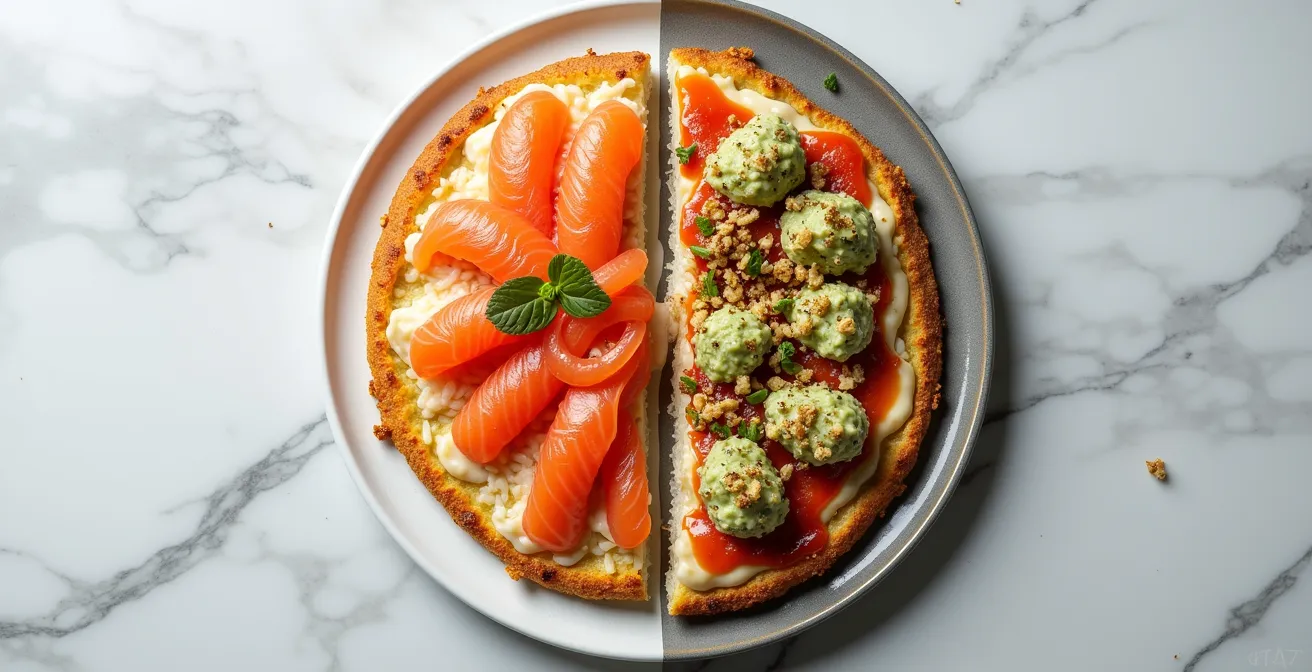
True Toronto fusion isn’t just a gimmick; it’s a culinary dialect with its own grammar of history, texture, and geography that separates authentic innovation from fleeting trends.
- Successful fusion, like Sushi Pizza, respects structural integrity, where textures and flavours enhance each other, unlike failures like soggy Butter Chicken Poutine.
- The city’s most exciting experiments often emerge from “suburban test kitchens” in places like Scarborough and Markham, not just downtown hotspots.
Recommendation: To find the next great dish, look beyond viral hype and learn to decode the city’s unique culinary language, from its 90s origins to its modern-day trend cycles.
For any diner in Toronto, the term “fusion” is inescapable. It’s on menus in Kensington Market, in food courts in Markham, and splashed across Instagram feeds from Queen West. The city’s celebrated multiculturalism is often presented as a simple explanation for this culinary landscape—a melting pot where anything can and will be combined. This leads to the common assumption that more mixing automatically equals more creativity. We see endless lists of “must-try” mashups, from dessert poutines to kimchi-stuffed everything.
But for a discerning diner, this explanation feels incomplete. It doesn’t account for the stark difference between a dish that feels like a stroke of genius and one that’s a forgettable, lazy gimmick. Is there a deeper logic at play? But what if the key to understanding Toronto’s food scene wasn’t just celebrating the mix, but learning to read its specific culinary dialect? This dialect has its own rules, born from specific waves of immigration, the economics of suburban restaurants, and a constant tension between authentic homage and viral-chasing trends.
This guide moves beyond the surface-level celebration of “mashups.” We will deconstruct the very DNA of “Toronto Style” cuisine. We will analyze the anatomy of a successful fusion dish, identify the red flags of a purely-for-the-‘gram creation, and equip you with the strategic tools to find the city’s most exciting and innovative dishes before they become mainstream. It’s time to stop chasing trends and start forecasting them.
To navigate this complex culinary landscape, we will explore the key pillars that define Toronto’s fusion identity, from its most iconic creations to the methods for spotting future classics. This structured approach will give you a new lens through which to view and taste the city.
Summary: Decoding Toronto’s Fusion Food Scene
- Why Did Sushi Pizza Become a Toronto Staple?
- How to Make Toronto-Style Sushi Pizza in Your Own Kitchen?
- Fusion Ramen vs. Traditional Tonkotsu: Which Is Worth the Calorie Splurge?
- The “Gold Leaf” Trap That Doubles the Price of Fusion Dishes
- When Does a Viral Food Trend Stop Being Cool in Toronto?
- Sushi Pizza vs. Butter Chicken Poutine: Which Fusion Dish Actually Works?
- Hakka vs. Cantonese: What is the Difference in Toronto Chinese Food?
- How to Find the Best Fusion Food Stalls Before They Go Viral?
Why Did Sushi Pizza Become a Toronto Staple?
To understand Toronto’s fusion scene, you must start with its foundational text: the sushi pizza. This dish is not a random collision of cultures but a calculated invention that solved a specific problem. According to culinary history, the dish was conceptualized no later than May 1993 by a chef who understood that many Western palates were still hesitant about raw fish and seaweed. The sushi pizza acted as a brilliant “gateway dish,” presenting familiar elements in an approachable new format.
The story of its creation is a masterclass in thoughtful fusion. Chef Kaoru Ohsada, with a background in French cuisine, brought an experimental approach to his work in Japanese restaurants in Toronto. At Nami, he began frying a patty of sushi rice and topping it with high-quality salmon, roe, spicy mayo, and a soy-wasabi sauce. The result was a textural masterpiece: a crispy, warm base contrasting with the cool, soft toppings. It wasn’t a lazy mashup; it was a dish with structural integrity, where each component served a purpose. It was an immediate success, demonstrating that the best fusion isn’t just about combining flavours, but about creating an entirely new and coherent experience.
This success cemented its place in the city’s identity. As Wikipedia contributors note in the entry on the topic, “Due to the popularity and wide availability of the dish in Toronto, it has quickly become one of the city’s signature dishes, along with the peameal bacon sandwich.” The sushi pizza isn’t just food; it’s a piece of Toronto’s culinary history that provides the perfect blueprint for what makes a fusion dish a lasting classic rather than a fleeting fad.
How to Make Toronto-Style Sushi Pizza in Your Own Kitchen?
Recreating this Toronto icon at home reveals the deliberate technique that separates it from lesser fusion attempts. The secret lies in creating a rice base that is both structurally sound and texturally perfect. It’s not as simple as slapping fish on a fried rice cake; it’s a process that requires attention to detail. The goal is a patty that is crispy enough to hold its shape and provide a satisfying crunch, yet tender on the inside.
The key is the double-fry method. This technique ensures the exterior achieves a perfect golden-brown crust without the inside becoming dry or hard. The first fry at a lower temperature cooks the patty and sets its shape, while the second, hotter fry creates that signature crispiness. This meticulous approach to texture is what makes the dish work so well and what is often missing in gimmicky mashups.
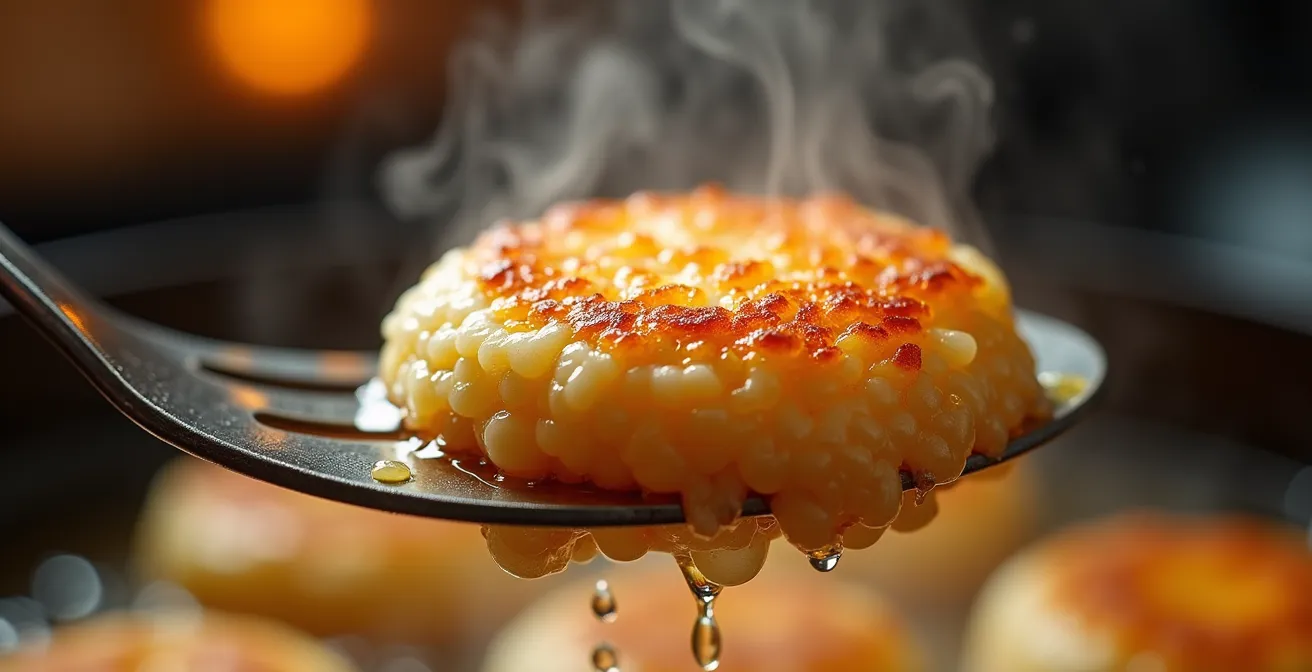
As you can see, achieving that perfect texture is a visual and culinary art. To replicate it, follow these essential steps:
- Cook sushi rice with rice vinegar to create a sticky, cohesive base.
- Using wet hands to prevent sticking, form the rice into compact, even patties.
- Perform the first fry in oil over medium heat to gently cook and set the patty’s shape.
- For the second fry, increase the heat to high and cook until the exterior is deep golden and audibly crispy.
- Let the patties drain and cool slightly before topping with a layer of spicy mayo, followed by your choice of sushi-grade fish, and garnishes like tobiko and avocado.
Fusion Ramen vs. Traditional Tonkotsu: Which Is Worth the Calorie Splurge?
The ramen bowl has become another key battleground for fusion in Toronto. Here, the line between innovation and sacrilege is incredibly fine. A traditional tonkotsu ramen is a testament to patience and purity—its broth, simmered for 12 hours or more, is a singular, powerful expression of pork. Fusion ramen, on the other hand, introduces new flavour bases, from butter chicken to spicy miso-butter, creating a dish that is distinctly Torontonian.
The critical question for the discerning diner is one of intent. Is the fusion an enhancement or a distraction? As Toronto Life highlights in their analysis of the city’s best new restaurants, the most successful fusion dishes are deeply personal. As they put it, “Unlike the cautionary tales of fusion cooking, Chin’s plates aren’t gimmicky; they’re personal.” This is the core of the debate: a great fusion ramen, like a great butter chicken ramen, should taste like it was conceived from a place of love for both traditions, not as a marketing ploy. It must create a new, harmonious whole rather than a confusing mix of competing flavours.
The decision often comes down to what you value in a dish. A purist seeking the profound depth of a single-origin broth will likely find fusion ramen lacking. However, a diner open to a novel experience might find joy in a creative, well-executed combination. The table below, inspired by market observations from sources like a Toronto Life international food guide, breaks down the trade-offs.
| Criteria | Traditional Tonkotsu | Fusion Variations |
|---|---|---|
| Broth Integrity | Pure pork bone base, 12+ hour simmer | Mixed bases (butter chicken, miso-butter) |
| Price Range | $15-20 | $18-25 |
| Authenticity | Japanese-trained chefs | Local innovation |
| Toronto Examples | Kinton Ramen | R&D (dim sum fusion) |
The “Gold Leaf” Trap That Doubles the Price of Fusion Dishes
One of the most telling signs of a lazy fusion gimmick is the “Gold Leaf” trap—the use of a flashy, expensive ingredient that adds little to the dish other than price. As diners, we’ve all seen it: a sprinkle of gold leaf on a dessert, a dollop of caviar on a taco, or a sliver of wagyu on a slider. These additions are often a smokescreen, designed to create a perception of luxury that justifies a higher price tag without adding any real culinary value.
This trend is happening against a backdrop of rising dining costs. The $63 average dining check in 2024 in Canada, up significantly from previous years, makes diners more critical of where their money is going. When a dish’s price is inflated by a non-essential garnish, it feels less like an innovation and more like an insult to the diner’s intelligence. It’s a hallmark of a dish created for Instagram, not for the palate.
Restaurants often justify these prices by pointing to consumer demand for premium ingredients. An analysis from Foodservice and Hospitality confirms that despite price hikes, Canadian diners are willing to splurge on items like wagyu and caviar. Their insights show that menu mentions for Wagyu and caviar are up 32% and 27% respectively. However, the crucial distinction for a discerning diner is *how* these ingredients are used. Is the wagyu the star of a thoughtfully constructed dish, or is it a superfluous topping on an otherwise mediocre burger? The former is innovation; the latter is the “Gold Leaf” trap.
When Does a Viral Food Trend Stop Being Cool in Toronto?
In a city as digitally connected as Toronto, food trends move at lightning speed. A dish can go from a hidden gem to a viral sensation with a single TikTok video, and then to an over-saturated cliché just as quickly. This is the concept of viral velocity. Understanding this lifecycle is key to staying ahead of the curve and finding authentic experiences before they’re diluted by mass popularity. The telltale sign a trend has peaked? When you see it everywhere, often in poorly executed forms, far from its original context.
The data on recent trends is staggering. For example, a SkipTheDishes report on Canadian order trends noted a 2310% year-over-year increase in orders for freeze-dried candy. This explosive growth shows how quickly a niche item can become a mainstream phenomenon, driven by social media. While exciting, this velocity often leads to a drop in quality as everyone rushes to cash in.

This cycle is a natural part of any creative scene. As Jo-Ann McArthur, president of Nourish Food Marketing, explained to Foodservice and Hospitality, “Humans crave new experiences. Chefs are getting creative in combining the unfamiliar with the familiar.” The challenge for diners is to catch these creations in their innovative phase, not their watered-down mainstream phase. The moment a unique fusion dish from a Scarborough strip mall starts appearing on a chain restaurant menu downtown, you know the trend is past its prime. The real excitement lies in the discovery phase, which is often happening far from the city’s most visible streets.
Sushi Pizza vs. Butter Chicken Poutine: Which Fusion Dish Actually Works?
To put our analytical framework to the test, let’s compare two famous Toronto-area fusion dishes: the established Sushi Pizza and the rising star, Butter Chicken Poutine. Both are mashups of beloved foods, but only one truly succeeds as a coherent culinary creation. The difference, once again, comes down to structural integrity.
Sushi Pizza works because its construction is sound. The crispy, stable rice patty provides a perfect platform for the delicate toppings. The textures—crispy, soft, creamy—complement each other without compromise. Butter Chicken Poutine, on the other hand, often fails on this fundamental level. The hot, wet gravy of the butter chicken inevitably turns the french fries—the very foundation of poutine—into a soggy, texturally monotonous mess. The crispiness that defines a good fry is lost, and the dish collapses into itself. It’s a flavour combination that sounds good on paper but fails in execution.
This isn’t to say all poutine fusions are doomed, but it highlights the risk. With Ontario accounting for 36% of all Canadian poutine orders according to SkipTheDishes, there is a massive market for it, but also a deep-seated understanding of what makes it great. Messing with the core texture is a cardinal sin. The following table breaks down the fundamental differences between these two fusion concepts.
| Aspect | Sushi Pizza | Butter Chicken Poutine |
|---|---|---|
| Creation Era | 1990s Toronto | 2010s fusion movement |
| Market Presence | Toronto signature dish | Rising trend (Butter Chicken #1 ordered dish 2024) |
| Cultural Story | Gateway dish for Western palates | South Asian-Quebecois mashup |
| Texture Profile | Crispy-soft contrast maintained | Risk of soggy fries |
Hakka vs. Cantonese: What is the Difference in Toronto Chinese Food?
To truly decode Toronto’s fusion landscape, one must understand that “Chinese food” is not a monolith. The subtle and distinct regional differences within Chinese cuisine are the primary drivers of fusion innovation, particularly in the suburbs. Two of the most influential styles in the Greater Toronto Area are Cantonese and Hakka, and their differences in flavour profile and geography are crucial.
Cantonese cuisine, known for its emphasis on fresh ingredients and delicate flavours (think dim sum and steamed fish), has its strongest presence in the suburban hubs of Markham and Richmond Hill. These areas are epicentres of traditional, high-quality Chinese cooking. Hakka cuisine, by contrast, is itself a fusion: Chinese dishes adapted to an Indian palate with bolder, spicier, and more pungent flavours. In the GTA, Hakka strongholds are concentrated in Scarborough and Brampton. This geographical distribution is not just a demographic curiosity; it’s the engine of Toronto’s culinary evolution.
The innovations coming out of a Cantonese-dominated food court in Markham will be vastly different from the experiments happening in a Hakka restaurant in Scarborough. The former might involve subtle twists on traditional dim sum, while the latter could produce a bold new fried chicken dish. These suburban test kitchens are where the real work of fusion happens, far from the gaze of downtown food critics. Understanding this map is essential for any trend-spotter looking for the next big thing, because the city’s next signature dish is more likely to be born in a Pacific Mall food court than on King Street West.
Key Takeaways
- Evaluate Structural Integrity: A great fusion dish maintains or enhances the textures of its original components, like the crispy base of a sushi pizza. Avoid dishes that turn into a soggy mess.
- Beware the “Gold Leaf” Trap: Question any dish where a high-price ingredient like gold leaf or a tiny piece of wagyu is used as a garnish. It’s often a sign of a gimmick designed to inflate the price, not the flavour.
- Explore the Suburban Test Kitchens: The most authentic and exciting food innovation in Toronto often happens outside the downtown core, in the regional culinary hubs of Markham (Cantonese) and Scarborough (Hakka).
How to Find the Best Fusion Food Stalls Before They Go Viral?
Now that you have the analytical tools, the final step is execution. Finding the next great fusion dish before it’s all over social media requires a proactive, strategic approach. It means shifting your focus from reactive trend-following to proactive trend-spotting. With Toronto leading Canadian cities with 9,378 restaurants, the opportunities are vast, but they require a smart search strategy.
The key is to look where new ideas are tested. Big, standalone restaurants are often too risk-averse to experiment wildly. The real innovation happens in lower-stakes environments: food halls, suburban food courts, and even the personal social media accounts of up-and-coming chefs. These are the modern-day culinary laboratories. You need to think like a scout, looking for talent in the minor leagues, not the big stadiums. This means dedicating time to exploring places that might not be on the typical “best of” lists but are buzzing with local energy and creativity.
By shifting your discovery process to these channels, you move from being a consumer of trends to an early adopter. You’ll not only eat better, more interesting food, but you’ll also be supporting the small businesses and creative chefs who are genuinely pushing the boundaries of Toronto’s culinary dialect. The following plan of action outlines a repeatable strategy for discovering these hidden gems.
Your Action Plan: Toronto Trend-Spotting Strategies
- Monitor food halls like Eataly and Time Out Market, where smaller businesses and pop-ups frequently test new concepts on a discerning audience.
- Track food courts in suburban hubs, specifically Pacific Mall in Markham for Cantonese-based innovation and various Scarborough and Mississauga plazas for Hakka and South Asian fusion.
- Follow the personal Instagram accounts of promising line cooks and sous chefs, not just the official restaurant accounts. This is where true experimentation is often showcased first.
- Join hyper-local food-focused Facebook groups for specific neighbourhoods (e.g., “Scarborough Food Lovers,” “East End Eats”) to see what real locals are excited about.
- Watch for the opening of new specialty grocery stores in diverse neighbourhoods like Kensington Market, as they often signal emerging culinary interests and ingredients.
Now, armed with this knowledge, your next dining adventure in Toronto is not just a meal; it’s a field study. Go out and apply this framework to discover the authentic, innovative culinary creations that truly define this city.