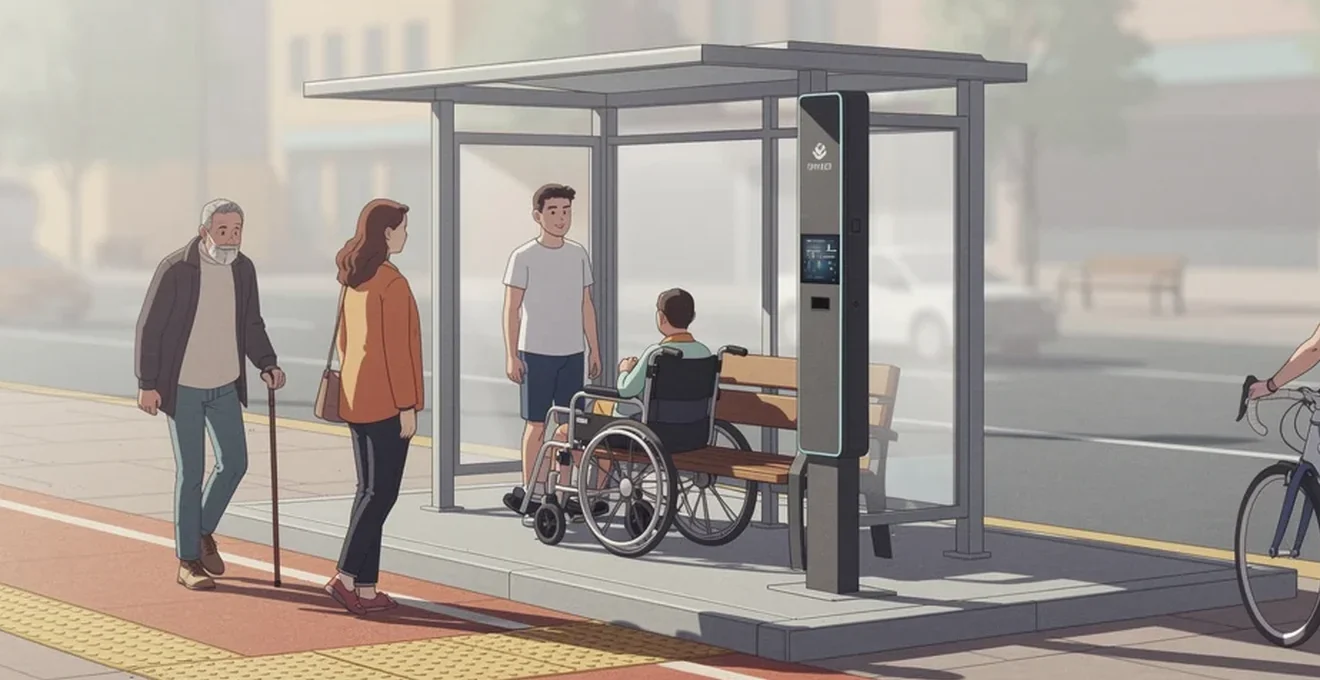
Cities are only as accessible as the streets people move through, and street furniture sits at the heart of that experience. Benches, bus shelters, crossings, cycle infrastructure and lighting all shape whether a city feels welcoming or exclusionary to the people who use it. Designing these elements well means thinking beyond aesthetics and considering how pedestrians, wheelchair users, cyclists and people with sensory impairments actually navigate public space. This article looks at how universal design principles, transit infrastructure, crossing technology, cycling provision, material choices and smart city features combine to make urban mobility genuinely inclusive. Whether you’re a planner, designer or simply curious about what makes a street work for everyone, understanding these interconnected elements reveals why thoughtful public realm design matters so much for health, equity and everyday convenience.
Universal design principles in street furniture development
Universal design asks a simple question: does this piece of infrastructure work for the widest possible range of people, regardless of age, ability or circumstance? In street furniture terms, that means every bench, railing, bollard and sign should be usable without requiring adaptation or specialist knowledge. It’s a shift away from designing for an « average » user and towards designing for genuine diversity of need.
Anthropometric data and ISO 21542 compliance standards
Good street furniture design starts with accurate data on human dimensions and movement. Anthropometric measurements, covering reach distances, seated and standing heights, and the space needed for mobility aids, inform everything from bench proportions to the clearance required around a bus stop pole. ISO 21542, the international standard covering accessibility and usability of the built environment, provides a reference framework that designers and specifiers use to check that furniture meets consistent, evidence-based requirements rather than relying on guesswork.
Tactile paving integration for visually impaired pedestrians
Tactile paving gives blind and partially sighted pedestrians physical cues underfoot about changes in the street environment, such as an approaching crossing, a platform edge or a hazard. Different textures signal different meanings, so consistency in application matters enormously. Poorly placed or inconsistent tactile paving can be as confusing as having none at all, which is why it needs to be considered as an integral part of street furniture layout rather than an afterthought added once the rest of the scheme is finished.
Wheelchair-accessible bench heights and clearance requirements
A bench that looks perfectly ordinary can still exclude wheelchair users if there’s no adjacent clear space to park alongside it, or if the seat height makes transferring difficult. Accessible seating design typically considers seat height, armrest presence for support when standing, and a level, unobstructed area beside the bench so a wheelchair user can sit with a companion rather than being positioned apart from the group. These details are inexpensive to get right at the design stage but costly and disruptive to retrofit later.
Multi-sensory wayfinding systems in public realm design
Wayfinding that relies solely on visual signage excludes a significant portion of any city’s population. Multi-sensory systems combine visual information with tactile maps, audible cues and sometimes app-based audio description, so that people navigate using whichever sense works best for them. Embedding these systems into street furniture, such as information totems with raised lettering or benches doubling as orientation points, helps create a public realm that communicates clearly to everyone passing through it.
Bus shelters and transit infrastructure accessibility
Public transport is often the backbone of urban mobility, but its usefulness depends entirely on how accessible the surrounding infrastructure is. A perfectly accessible bus doesn’t help much if the shelter, platform or boarding point creates a barrier before passengers even get on board.
Low-floor boarding platforms and kerb height specifications
Low-floor buses paired with correctly specified kerb heights allow level or near-level boarding, removing the need for ramps in most cases and significantly speeding up journeys for wheelchair users, people with pushchairs and anyone with limited mobility. Getting the kerb height right at each stop is a precise engineering task; too low and a gap remains, too high and it creates its own hazard, so specifications need to be applied consistently across a transit network rather than on a stop-by-stop basis.
Real-time passenger information displays for sensory impairments
Real-time information displays that show upcoming arrivals help all passengers plan their journey with confidence, but they’re particularly valuable for people with sensory impairments when paired with audio announcements. Visual displays support people who are deaf or hard of hearing, while audio announcements support people who are blind or partially sighted. Offering both formats simultaneously, rather than one or the other, ensures the information reaches the widest possible audience.
Seating configurations for ambulant disabled users
Not every disability requires a wheelchair, and shelter seating needs to reflect that. Ambulant disabled users, including people with limited stamina, balance issues or chronic pain, often benefit from perch seating at a slightly higher height than standard benches, along with sturdy armrests or grab points that make sitting down and standing up easier. Shelters that offer a mix of seating types, rather than a single bench design, accommodate a broader range of needs within the same limited footprint.
Pedestrian crossing infrastructure and signal timing
Crossing the road safely is one of the most fundamental urban mobility tasks, yet it remains one of the most variable in quality from street to street. Signal timing, technology and audible or tactile feedback all determine whether a crossing genuinely serves pedestrians of differing speeds and abilities.
Puffin and toucan crossing technology differences
Puffin crossings use kerbside detectors to sense when a pedestrian is waiting and cameras to detect when they’ve cleared the crossing, allowing signal timing to adjust dynamically rather than running to a fixed cycle. Toucan crossings serve both pedestrians and cyclists, allowing cyclists to cross without dismounting alongside pedestrians on foot. Understanding which technology suits a given location depends on the mix of users expected to cross there and the traffic conditions surrounding the junction.
Audible and vibrotactile signals for blind pedestrians
Audible signals, typically a distinct beeping tone, tell blind and partially sighted pedestrians when it’s safe to cross without needing to see a visual signal change. Vibrotactile units, often a small rotating cone beneath the control box, provide the same information through touch, which is essential in noisy streets where an audible tone might be missed or in situations where someone has both a visual and hearing impairment. Combining both feedback types in a single crossing point is standard practice for genuinely inclusive design.
Countdown timers and extended crossing phases for elderly users
Older pedestrians, and anyone with reduced mobility, often need longer to cross than the standard signal timing allows. Countdown timers give people visual confirmation of how much time remains, reducing anxiety and the temptation to rush, while extended crossing phases at appropriate locations, such as near care homes, hospitals or shopping areas with a high proportion of elderly pedestrians, directly address the physical reality that walking speed varies significantly across the population.
Cycling infrastructure and micromobility integration
As cities diversify their transport mix, cycling and micromobility options like e-scooters have become central to urban mobility strategies. Supporting them properly requires dedicated infrastructure rather than simply allowing these modes to share space designed for cars or pedestrians.
Segregated cycle lane design following london cycling design standards
Segregated cycle lanes, physically separated from motor traffic rather than marked only by paint, significantly reduce the risk of collision and encourage a wider range of people to cycle, including those who would otherwise feel unsafe sharing a lane with vehicles. Design standards such as London’s Cycling Design Standards set out specifications for lane widths, junction treatments and separation methods that aim to make cycling a viable option for everyday journeys, not just confident, experienced riders.
Bike rack placement and Anti-Theft locking mechanisms
Where a bike rack is placed matters almost as much as its design. Racks located near transit hubs, shops and public buildings, and positioned so they don’t obstruct pedestrian flow, encourage cycling as part of a wider multimodal journey. Secure locking mechanisms, sturdy enough to resist tampering and designed so both wheels and the frame can be secured, give cyclists the confidence to leave their bike without worrying about theft.
E-scooter parking bays and geofencing regulations
The rapid growth of shared e-scooter schemes has created a new challenge: preventing scooters from being abandoned haphazardly across pavements, which creates trip hazards and blocks accessible routes. Designated parking bays, often combined with geofencing technology that restricts where a scooter can legally be left or ridden, help keep pathways clear. Getting this right requires close coordination between operators, local authorities and the street furniture layout itself.
Materials selection and weathering resilience in public furniture
Street furniture has to withstand years of weather, footfall and, in some cases, deliberate misuse, without becoming a maintenance burden or a safety hazard. Material choice directly affects longevity, appearance and total cost of ownership over a product’s lifespan.
Corten steel versus galvanised metal for outdoor durability
Corten steel develops a stable, rust-like patina that protects the metal beneath it, giving it a distinctive weathered appearance that many designers favour for its low maintenance and natural ageing process. Galvanised metal, coated with a protective zinc layer, resists corrosion differently and tends to retain a more uniform, industrial appearance over time. The choice between the two often comes down to the aesthetic a scheme is aiming for alongside practical considerations like local climate and expected footfall.
Recycled plastic lumber applications in bench manufacturing
Recycled plastic lumber offers a sustainable alternative to timber for bench slats and other furniture components. It resists rot, splintering and insect damage far better than natural wood, and using recycled material reduces demand on virgin resources. As sustainability considerations become more central to public procurement, recycled plastic lumber has become an increasingly common specification for outdoor seating.
Anti-vandalism coatings and Graffiti-Resistant surfaces
Anti-vandalism coatings and graffiti-resistant surface treatments allow paint and markers to be removed without damaging the underlying material, keeping street furniture looking presentable without constant replacement. These treatments are particularly valuable in high-footfall urban areas where furniture is exposed to frequent public use and, occasionally, deliberate damage.
Smart city integration and IoT-Enabled street furniture
Digital technology is increasingly embedded directly into street furniture, turning ordinary objects like benches and lighting columns into sources of useful data and added functionality for the people who use them.
Solar-powered lighting bollards with motion sensors
Solar-powered lighting bollards reduce reliance on the electricity grid while motion sensors ensure light output responds to actual footfall rather than running continuously at full brightness. This combination improves energy efficiency and extends the working life of the fitting, while still providing reliable illumination for pedestrians when and where it’s needed.
Air quality monitoring stations embedded in public seating
Embedding air quality sensors within public seating and other street furniture allows cities to gather granular environmental data across a network of locations without installing separate monitoring infrastructure. This data can inform planning decisions, highlight pollution hotspots and, over time, support policies aimed at improving public health outcomes for people spending time in outdoor public spaces.
Contactless charging points within urban rest areas
Contactless charging points integrated into benches and rest areas give pedestrians a practical reason to pause and recharge a phone or device while resting. As smartphones become essential tools for navigation, ticketing and accessing local information, this kind of small-scale infrastructure addition offers meaningful convenience with relatively modest installation requirements.