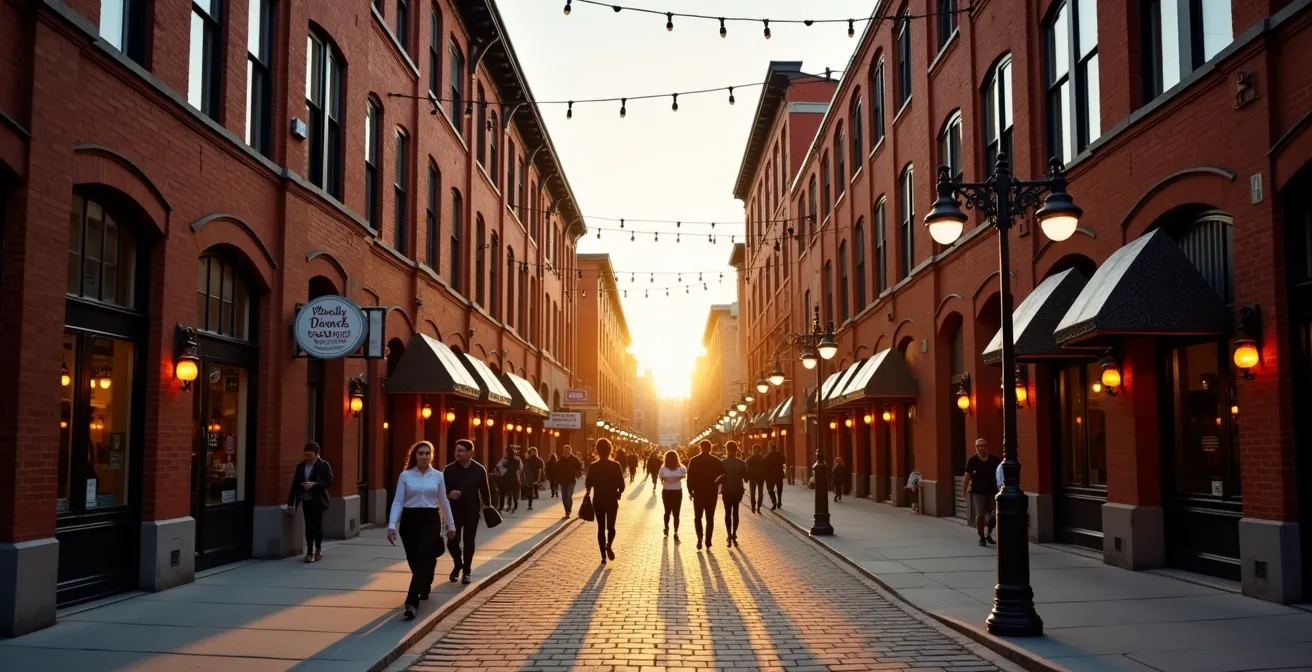
The Distillery District isn’t a quaint historic village; it’s a meticulously preserved industrial machine repurposed into a highly efficient commercial engine.
- Most “conveniences” like underground parking and main street access are designed as tourist funnels to maximize spending.
- True value and authentic experiences are found in the shoulder seasons and on the periphery, away from the curated crowds.
Recommendation: To experience the district like a savvy local, you must think like an operator, not a tourist. Understand its historical logistics to sidestep the modern commercial traps.
Every Torontonian has a complicated relationship with the Distillery District. We are intensely proud of it. It’s a ghost of our industrial past, a brick-and-mortar testament to the Gooderham & Worts empire that once fueled the city. We bring visiting family here to show off the stunning Victorian architecture, the largest and best-preserved collection of its kind in North America. But as we walk those cobblestone streets, a quiet resentment simmers. We see the overpriced patio drinks, the endless queues for the Winter Village, and the bewildered tourists paying a small fortune for parking. It feels less like our history and more like a theme park with an entrance fee cleverly disguised as a lunch bill.
The standard advice you’ll find online is to “take the TTC” or “wear comfy shoes.” This is technically correct but utterly useless. It doesn’t tell you why the streetcar drops you a 15-minute walk away or why your trendy sneakers are a sprained ankle waiting to happen. It ignores the fundamental truth: the district operates on a specific industrial logic. To navigate it effectively and avoid the feeling of being fleeced, you can’t just be a visitor; you have to understand the machine. This guide isn’t about the best photo spots—you can find those on your own. This is about using the district’s own history and operational logic against its commercial pressures, allowing you to experience its authentic soul without paying the tourist tax.
This article breaks down the essential strategies for reclaiming the Distillery District. From sidestepping the most expensive traps to understanding the very ground beneath your feet, you’ll learn to navigate this historic zone with the confidence of a local who knows all the angles.
Summary: How to Visit the Distillery District Without Falling for Tourist Prices?
- Why Is Parking Near the Distillery District So Exorbitantly Expensive?
- How to Get to the Distillery by Streetcar Without a 15-Minute Walk?
- Summer Patios vs. Winter Market: Which Season Offers Better Value?
- The Footwear Error That Leads to Sprained Ankles on Cobblestones
- When to Shoot Wedding Photos in the Distillery for Empty Backgrounds?
- How to Get Into the Distillery Winter Village Without a Ticket?
- Why Does the East End Have So Many Cobblestone Alleyways?
- How to Enjoy Toronto’s Winter Markets Without Freezing?
Why Is Parking Near the Distillery District So Exorbitantly Expensive?
The first and most painful “tourist tax” you’ll encounter is for parking. The exorbitant cost isn’t an accident; it’s the primary gear in the district’s commercial engine. The underground lot is a masterfully designed tourist funnel. It deposits you directly into the heart of the retail zone, disoriented and immediately susceptible to the nearest cafe or shop. The price is high because convenience is the bait, and they know that once you’re in, you’re a captive audience. They’re not just selling a parking spot; they’re selling immediate immersion into their curated commercial experience, and you pay a premium for that privilege.
A true local understands this and never, ever uses the official underground lot unless someone else is paying. The secret is to think about your arrival not as “parking at the Distillery” but as “parking in the vicinity of Old Town.” Lots just a five-minute walk away on The Esplanade are dramatically cheaper, and the stroll through the historic St. Lawrence and Corktown neighbourhoods is part of the authentic Toronto experience. You’re trading five minutes of walking for a significant saving and a more genuine sense of place. This simple shift in mindset—from seeking convenience to seeking value—is the first step to sidestepping the tax.
For those willing to plan, a little digital foresight pays dividends. Using apps to pre-book a spot can secure you a discount, especially on busy weekends. The ultimate pro move for a short visit, however, remains hunting for the rare free Sunday spots on the side streets east of Parliament. It’s a gamble, but the reward is a visit that starts with a sense of victory, not financial defeat. During the Winter Village, all bets are off. Don’t even try to park; the system is designed to punish drivers and reward those who use transit.
How to Get to the Distillery by Streetcar Without a 15-Minute Walk?
So you’ve wisely decided to avoid the parking trap and take the TTC. You hop on the 504 King streetcar, feeling smug. Then you get off at King and Parliament, as your map app suggests, and find yourself on a bleak 15-minute trek past auto shops and underpasses. You’ve fallen for the second trap. The problem isn’t the streetcar; it’s the lack of insider knowledge. The operational logic of the transit system wasn’t designed around the modern Distillery experience; it was designed to serve the city’s grid. Most visitors simply don’t know the trick.
The secret is to stay on the 504 King streetcar past all the obvious stops. You must ride it all the way to the Cherry Street Loop. This stop feels like you’ve gone too far, but it deposits you at the district’s “back door,” a far more relaxed and less-trafficked entrance. A more direct, if lesser-known, option is the 121 Fort York-Esplanade bus, which drops you right on Mill Street. It’s the closest you can get without a car. But the most elegant solution, one that truly feels like you’re hacking the system, is the “last-mile” bike-share option. Grab a Bike Share Toronto bike from a dock at King & Parliament and enjoy a breezy five-minute ride to the dedicated dock right at Distillery Lane. It’s a cheap, fast, and satisfying way to bridge the final gap.

This approach transforms the journey from a frustrating walk into a seamless part of the adventure. It’s about knowing the system’s quirks. The tourists walk; the locals ride. This small optimization in your route is a perfect example of how local knowledge beats generic advice every time, saving you time and frustration before you even step onto the first cobblestone.
Summer Patios vs. Winter Market: Which Season Offers Better Value?
The Distillery District’s atmosphere is dictated by two major commercial seasons: the sprawling summer patios and the famous Winter Village. From a historical interpreter’s perspective, both are fascinating exercises in monetizing nostalgia, but they offer vastly different value propositions. Summer is about relaxed, passive spending. Patios expand like an occupying force, and the cost of a pint buys you a few hours of prime real estate. Entry is free, the crowds are manageable, and there’s a pleasant hum of activity with street performers and art installations. It feels expensive, but you’re in control of your spending.
The Winter Village is another beast entirely. It is an aggressive, active spending environment. The introduction of a ticket fee on evenings and weekends fundamentally changes the dynamic. It creates a sense of obligation to “get your money’s worth,” pushing you towards expensive mulled wine and novelty snacks. The crowds are immense, turning a leisurely stroll into a battle for personal space. While the light displays are undeniably beautiful, they are part of a highly structured experience designed to extract maximum revenue. As a local, the clear winner for value is neither of these. The “shoulder seasons” of April-May and September-October are the district’s golden hours. You get all the architectural beauty, pleasant weather, and open space without the seasonal price-gouging or oppressive crowds. This is when the district feels like a real place again, not a ticketed event.
To truly analyze the cost-benefit of each season, it’s helpful to compare them directly. The difference in spending and experience becomes stark when laid out. A comparative analysis of seasonal costs reveals that the best experiences often come with the lowest price tag.
| Season | Entry Cost | Typical Spend | Free Activities | Crowds | Value Score |
|---|---|---|---|---|---|
| Summer (Jun-Aug) | Free always | $40-60 (patio drinks + food) | Live music, art installations, street performers | Moderate-High | 8/10 |
| Winter Market (Nov-Dec) | Free weekdays before 4PM, $8-15 evenings | $50-70 (entry + drinks + snacks) | Light displays (outside ticketed hours) | Very High | 6/10 |
| Shoulder Season (Apr-May, Sep-Oct) | Free always | $30-45 | All regular activities, seasonal markets | Low-Moderate | 10/10 |
Your Action Plan: Auditing Your Distillery District Visit for Value
- Timing Check: Identify the season of your visit. Is it a peak commercial season (Summer/Winter Village) or a value-driven shoulder season?
- Cost Inventory: List all potential costs beyond food—parking, transit fares, event tickets. Compare this against your budget.
- Crowd Tolerance: Honestly assess your tolerance for large crowds. Does the appeal of a specific event outweigh the stress of navigating a packed space?
- Activity Analysis: Separate the “free” historical atmosphere from the paid, curated activities. Are you paying for an experience you could get for free at another time?
- Value Decision: Based on the points above, decide if your planned visit aligns with a high-value, low-stress experience or if shifting it to a different day or season would be wiser.
The Footwear Error That Leads to Sprained Ankles on Cobblestones
Now, let’s talk about the very ground you walk on. The cobblestones are not a decorative choice; they are authentic 19th-century infrastructure. They are the single most historically significant element of the district, and the most misunderstood. Tourists arrive in flimsy sandals or soft-soled running shoes, treating the streets like a modern sidewalk. This is a profound mistake. These are Belgian block pavers, designed for heavy, slow-moving, horse-drawn carts, not for human ambulation. They are uneven by design.
The gaps between stones can be up to two inches wide, and the height difference between adjacent blocks can be just as severe. This is a minefield for weak-ankled footwear. The number of twisted ankles I’ve seen over the years is staggering. Toronto locals, by contrast, almost instinctively wear boots with firm ankle support, like Blundstones or Doc Martens. It’s not a fashion statement; it’s a practical necessity born of experience. This isn’t just about comfort; it’s about safety. As a cobblestone navigation safety analysis points out, the danger is amplified during Toronto’s notorious freeze-thaw cycles from December to March, when black ice forms invisibly in the gaps, turning a charming alleyway into a treacherous slide.

The district’s management is aware of this. If you look closely, you’ll see they’ve laid smoother, modern brick pathways along key arteries like Tank House Lane. These are concessions to accessibility and litigation. The tourists stick to these modern paths, unknowingly bypassing the most authentic textures of the site. By wearing the right footwear, you are liberated. You can confidently explore the original, uneven surfaces where the history is most palpable. You’re not just protecting your ankles; you’re unlocking the full, un-sanitized landscape of the past.
When to Shoot Wedding Photos in the Distillery for Empty Backgrounds?
The Distillery District is arguably Toronto’s most popular backdrop for photography, from wedding shoots to Instagram posts. This creates a constant, moving wall of human traffic that makes getting a clean, empty shot feel impossible. Most people make the mistake of aiming for the “golden hour” before sunset, believing it’s the best light. They are wrong. Golden hour coincides with the dinner rush, making it one of the busiest times of day. You’ll be fighting for every inch of space with patio-goers and diners.
The secret to an empty Distillery is to work against the rhythms of the crowd. The most effective time, by far, is a weekday sunrise session between 6:30 and 7:30 AM. The streets are utterly deserted, the light is clean and cool, and you have the entire industrial cathedral to yourself. It requires an early start, but the payoff is immense. If early mornings aren’t feasible, the next best window is the “blue hour,” about 30 minutes after sunset, when the dinner crowd is seated inside restaurants and the sky has a deep, cinematic glow. Another counter-intuitive strategy is to embrace bad weather. A rainy day clears out the crowds and leaves the cobblestones with dramatic, moody reflections that are far more interesting than a generic sunny-day shot.
The data confirms what locals already know: the difference between peak and off-peak times is staggering. There are 87% fewer visitors on weekday mornings before 10 AM compared to weekend afternoons. This isn’t a small difference; it’s the gap between a frustrating, crowded experience and a serene, creative one. For truly unique shots, look for unconventional angles away from the main Trinity Street plaza. The overhead GO train bridge and the industrial fire escapes on Tank House Lane offer powerful, gritty backdrops that tell a more authentic story of the district’s industrial heritage than the much-photographed heart sculpture ever could.
How to Get Into the Distillery Winter Village Without a Ticket?
The Distillery Winter Village ticket is the most overt “tourist tax” of all. The very idea of paying to enter a public-feeling space to be marketed to is, frankly, an insult to any self-respecting Torontonian. But here again, understanding the operational logic of the event is the key to sidestepping the fee. The ticketing system is not a blanket policy; it’s a targeted strategy to manage and monetize peak-hour crowds. Therefore, the easiest way to get in for free is simply to go during non-peak hours.
Entry is completely free from Monday to Thursday all day, and on Fridays before 4 PM. This is when you should go. You get to see all the lights and vendor cabins without the fee and with a fraction of the oppressive weekend crowd. The experience is infinitely more pleasant. If you absolutely must go during a ticketed time, there is a loophole: a reservation at one of the district’s main restaurants, like Cluny Bistro or El Catrin, grants you entry without needing a separate Village ticket. You’re essentially pre-paying for your access with your dinner bill, which is a far better value proposition than paying just to walk around.
For those who just want the atmosphere without the commitment, the “perimeter experience” is a valid strategy. The views from the Mill Street bridge and along Cherry Street allow you to soak in the festive lights and sounds without entering the ticketed chaos. And the ultimate hack? Arrive after 9 PM. On many nights, the ticket booths close, but the district itself remains open. You can wander through the tail-end of the market, enjoying the lights as the crowds begin to thin, all for free. It requires patience, but it’s a small price to pay for principle.
Why Does the East End Have So Many Cobblestone Alleyways?
To truly appreciate the Distillery District, you must understand that it wasn’t built for you. It was built for barrels, wagons, and horses. The cobblestones that now punish your fashionable footwear were once a high-tech solution for an industrial problem. In the 1860s, the Gooderham & Worts distillery was a logistical behemoth. They needed a surface that could withstand the immense weight of carts laden with grain and whiskey, a surface that wouldn’t turn to a muddy quagmire. The answer was Belgian block paving, the durable, hand-hewn stones imported for this purpose.
These streets are a survivor’s tale. The district’s location in the East End is the primary reason this landscape still exists. It was far enough away to escape the Great Fire of Toronto in 1904, which wiped out much of the city’s original core. While the rest of Toronto was being rebuilt and paved over with asphalt, this industrial enclave was left largely untouched, a time capsule of Victorian infrastructure. This heritage is shared with the surrounding Corktown neighbourhood, another historic Irish enclave, which is why you’ll find similar preserved streetscapes nearby. It’s a tangible link to the city’s working-class, industrial roots.
Designated a National Historic Site of Canada, the area is celebrated for containing more than 40 Victorian buildings preserved across 13 acres, the largest such collection in North America. You can tell the difference between the past and the present with a careful eye. The authentic 19th-century stones are irregular, with visible marks from the hands that shaped them. The modern interlocking bricks added after the 2003 revitalization are uniform, with machine-cut precision. They look cleaner, but they lack a soul. They are a quiet admission that while we can preserve history, we can no longer replicate its rugged, imperfect character.
Key takeaways
- The Distillery District’s “tourist traps” are predictable systems that can be bypassed with local knowledge.
- True value lies in the shoulder seasons (spring/fall) and off-peak hours (weekday mornings), not in the crowded, high-priced summer and winter events.
- Respecting the district’s industrial heritage—from its cobblestones to its layout—is the key to a safer, more authentic, and less expensive visit.
How to Enjoy Toronto’s Winter Markets Without Freezing?
A Toronto winter is not to be underestimated, and the Distillery District, with its wide-open spaces and wind-tunnel alleyways, can be particularly brutal. Enjoying the Winter Village isn’t just about avoiding ticket fees; it’s a battle against the elements. Tourists show up in light jackets, shivering and miserable, forced to buy overpriced hot chocolate just to feel their fingers again. A local knows that survival here is about preparation and strategy.
The key is the “Toronto winter uniform”: layering with a merino wool base, a fleece mid-layer, and a windproof outer shell. This system traps heat while allowing moisture to escape, keeping you warm and dry. Forget fashion; this is about function. Supplement this with reusable hand warmers and, crucially, a thermos of your own hot beverage. This simple act can save you $15-$20 and keep you comfortable for hours. The second part of the strategy is to plan for “warm-up breaks.” The district is dotted with free-to-enter indoor art galleries, like the Arta Gallery or Thompson Landry Gallery. Use them. Spend 10-15 minutes inside, appreciating the art while you thaw out. It breaks up your visit and costs you nothing.
Strategic stops at places like Balzac’s Coffee or Soma Chocolatemaker are also essential, but treat them as planned retreats, not desperate last resorts. By planning your visit around these warm-up points, you control your environment instead of letting the cold control you. End your visit with a full thaw-out at a cozy Leslieville cafe or the indoor facilities at nearby Corktown Common. This approach transforms the experience from an endurance test into a genuinely enjoyable winter outing. You’re not just surviving the cold; you’re mastering it, which is the most Torontonian thing you can do.
By applying this cynical but practical mindset, you can transform your relationship with the Distillery District. Your next visit won’t be as a passive consumer in a historical theme park, but as an informed participant who can appreciate the authentic machinery of the past while gracefully sidestepping the commercial gears of the present.
Frequently asked questions about How to Visit the Distillery District Without Falling for Tourist Prices?
Is the Distillery District free to visit?
Yes, for most of the year, the Distillery District is completely free to enter and walk around. The only exception is during the Winter Village (typically mid-November to early January), when tickets are required for entry on weekend evenings and some weekday evenings. However, you can still visit for free during weekdays before 4 PM.
What is the best time of year to visit the Distillery District?
For the best combination of good weather, fewer crowds, and lower prices, the shoulder seasons of spring (April-May) and fall (September-October) are ideal. You can enjoy all the architectural beauty and regular shops without the premium pricing and large crowds associated with the peak summer patio season or the ticketed Winter Village.
How much time should I plan for a visit to the Distillery District?
For a casual visit, plan for about 2 to 3 hours. This gives you enough time to walk through the main streets, browse a few shops and art galleries, and grab a coffee or a drink. If you have a dinner reservation or plan to attend a specific event, you could easily spend a whole evening there.