The secret to collecting art in Toronto on a budget isn’t finding discounts; it’s investing in the city’s creative culture directly.
- Understand the real costs Toronto artists face to appreciate the true value behind the price tag.
- Focus on artist-direct ‘access points’ like grad shows, open studios, and gallery openings, not just formal purchases.
Recommendation: Start by visiting a free weeknight gallery opening or exploring a print studio like Open Studio to find your first meaningful piece for under $100.
Walking down Queen Street West, it’s easy to feel a pang of what’s often called “gallery-timidation.” You peer through the large glass windows into stark white spaces, seeing art that feels both captivating and impossibly out of reach. The common wisdom for aspiring collectors often feels hollow: “just buy what you love” doesn’t help when what you love seems to have a five-figure price tag. The assumption is that art collecting is a game reserved for the ultra-wealthy, a world of blue-chip galleries and exclusive auctions.
But what if the goal wasn’t just to acquire a decorative object, but to buy a piece of Toronto’s living, breathing story? What if your budget, rather than being a limitation, was actually your key to a more authentic and exciting corner of the art world? The real entry point to art collecting in this city isn’t about having a massive bank account. It’s about shifting your mindset from being a “buyer” to becoming a “patron” of Toronto’s unique creative ecosystem. It’s about understanding the narrative value behind a piece and the artist who made it.
This guide demystifies that process. We’ll break down why art from emerging artists costs what it does, show you where to find incredible work for free (and how to meet the artists), and give you the tools to distinguish a valuable investment from a simple poster. You’ll learn to see the city not just as a backdrop, but as a gallery in itself, from its most prestigious museums to its most vibrant laneways.
This article provides a complete roadmap for the aspiring Toronto-based collector. By exploring the economics, venues, and culture of the local art scene, you’ll gain the confidence to make your first meaningful acquisition.
Summary: Navigating Toronto’s Art Scene as a New Collector
- Why Does Emerging Canadian Art Cost More Than You Expect?
- How to Visit Toronto’s Best Galleries for Free on Weeknights?
- AGO vs. MOCA: Which Museum Offers a Better Contemporary Experience?
- The “Limited Edition” Print Scam That Fools New Collectors
- When to Visit the Galleries to Meet the Artists in Person?
- Why Did Your Favorite Indie Coffee Shop Become a Taco Bell?
- Graffiti Alley vs. Underpass Park: Which Has Better Murals?
- How to Respectfully Explore Toronto’s Graffiti Culture?
Why Does Emerging Canadian Art Cost More Than You Expect?
One of the first hurdles for new collectors is sticker shock. You see a painting you love by an artist you’ve just discovered and think, “Why does this cost $1,500?” It’s easy to assume the price is arbitrary, but it’s rooted in the harsh economic realities of being a creative professional in Toronto. The price tag isn’t just for paint and canvas; it’s a reflection of the artist’s investment in their career and the high cost of living in the city. Before a piece even reaches a gallery wall, the artist has incurred significant expenses.
Studio space is a primary driver. In a city where real estate is at a premium, just having a place to work is a major financial burden. According to current pricing from a popular local provider, even a small shared artist space can cost from $195 to over $816 per month. This is a fixed cost that exists whether the artist sells a single piece or not. This cost is just one part of the complex financial puzzle that an artist must solve to sustain their practice.
Beyond rent, the costs accumulate quickly. These include:
- Gallery Commission: A standard 50% commission is taken by the gallery on any sale. That $1,500 painting? The artist only sees $750.
- Materials and Supplies: For an active artist, this can easily run from $200 to $500 per month.
- Professional Framing: Presenting work properly is crucial and can cost $100 to $400 per piece.
- Marketing: Website hosting, portfolio development, and application fees are ongoing expenses.
Understanding this breakdown shifts your perspective. The price is not an inflated number; it’s a direct reflection of the artist’s labor, investment, and cost of survival in Toronto’s creative ecosystem. You’re not just buying an object; you’re funding the continuation of their work.
How to Visit Toronto’s Best Galleries for Free on Weeknights?
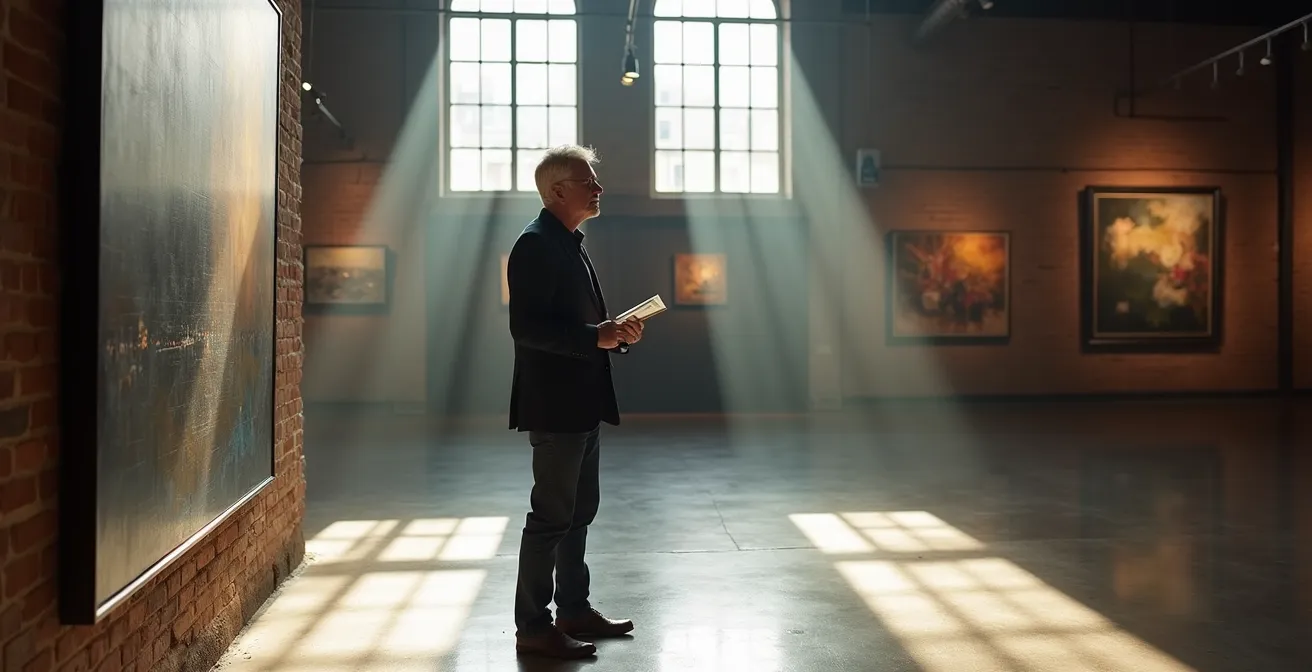
The secret that intimidates so many beginners is actually the most welcoming entry point into the art world: the gallery opening reception. These events, typically held on a Thursday or Friday evening to launch a new exhibition, are completely free and open to the public. They are not exclusive parties for high-profile buyers; they are cultural events designed to bring people together around art. The atmosphere is social, relaxed, and there is absolutely no pressure to buy anything.
This is your chance to see new work, often with a complimentary glass of wine in hand, and feel the energy of the local art scene. Key gallery districts like those on Queen West, in the Junction, or around the 401 Richmond building often have multiple openings on the same night, creating a neighborhood-wide art crawl. It’s an incredibly efficient and enjoyable way to see a diverse range of contemporary art in a single evening.

As you can see, these events are about community and engagement. They offer a direct line of sight into what is current and exciting in Toronto’s art scene. To find them, simply sign up for the email newsletters of galleries that interest you. They will announce their opening dates well in advance. Following gallery hubs and art publications on social media is another great way to stay informed. Attending these receptions is the single best way to train your eye, discover what you’re drawn to, and build your confidence as a future collector, all without spending a dime.
AGO vs. MOCA: Which Museum Offers a Better Contemporary Experience?
For an aspiring collector, Toronto’s major art institutions are not just places to see art; they are educational tools. The Art Gallery of Ontario (AGO) and the Museum of Contemporary Art (MOCA) offer two distinct but equally valuable experiences for understanding the art landscape. Your choice between them depends on your goal: are you looking to understand the deep historical context of art, or do you want to plug directly into the pulse of today’s art world?
The AGO is your art history textbook. With its vast collection of over 120,000 works, it provides the foundation. Walking through its halls, you can trace the lineage of styles and ideas that inform the work you see in contemporary galleries. For a new collector, this is invaluable for building a visual vocabulary. The AGO also has an excellent Art Rental & Sales program, which is a fantastic, low-risk way to live with original Canadian art before committing to a purchase.
MOCA, in contrast, is a living laboratory. As a non-collecting institution housed in a raw, industrial space, its focus is entirely on temporary exhibitions of living artists. It’s the place to discover who is making waves right now, both locally and internationally. The experience is often more experimental and challenging, reflecting the immediate concerns of contemporary culture. For a collector looking to spot emerging talent, MOCA is an essential destination.
The best approach is not to choose one over the other, but to use them in tandem. Use the AGO to build your foundational knowledge and MOCA to see where art is heading. This table breaks down their key differences from a collector’s perspective:
| Feature | AGO | MOCA |
|---|---|---|
| Collection Type | 120,000+ works spanning centuries | Non-collecting, temporary exhibitions |
| Best For Collectors | Learning art history context | Discovering emerging artists |
| Free Access | Wed 6-9pm, Free under 25 pass | Friday 5-9pm |
| Programs | Art Rental & Sales program | Artist talks, community events |
| Architecture | Grand, formal Frank Gehry design | Raw industrial Lower Junction space |
The “Limited Edition” Print Scam That Fools New Collectors
For those starting on a budget, prints and editions are a fantastic gateway to collecting. However, this market is also where new collectors are most vulnerable to scams. The term “limited edition” can be misleading. A true fine art print (like a screenprint, lithograph, or archival pigment print) is a work of art in its own right, created in a finite number with the artist’s direct involvement. A fake is often just a mass-produced poster with a fancy label.
The most common trap is the “unlimited limited edition”—a print sold as “limited” but without a clearly stated edition size (e.g., 12/50, meaning the 12th print in an edition of 50). Without this number, the term is meaningless. Another red flag is a print without an artist’s signature or a “chop mark,” which is an embossed seal from the printmaking studio. Reputable Toronto print studios like Open Studio or Art Metropole have rigorous standards that guarantee authenticity.
Investing in a print is about owning a piece of the artist’s process, not just a reproduction of their image. The value comes from its scarcity and the artist’s hand in its creation. Fortunately, authentic, affordable editions are plentiful in Toronto if you know what to look for. In fact, legitimate, signed editions from recognized artists and studios can often be found for under $100, making them a perfect first purchase. This is a powerful way to support an artist and begin your collection with a piece of genuine value.
Your Checklist for Print Authenticity in Toronto
- Verify the reputation of the printmaking studio (e.g., Open Studio, Art Metropole are trusted names).
- Look for clear edition numbers marked on the print (e.g., “12/50”).
- Request a Certificate of Authenticity (COA) that includes the artist’s signature.
- Check for “chop marks” or the embossed seal of the print studio on the paper.
- Confirm the artist was directly involved in the printing process, not just signing off on a reproduction.
When to Visit the Galleries to Meet the Artists in Person?
One of the most rewarding aspects of collecting emerging art is the potential to connect directly with the creators. This personal connection adds immense narrative value to a piece, transforming it from an object on your wall into a story you can share. While it might seem daunting, there are several specific times and places in Toronto’s art calendar where meeting artists is not only possible but encouraged. These are crucial “access points” for the new collector.
Opening nights, as mentioned, are a primary opportunity. The artist is almost always present and happy to discuss their work. Don’t be shy; a simple “I really love this piece, can you tell me about your process?” is a perfect conversation starter. Beyond openings, look for artist talks, which are often scheduled midway through an exhibition. These are more formal but offer deep insights into the artist’s thinking.
However, the best opportunities often lie outside of traditional commercial galleries. Annual open studio weekends, like those held by Akin Collective, allow you to visit artists in their creative environment. Even more importantly, student art shows are a goldmine for discovering talent at the very beginning of their careers.
Case Study: OCAD University’s GradEx
The annual graduate exhibition at OCAD University, known as GradEx, is arguably the single most important event for new collectors in Toronto. For a few days each spring, the entire university transforms into a massive gallery showcasing work from hundreds of emerging artists and designers. Here, you can speak directly with the creators, understand their concepts, and purchase work at pre-gallery prices, often before they have any formal representation. It’s a vibrant, low-pressure environment perfect for scouting the next generation of Toronto talent.
Key moments to put in your calendar include:
- Opening nights (first Thursday/Friday of a show)
- Closing receptions (often quieter and more intimate)
- Scheduled artist talks during an exhibition
- OCADU GradEx (annual spring graduate show)
- Open studio weekends at artist collectives
- Art Toronto, the city’s major art fair (October)
Why Did Your Favorite Indie Coffee Shop Become a Taco Bell?
This question is a metaphor for a process every Torontonian has witnessed: gentrification. The same economic forces that turn unique local businesses into chain stores are putting immense pressure on the city’s artists. As property values and commercial rents skyrocket, artists and small galleries are often the first to be priced out of neighborhoods, taking the area’s creative soul with them. This isn’t an abstract problem; it’s a direct threat to the cultural vibrancy that makes Toronto an exciting place to live.
The affordability crisis for artists is not new, but it is ongoing, and it directly impacts the art you see and can collect. When an artist’s primary concern is making rent, they have less freedom to experiment and take creative risks. Supporting the local art scene, therefore, becomes an act of cultural preservation. Every dollar you spend on a piece by a local artist is a vote for a city that values creativity and independent culture over homogeneity.
This is the core of the “cultural investment” mindset. You are not merely decorating your home; you are contributing to a sustainable creative ecosystem. You are helping an artist afford their studio for another month, enabling them to continue creating work that enriches the city’s landscape. This connection between your purchase and its impact on the community is what gives collecting on a budget its profound meaning. As a local arts initiative powerfully states, this support is fundamental to the city’s identity.
Every dollar spent on local art is a vote for a city rich with creativity and independent culture.
– Toronto Art Community, Supporting Local Artists Initiative
Graffiti Alley vs. Underpass Park: Which Has Better Murals?
For the budget-conscious collector, Toronto’s street art scene is the world’s greatest free gallery. It’s a dynamic, ever-changing exhibition space that offers an unfiltered look at raw artistic talent. Two of the city’s most prominent street art destinations, Graffiti Alley and Underpass Park, offer vastly different experiences, each valuable for training your eye. Understanding their differences helps you appreciate the spectrum of public art, from organic and rebellious to curated and architectural.
Graffiti Alley, located in the Fashion District, is the heart of Toronto’s grassroots street art culture. It’s a chaotic, vibrant, and constantly evolving canvas where artists like the iconic Uber5000, ELICSER, and SKAM have left their mark. The rules here are the rules of the street: new work is constantly painted over old, creating a layered, living history of the city’s graffiti scene. It’s the perfect place to experience the energetic and spontaneous side of urban art. Uber5000’s famous Toronto Tribute mural, for instance, is a dense “Where’s Waldo” of local icons, bridging street art with collectible pop culture.
Underpass Park, near the Don Valley Parkway, is a different beast entirely. It represents the institutional embrace of street art. The murals here are largely commissioned through programs like StreetARToronto (StART), resulting in large-scale, polished works that interact with the unique concrete architecture of the overpass. The vibe is less chaotic and more monumental, showcasing how street art can be integrated into urban planning. It’s a testament to the skill and vision of artists working on a massive scale.
Neither is “better”—they simply represent different facets of the same culture. Here’s how they compare:
| Aspect | Graffiti Alley | Underpass Park |
|---|---|---|
| Location | Queen West between Spadina-Portland | Eastern Waterfront District |
| Art Style | Organic, ever-changing, street rules | Commissioned StreetARToronto murals |
| Key Artists | Uber5000, ELICSER, SKAM | StART program artists |
| Best Time to Visit | Afternoon for vibrant energy | Early morning/evening for lighting |
| Photography | Colorful chaos, constant change | Architectural lines, moody atmosphere |
Key takeaways
- The price of emerging art reflects the real, significant costs of being a professional artist in Toronto.
- The best and most accessible entry points to the art scene are often free: gallery openings, grad shows, and open studios.
- Collecting local art is an act of cultural preservation; every purchase directly supports Toronto’s creative ecosystem.
How to Respectfully Explore Toronto’s Graffiti Culture?
As you explore Toronto’s vibrant street art, it’s crucial to remember that this is a living culture, not just a static backdrop for your Instagram photos. Engaging with it respectfully means understanding its unwritten rules and acknowledging the artists behind the work. This culture, once seen as vandalism, has fought for its legitimacy. This vibrant culture was officially recognized when, in 2011, Graffiti Alley was designated an area of municipal significance, leading to the creation of supportive programs like StreetARToronto.
The most important rule is to give credit. If you post a photo of a mural, make an effort to find the artist’s social media handle (it’s often tagged nearby) and credit them in your post. This simple act provides visibility and acknowledges their labor. Many street artists sell prints or merchandise of their work online; buying directly from them is a fantastic way to start a collection and directly support their practice.
Respect also extends to the physical space. Never interrupt an artist while they are actively painting, and be mindful not to touch wet paint or damage the work. For those wanting a deeper, more contextualized experience, consider taking a guided tour. Companies like Tour Guys offer walks through Graffiti Alley, providing historical insights and stories that you would otherwise miss, with proceeds often supporting the community.
By following a simple code of conduct, you transition from a passive consumer to an active and respectful participant in the scene:
- DO tag the artist’s Instagram handle when posting photos of their work.
- DON’T interrupt artists while they are working or get in their way.
- DO support artists by purchasing prints or merchandise if they offer it.
- DON’T touch the art, especially if it looks like it might be wet paint.
- DO be aware of your surroundings and visit during daylight hours for safety.
This mindful approach enriches your experience and honors the creative community that makes Toronto’s streets so visually exciting.
Your journey into art collecting starts not with a big cheque, but with a small, intentional step. It begins with curiosity, with visiting a gallery on a Thursday night, with following a new artist on Instagram, or with buying a $50 print from a student at GradEx. By shifting your perspective from consumption to participation, you unlock a world of meaning and connection. You become part of the story, not just an observer. Start by exploring the listings for this month’s gallery openings on Queen West, and take the first step toward building a collection that reflects not just your taste, but your investment in Toronto’s unique cultural fabric.