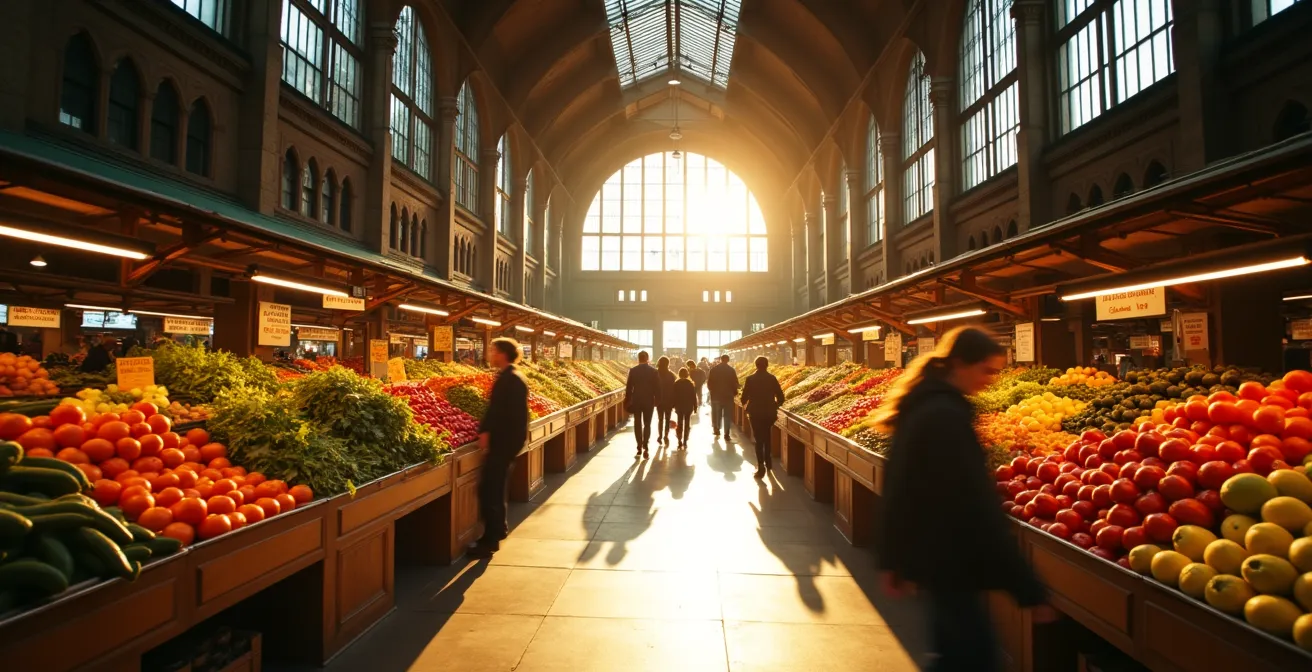
Forget the tourist checklists; shopping St. Lawrence Market like a chef means decoding quality, not just buying what’s famous.
- True value is often found on Saturday afternoon, not first thing in the morning, as vendors look to clear fresh stock.
- The “artisan” label on cheese is frequently a marketing trap; a chef judges by taste, complexity, and story, not by price or packaging.
Recommendation: Your greatest tools are your questions. Interrogate vendors about their produce, judge a sandwich by its structural integrity, and learn to see the story behind the ingredients.
Every foodie in Toronto thinks they know St. Lawrence Market. They tick the boxes: peameal bacon sandwich, butter tarts, a quick walk-through. They follow the crowds, take the same pictures, and leave with a bag of famous but not necessarily superior goods. They treat it like a museum. That’s the tourist’s way. A chef, however, sees something entirely different. We see a pantry, a living ecosystem of ingredients where quality is a moving target, hidden behind tourist-friendly facades and misleading labels.
The common advice is to “go early on Saturday.” It’s not wrong, but it’s tragically incomplete. It misses the strategy, the nuance. The real art of the market isn’t about beating the crowds; it’s about understanding the rhythm of the vendors, the lifecycle of the produce, and the subtle tells that separate true craft from mass-produced convenience masquerading as “artisan.” You’re told what to buy, but never how to *judge*. No one explains the structural integrity of a proper kaiser roll or the questions you must ask a farmer to know if their tomatoes are truly worth your time.
This is where we diverge from the tourist path. This guide isn’t a list of things to eat. It’s a lesson in how to *see*. We’re going to dismantle the market experience, from the timing of your visit to the critical assessment of its most iconic sandwich. You will learn to look past the “artisan” veneer, understand the fundamental differences between the North and South markets for a cook, and develop the ingredient intelligence to build a meal, not just collect souvenirs. It’s time to stop being a visitor and start shopping with purpose.
This article provides a framework for navigating the market with a chef’s critical eye. The following sections break down the strategies, from timing your visit for the best deals to a point-by-point system for judging the perfect peameal bacon sandwich.
Summary: A Chef’s Playbook for St. Lawrence Market
- Why Do Vendors Discount Produce heavily on Saturday Afternoons?
- How to Choose the Best Peameal Bacon Sandwich at the Market?
- North Market vs. South Market: Which Is Better for Fresh Farmers’ Produce?
- The “Artisan” Label Trap That Doubles the Price of Cheese
- When to Drive to St. Lawrence Market to Find Cheap Parking?
- Carousel vs. Paddington’s: Who Makes the Best Bun on the Market?
- The Hygiene Red Flag to Watch For at Summer Food Festivals
- How to Judge a Perfect Peameal Bacon Sandwich?
Why Do Vendors Discount Produce heavily on Saturday Afternoons?
The tourist rushes to the market at 8 a.m. on a Saturday, fighting for the shiniest apple. The chef knows better. The real opportunity, the strategic play, often comes late in the day. This isn’t about picking through leftovers; it’s about understanding a simple, crucial piece of logistics: the market is closed on Sundays and Mondays. This forces the vendors’ hands. Anything perishable that hasn’t sold by 3 p.m. on Saturday becomes a liability, not an asset.
This creates a window of opportunity for what I call the “Saturday Afternoon Gambit.” You can acquire high-quality produce, perfect for Sunday cooking, at a significant discount. We’re not talking about moldy berries. We’re talking about slightly soft tomatoes ideal for a sauce, mushrooms that are perfectly fine for a duxelles, or root vegetables that have lost their picture-perfect sheen but none of their flavour. This is where a cook’s eye for potential triumphs over a tourist’s eye for perfection. As Toronto Chef Matt Dean Pettit notes, this is a part of the market’s natural rhythm, confirming that because the market is closed on Mondays, vendors will often offer deals on Saturday or Sunday evenings.
However, this requires discernment. Not all discounts are created equal. You must be able to assess the usability of the produce. Here’s how to think about it:
- Check firmness: Root vegetables like carrots and potatoes should still be solid. A slight softness is acceptable for immediate cooking, but avoid anything truly limp.
- Smell test: Trust your nose above all. Avoid any produce with a fermented or sour odor. Earthy smells, especially for mushrooms, are perfectly normal and a good sign.
- Visual inspection: Surface blemishes on things like apples or peppers are fine, especially for stocks, sauces, and stews. But draw the line at visible mold or excessive, deep bruising that indicates rot.
- Touch test: Tomatoes for sauce-making can be very soft, but their skin shouldn’t break with gentle pressure. If it does, it’s past its prime.
Ask the vendors directly: “Is this good for cooking tonight or tomorrow?” They have no incentive to lie; they want to move the product and maintain their reputation. Their honesty is your best guide to unlocking the hidden value of the market’s final hours.
How to Choose the Best Peameal Bacon Sandwich at the Market?
The peameal bacon sandwich is the undisputed icon of St. Lawrence Market, but its fame has made it a tourist commodity. Most people just line up at the most famous stall without a second thought. A chef doesn’t follow lines; a chef follows quality. To understand the sandwich, you must first understand its history. This isn’t just a sandwich; it’s a piece of Toronto’s industrial past. The “peameal” process was born here, and at its peak, the city was the largest pork processor in the British Empire. This context is vital, as the William Davies Company, a predecessor to the market’s culture, was a behemoth; in fact, William Davies’ company processed nearly 500,000 hogs annually by the 1900s.
The Accidental Genius: How the Peameal Sandwich Was Born
The sandwich as we know it wasn’t some grand culinary invention. It was a solution to a problem. In the 1960s, butcher Joe Homer found his customers preferred the centre-cut of peameal loins, leaving him with the less desirable ends. Instead of wasting them, he and bakery owner Elso Biancolin sliced and fried the ends, serving them on fresh buns. It was a simple, resourceful creation. Biancolin’s sons later expanded this into the now-famous Carousel Bakery, turning their humble sandwich into a global attraction.
This origin story tells you everything: the sandwich’s soul is in its simplicity and the quality of its two main components: the bacon and the bun. Today, with multiple vendors, the challenge is to find the one that honours this simplicity best. Forget the toppings and fancy mustards for a moment and focus on the core.

Look at the bacon itself. Is it a uniform, pale pink, or does it have a deeper, more natural colour? The cornmeal crust should be visible and golden, not a sparse, sad dusting. The slices should be thick enough to be juicy, but cooked through so the edges have a slight crispness. A pile of flabby, grey meat is a red flag. The bun should be a simple, fresh kaiser roll, substantial enough to hold the juices without disintegrating. It is an exercise in texture and balance.
Before you even taste it, you can judge it with your eyes. Is the construction sloppy or neat? Is the meat-to-bun ratio balanced? These are the details a chef sees, and they separate a thoughtfully prepared sandwich from a perfunctory one churned out for the tourist masses.
North Market vs. South Market: Which Is Better for Fresh Farmers’ Produce?
A common mistake is treating the St. Lawrence Market as one monolithic entity. It’s not. The South Market and the Saturday-only North Market are two entirely different beasts, serving different purposes for a serious cook. Understanding this distinction is fundamental to efficient, high-quality sourcing. The South Market is your reliable, year-round pantry. The North Market is your seasonal, direct-from-the-source treasure chest.
The South Market is where you find permanent vendors, specialty importers, and butchers. It’s consistent. You can build relationships with these vendors and rely on them for staples like olive oil, imported cheeses, and quality meats any day of the week. The North Market, however, is a direct conduit to Ontario’s farms. It operates only on Saturdays and is populated by the farmers themselves. This is where you find true seasonality and have the opportunity for what I call “vendor interrogation”—getting intelligence straight from the grower.
This table, based on information from insights provided by Destination Ontario, breaks down the strategic differences:
| Aspect | North Market (Saturday) | South Market (Tue-Sun) |
|---|---|---|
| Best For | Seasonal Ontario produce direct from farms | Year-round staples and specialty imports |
| Operating Hours | Saturday only, 5am-3pm | Tue-Fri 9am-7pm, Sat 7am-5pm, Sun 10am-5pm |
| Vendor Type | Local farmers, direct growers | Permanent vendors, specialty shops |
| Price Point | Lower for in-season items | Higher but consistent pricing |
| Interaction | Direct farmer conversations about growing practices | Established vendor relationships |
In the North Market, your greatest tool is your curiosity. You’re not just buying a squash; you’re learning about its specific variety, when it was picked, and how the farmer suggests preparing it. This is information you will never get in a supermarket. To get chef-level intel, you need to ask the right questions:
- What came in fresh this morning that wasn’t here last week?
- Which variety of tomato has the best flavour right now, not just the best look?
- Do you have any “seconds” that would be perfect for canning or making sauce?
- What’s your farm’s specialty that other vendors don’t grow?
- Can you tell me about your growing practices—are you spray-free?
- What’s coming into season in the next two weeks?
Go to the South Market for your pantry staples and the specific cuts from your trusted butcher. Go to the North Market for inspiration, for the best of what the season has to offer, and to connect directly with the source of your food. A good cook needs both.
The “Artisan” Label Trap That Doubles the Price of Cheese
Nowhere is the tourist-chef divide more apparent than at the cheese counter. The word “artisan” is thrown around so carelessly it has become almost meaningless. It’s a marketing term, a veneer of quality slapped onto products that are often anything but. A high price and a rustic-looking label do not guarantee a superior product. A chef knows that taste, complexity, and the story behind the cheese are the true measures of value, not the price per 100 grams.
The “artisan” trap is designed to appeal to our desire for authenticity. But real artisanal cheese has tells. It’s often irregular. It shows variations in colour and texture. It is cut to order from a large wheel, not pre-wrapped in plastic sweating on a shelf. A real cheesemonger can tell you the name of the cheesemaker, the region of production, and the details of its aging process. If they can’t, you’re likely paying a premium for a clever marketing story, not a superior product.
As local chef Matt Dean Pettit wisely advises, you must engage with the monger to determine real value. His insight is key: “Ask the cheesemonger for samples and what to taste for – finish, texture, terroir – to determine if a C$10 cheese is better value than a C$6 one. The intensity and complexity of flavour matters more than price per 100g.” This transforms you from a passive buyer into an active taster. To avoid the trap, you need to look for the red flags of fake “artisan” products:
- Pre-cut portions: Plastic-wrapped pieces that were cut days ago are a major warning. Real artisan cheese is cut fresh from the wheel to preserve its integrity.
- Generic terms: Phrases like “farmhouse style” without a specific farm name are often used to evoke a story that doesn’t exist.
- Uniformity: True small-batch cheese shows natural variations in colour and texture. A perfectly uniform block often points to industrial production.
- Lack of information: If the vendor has no details on the aging process or the specific production region, be skeptical.
- Price seems too good: Authentic, labour-intensive, small-batch cheese costs money to produce. An unusually low price can be as much of a red flag as an inflated one.
Don’t be intimidated. Ask for a taste. Ask about the finish, the texture, the “terroir.” A good cheesemonger will be delighted to share their passion. A seller of generic cheese will be annoyed. Their reaction is as telling as the cheese itself.
When to Drive to St. Lawrence Market to Find Cheap Parking?
Let’s be brutally practical. The most wonderful ingredients in the world are useless if you abandon your trip in a fit of parking-induced rage. The logistics of visiting St. Lawrence Market, particularly by car, can be a nightmare and a significant expense. The area is dense, and on a weekend, finding a spot feels like a competitive sport. For reference, according to recent visitor reviews, nearby parking garages charge approximately $15.00 for full day parking. This isn’t pocket change.
The conventional wisdom is to avoid driving on a Saturday altogether. That’s sound advice if you have other options. But if you’re doing a large shop and need your car, strategy is everything. The key is to think in opposition to the crowds. The absolute worst time to look for parking is between 10 a.m. and 2 p.m. on a Saturday. The best time? Early. Very early.

If you must drive on a Saturday, arriving between 7 a.m. and 8 a.m. is your best bet. The streets are quieter, the nearby Green P lots have spaces, and the tourist rush hasn’t yet descended. You trade an hour of sleep for an hour of sanity. But the real chef’s move, if your schedule allows, is to avoid the Saturday chaos entirely. A Friday morning shop offers the best of both worlds.
There’s a crucial piece of internal market logic at play here. Vendors stock up during the week to be fully prepared for the weekend rush. This means that a Friday morning offers arguably the best and freshest selection, before the weekend crowds have picked everything over. You get prime choice of ingredients and a much less stressful parking experience. A Tuesday morning can also be quiet, though selection might be slightly reduced as vendors restock after the weekend.
Ultimately, the “best” time depends on your goal. For a massive haul, a strategic early Friday morning is optimal. For the Saturday farmers’ market experience, be the first one there. For bargain hunting, as we’ve discussed, the late afternoon is key. Never just show up and hope for the best.
Carousel vs. Paddington’s: Who Makes the Best Bun on the Market?
The debate between Carousel Bakery and Paddington’s Pump for the best peameal bacon sandwich is a Toronto classic. Tourists and locals alike pledge allegiance to one or the other. But a chef knows the debate isn’t just about the bacon; it’s about the entire system. And the most overlooked, yet arguably most critical, component is the bun. A sandwich is only as good as the bread that holds it. The bun is not a plate; it’s an active ingredient.
The standard is a soft, fresh kaiser roll. Carousel Bakery, in particular, is known for its simple approach, which, as food historians note, is composed of “1/8-inch slices of peameal bacon cooked on a griddle…drizzled with honey mustard, and served on a soft fresh roll.” The bun’s job is to be the perfect supporting actor: it must be substantial enough to absorb the juices from the bacon and the tang of the mustard without collapsing into a soggy mess. This is a question of structural integrity.
To judge the bun like a chef, you need a technical framework. You’re not just asking “is it fresh?” You’re performing a series of micro-tests to assess its quality across several metrics. This approach moves beyond subjective taste and into objective analysis.
Here is a technical comparison of what defines a high-quality kaiser bun, the foundation of a superior sandwich.
| Quality Metric | Ideal Standard | Testing Method |
|---|---|---|
| Freshness | Baked same day, slight spring when pressed | Gentle press test – should bounce back slowly |
| Density | Light but substantial enough to hold juices | Weight in hand – not too airy, not too dense |
| Crust | Thin, slightly crispy exterior | Tap test – should sound hollow |
| Moisture Content | Soft interior without being gummy | Tear test – clean tear without compression |
| Structural Integrity | Holds up to meat juices for 5+ minutes | Sauce-soak test with water |
Does it feel light and airy, or does it have a reassuring heft? Does it look pillowy and fresh, or compressed and tired? A great sandwich is an exercise in engineering. If the foundation is weak, the entire structure will fail, no matter how good the bacon is.
The Hygiene Red Flag to Watch For at Summer Food Festivals
While St. Lawrence Market itself is a permanent structure with established vendors, its spirit extends to outdoor food stalls and festivals, especially in the summer. This is where a chef’s eye for hygiene becomes non-negotiable. A vibrant atmosphere and delicious smells can easily mask poor food handling practices. For a professional, food safety is paramount, and the most glaring red flag is often the simplest: the handling of money.
Money is one of the dirtiest things we touch. If you see a vendor take your cash and then immediately turn to assemble your food with their bare hands, walk away. It’s the most basic violation of food safety protocols. This isn’t being picky; it’s protecting yourself. The lack of this simple separation of duties indicates a deeper disregard for proper hygiene across the board. As one blunt TripAdvisor reviewer noted about a market experience, “The same guy who charges is the one who prepares the food, without gloves, without washing his hands…” This is a massive, unambiguous warning sign.
Look for the DineSafe green “Pass” sign, which is mandatory for all food vendors in Toronto. It’s your first assurance of basic compliance. But a chef looks beyond the sign and observes the process. We are trained to see the small details that signal a clean, safe operation. You can and should do the same.
Your Action Plan: Chef-Standard Hygiene Checklist
- Temperature Control: Check if hot foods are held above 140°F (60°C) – steam should be visible. Ensure cold items are in refrigerated displays or on ample ice.
- Glove Discipline: Watch for gloved hands. More importantly, are they changed between handling money and handling food? A glove is only as clean as the last thing it touched.
- Cross-Contamination Prevention: Look for separate cutting boards for different food types (e.g., raw meat vs. vegetables). Professionals often use color-coded boards.
- Surface Cleanliness: Notice if surfaces are wiped down frequently, especially between orders. A tidy workspace is a sign of a disciplined operation.
- Visible Certification: Always look for the green DineSafe ‘Pass’ sign issued by Toronto Public Health. It should be clearly visible at each vendor.
Enjoying market food and street food is one of life’s great pleasures, but it should never come at the cost of your health. Training your eye to spot these red flags allows you to indulge with confidence, knowing you’ve chosen a vendor who respects their ingredients and their customers.
Key takeaways
- Shopping at St. Lawrence Market is a strategic exercise; the best value and quality are found by understanding vendor rhythms and product lifecycles, not by following tourist trends.
- True quality is judged by ingredient integrity—the freshness of a bun, the complexity of a cheese, the story from a farmer—rather than by price or marketing labels like “artisan.”
- A chef’s mindset involves active interrogation and observation: asking the right questions, checking for hygiene red flags, and deconstructing a dish to its core components.
How to Judge a Perfect Peameal Bacon Sandwich?
We’ve discussed the history, the bun, and the pitfalls. Now, we synthesize it all into a unified system. Judging the perfect peameal bacon sandwich is not a matter of vague preference. It’s a technical scoring exercise, much like judging wine or coffee. By breaking it down into its core components and assigning weight to each, you move from “I like this one” to “This one is superior because…” This is the final step in developing your chef’s palate.
This isn’t about being a food snob. It’s about respecting the craft and giving credit where it’s due. A well-made sandwich, even a simple one, is a work of balance and execution. For context, this is a substantial food item; a laboratory analysis conducted in 2018 found that Carousel Bakery’s signature sandwich contains 499 calories and 57g of protein. With that much substance, every component must be perfect to justify it. The following scoring system is how a professional would deconstruct it.
This 100-point system gives you a framework to evaluate any peameal bacon sandwich at the market, or anywhere else. It forces you to pay attention to details you might otherwise overlook.
| Category | Points | Key Criteria |
|---|---|---|
| Bacon Quality | 25 | Lean-to-fat ratio, cornmeal crust crispness, pink center |
| Bun Freshness & Integrity | 20 | Same-day baked, structural hold, appropriate density |
| Sear & Temperature | 15 | Caramelized exterior, warm throughout, slight crust |
| Condiment Quality | 15 | House-made mustard, proper application, balance |
| Construction & Ratio | 15 | Meat-to-bun proportion, even distribution, neat assembly |
| Value | 10 | Price relative to portion and quality |
Go to the market, order a sandwich, and take a moment before your first bite. Assess it against these criteria. You’ll start to notice the subtle differences—the freshness of the bun, the quality of the sear on the bacon, the balance of the mustard. This is how you start to taste like a chef. This is how you find the true best peameal bacon sandwich, not by following the longest line, but by trusting your own informed judgment.