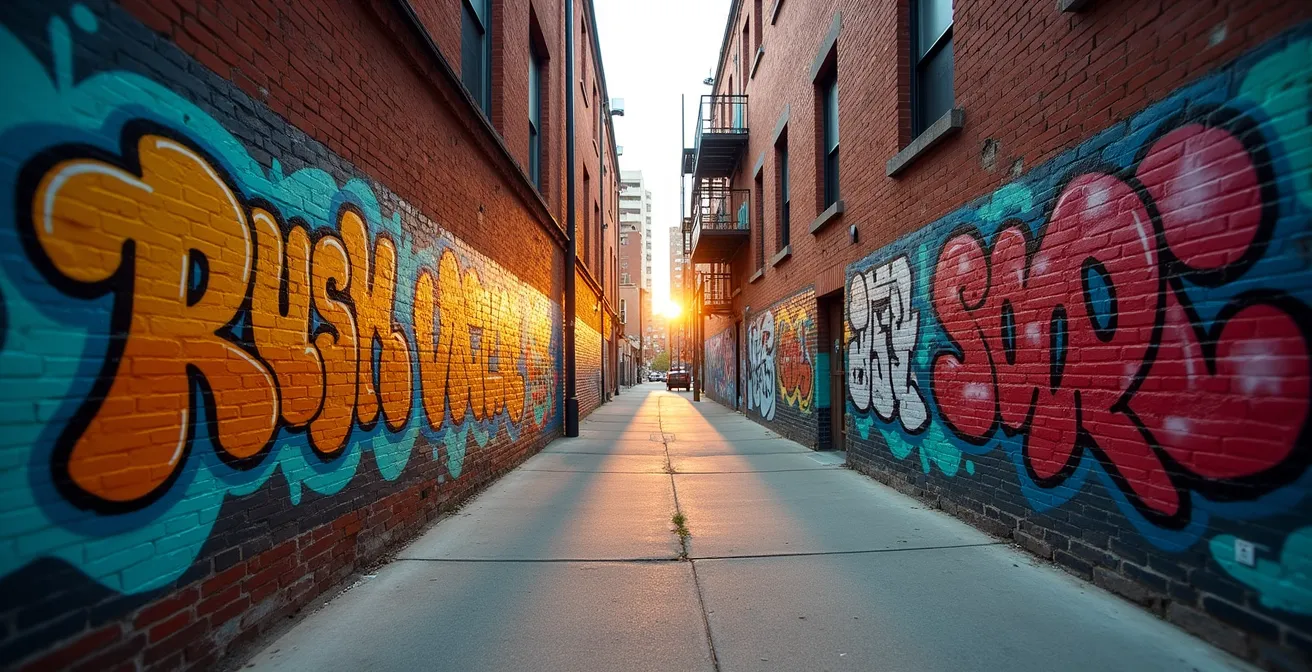
The key to exploring Toronto’s street art is understanding it as a living gallery with its own codes, not just a photo backdrop.
- Legal status is complex; Toronto’s Graffiti Management Plan protects specific areas like Graffiti Alley while penalizing unauthorized “vandalism” elsewhere.
- True respect involves practical etiquette: minding your timing, being aware of functional laneways, and knowing the unwritten rules of the artists’ space.
Recommendation: Plan your visit like a curator: understand the context behind the art, respect the artists’ evolving canvas, and observe the laneways as the functioning, living spaces they are.
For many visitors to Toronto, a trip to the iconic Graffiti Alley is a non-negotiable part of the itinerary. The vibrant, paint-splashed laneways south of Queen Street West have become a world-famous backdrop for selfies and fashion shoots. The common advice is simple: go, take amazing photos, and soak in the “cool” urban atmosphere. This approach, however, barely scratches the surface and often overlooks the rich, complex culture that thrives on these brick walls.
Merely treating these spaces as a static tourist attraction misses the point entirely. It ignores the dialogue happening between artists, the constant evolution of the murals, and the crucial distinction between sanctioned art and illegal tagging. The real value lies not just in seeing the art, but in understanding its context. What makes this specific alley legal while other walls are quickly “buffed” or painted over? How do you navigate these spaces without disrespecting the local residents and the artists who consider it their studio?
This guide offers a different perspective. Forget being a passive tourist; it’s time to become a respectful observer. The true key to appreciating Toronto’s street art is to recognize it as a living gallery governed by a set of unwritten codes. It’s about learning the difference between art and vandalism in the eyes of the city, understanding the hierarchy of the street, and appreciating the ephemeral nature of a masterpiece that might be gone tomorrow.
We will delve into the legal framework that protects Graffiti Alley, provide concrete rules for respectful photography, and explore the safety considerations for laneway exploration. By understanding the ‘why’ behind the art, you can transform a simple photo walk into a deeply insightful cultural experience.
This article breaks down the essential knowledge you need to explore Toronto’s street art scene with the respect and understanding it deserves. Discover the stories, the rules, and the hidden gems beyond the obvious photo opportunities.
Summary: How to Respectfully Explore Toronto’s Graffiti Culture: A Visitor’s Guide
- Why Is Graffiti Alley Legal While Other Walls Get Buffed?
- How to Photograph Rick Mercer’s Alley Without Angering Locals?
- Graffiti Alley vs. Underpass Park: Which Has Better Murals?
- The Safety Risk of Exploring Laneways After Dark
- When Do Artists Usually Repaint the Walls in the Alley?
- How to Map a Laneway Photo Walk for Golden Hour Lighting?
- Why Does Emerging Canadian Art Cost More Than You Expect?
- How to Explore Toronto’s Hidden Laneways Without Trespassing?
Why Is Graffiti Alley Legal While Other Walls Get Buffed?
The legality of Graffiti Alley isn’t an accident or an oversight; it’s the result of a deliberate and progressive municipal strategy. The core of this protection lies in the Graffiti Management Plan adopted by Toronto City Council in 2011. This plan designated the entire laneway system south of Queen Street West, from John Street to Bathurst Street, as an area of municipal significance. This special status exempts it from the standard bylaw enforcement that applies to the rest of the city, effectively creating a legal, open-air gallery.
Outside of this protected zone, the rules are drastically different. Under the bylaw, private and commercial property owners are responsible for cleaning up graffiti vandalism at their own expense. If they fail to remove it within 72 hours (or 24 hours for hate or gang-related graffiti), the city will do the work and bill the owner. This creates a sharp contrast: what is celebrated as culture in one alley is considered a costly nuisance on another.
The city formally distinguishes between “graffiti art” and “graffiti vandalism.” “Graffiti art,” allowed through municipal permits or located in designated areas like Graffiti Alley, is protected. This is part of a broader strategy embodied by programs like StreetARToronto (StART). The city actively invests in public art to beautify neighbourhoods and provide opportunities for artists. This proactive approach helps reduce vandalism by providing legitimate outlets for creative expression, turning a problem into a celebrated feature of Toronto’s urban landscape.
How to Photograph Rick Mercer’s Alley Without Angering Locals?
Graffiti Alley was propelled into the national spotlight largely thanks to comedian Rick Mercer, who used it as the dynamic backdrop for his famous “Rant” segment. As his former producer, Liisa Wanders, notes, he brought the alley to wide attention. This fame, however, turned a functional back lane into a major tourist destination, creating friction between visitors, residents, and businesses.
Rick Mercer brought Grafitti Alley to wide attention when he used it was that backdrop for a regular segment on his TV show where he would rant while walking through the alley.
– Liisa Wanders, Graffiti Alley in Toronto: a free street art walk
To photograph the space respectfully, you must remember it’s a working alley. It serves as a service lane for garages, deliveries, and waste disposal for the businesses and homes on Queen Street. The key to not angering locals is to minimize your disruption. This means being spatially aware and prioritizing their access over your perfect shot. Blocking a garage door, even for a moment, is a major faux pas. So is setting up a bulky tripod during peak hours, which can obstruct both vehicle and pedestrian traffic.
Adhering to a few simple guidelines can make all the difference:
- Time your visit wisely: The best time for a respectful visit is during weekday mornings or before 10 am on weekends. This is when the alley is least likely to be used by residents or for commercial deliveries.
- Stay mobile and alert: Be prepared to move immediately for cars or trucks. Keep your ears open and don’t get so lost in your viewfinder that you become an obstacle.
- Travel light: Avoid bulky equipment like large tripods or extensive lighting setups, especially during busier times. A handheld camera or phone is much less intrusive.
- Respect the reality: You will see garbage bins and other signs of a working laneway. Don’t move things or complain; accept it as part of the authentic environment. The art exists within a functional urban space, not a sterile museum.
Graffiti Alley vs. Underpass Park: Which Has Better Murals?
When seeking out Toronto’s best street art, the conversation often turns to two premier locations: the chaotic, layered walls of Graffiti Alley and the monumental, curated pillars of Underpass Park. Asking which has “better” murals is like asking if a jazz club is better than a symphony hall; they offer fundamentally different, yet equally valid, artistic experiences. The right choice depends entirely on what you’re looking to see and feel.
Graffiti Alley is the heart of the city’s raw, evolving street art scene. It’s a dense, multi-layered environment where tags, throw-ups, and elaborate pieces compete for space. The atmosphere is that of a living gallery, where a mural you see today might be painted over tomorrow. It offers an authentic, almost chaotic immersion into the subculture.

Underpass Park, located in the city’s East End, presents a starkly different aesthetic. Situated beneath a highway overpass, this space feels more like a structured, outdoor museum. It features massive, large-scale murals, often commissioned, that wrap around towering concrete pillars. The art is monumental, clean, and designed for grand visual impact rather than the dense layering of the alley. This comparison highlights the diversity of Toronto’s public art landscape.
This table breaks down the key differences to help you decide which destination best suits your artistic tastes.
| Feature | Graffiti Alley | Underpass Park |
|---|---|---|
| Location | Located within Toronto’s Fashion District, runs parallel to Queen Street West, encompasses three city blocks including Rush Lane | Beneath highway overpass in East End |
| Art Style | Dense, layered, mix of tags and pieces | Large-scale, curated murals on pillars |
| Atmosphere | Dynamic, chaotic ‘living gallery’ feel | Structured ‘outdoor museum’ aesthetic |
| Artists | Works by iconic artists like Duro the Third, uber5000, and ELICSER | Commissioned large-scale pieces |
| Best For | Instagram photos, street art authenticity | Monumental art appreciation |
The Safety Risk of Exploring Laneways After Dark
While Toronto is generally a safe city, the universal rules of urban exploration apply, especially when it comes to its laneways after dark. The primary risk isn’t necessarily about crime, but about visibility and isolation. During the day, Graffiti Alley is a high-traffic location bustling with tourists, photographers, and locals, which provides a strong sense of security. As one solo female visitor noted, the daytime experience feels perfectly safe and comfortable.
Like most of Toronto, it’s completely safe to visit during the day, even if you’re by yourself. As a female, I felt perfectly safe and comfortable walking around Graffiti Alley on my own… However, I wouldn’t walk around here at night on your own. Like most alleys in any major city, I wouldn’t be wandering around on my own at night.
– Lauren, Justin Plus Lauren
At night, the dynamic changes. The crowds disappear, lighting can be poor and inconsistent, and the laneways become isolated corridors. This increases vulnerability not just to potential encounters but also to physical hazards like uneven pavement, broken glass, or other debris that are hard to see. Flashing expensive camera equipment in a poorly lit, empty alley is also unwise.
The smartest approach is to treat laneway exploration with the same caution you would in any major city. Prioritize daylight hours for your visit. If you must explore in the evening or are venturing into less-trafficked laneways, it’s highly recommended to go with a companion. Being aware of your surroundings is paramount.
Your Laneway Exploration Safety Checklist
- Assess your timing: Visit during daylight hours when there are other people around for natural surveillance.
- Choose your location wisely: Avoid isolated, dead-end residential laneways in unfamiliar areas, especially after dusk.
- Manage your equipment: Use a discreet phone camera instead of expensive DSLR gear after dark to avoid drawing unwanted attention.
- Travel with a companion: Exploring with at least one other person is the simplest and most effective safety measure for evening visits.
- Watch your step: Stay aware of physical hazards like uneven pavement, potholes, and broken glass, which are more dangerous in low light.
When Do Artists Usually Repaint the Walls in the Alley?
There is no set schedule for when the art in Graffiti Alley changes; this is the fundamental principle of the space as a “living gallery.” The evolution is constant and organic, driven by the artists themselves. This ephemerality is one of the most exciting aspects of street art culture. A piece you fall in love with on one visit may be gone by the next, replaced by a new creation.
One of the wonderful things about Graffiti Alley and street art is that it’s constantly changing. One mural or piece that might exist one year could be gone the next. Artists are constantly painting over their old works with new creations.
– Justin Plus Lauren, Graffiti Alley in Toronto Guide
This process of painting over existing work is governed by a complex, unwritten code of ethics and hierarchy within the subculture. It is not a free-for-all. Generally, a less experienced artist (or one simply “tagging”) would not paint over a complex, respected “piece” by a veteran artist. Doing so is a sign of immense disrespect. However, artists will often paint over their own older work, or a new masterpiece might replace a faded, less significant one. This dialogue on the walls—what gets covered, what remains, and what is altered—is a core part of the culture.
Sometimes, this layering becomes a statement in itself, a form of public commentary between artists. The unwritten rules of respect and artistic hierarchy dictate the lifecycle of the murals you see.
Case Study: The Rob Ford Mural Diss
A famous example of this artistic dialogue involved a mural of former Toronto mayor Rob Ford. The original piece depicted him sitting on a tree branch that appeared to be cracking under his weight. Later, another artist painted over the mural, but not completely. They deliberately left Ford’s head visible while covering the rest of the image. This act was seen as the ultimate “diss” within the community—a powerful statement that used the act of painting-over to comment on and disrespect the original subject, while still acknowledging its prior existence.
How to Map a Laneway Photo Walk for Golden Hour Lighting?
For photographers, capturing street art is not just about the subject, but also about the light. The “golden hour”—the period shortly after sunrise or before sunset—provides a warm, soft light that can make the vibrant colours of a mural pop and add dramatic long shadows. Planning a photo walk to take advantage of this fleeting light in Toronto’s laneways requires a bit of strategic thinking, as the tall city buildings can create unpredictable shadows.
Your primary tools for this are a map and a sun-tracking app. Apps like PhotoPills or Sun Seeker can show you the exact angle of the sun at any given time of day, helping you predict which walls will be illuminated and which will be in shadow. Before you even leave, use Google Street View to pre-visualize your route. This allows you to scout for potential obstructions, like tall buildings or trees, that might block the golden hour light, even if the wall is facing the right direction.
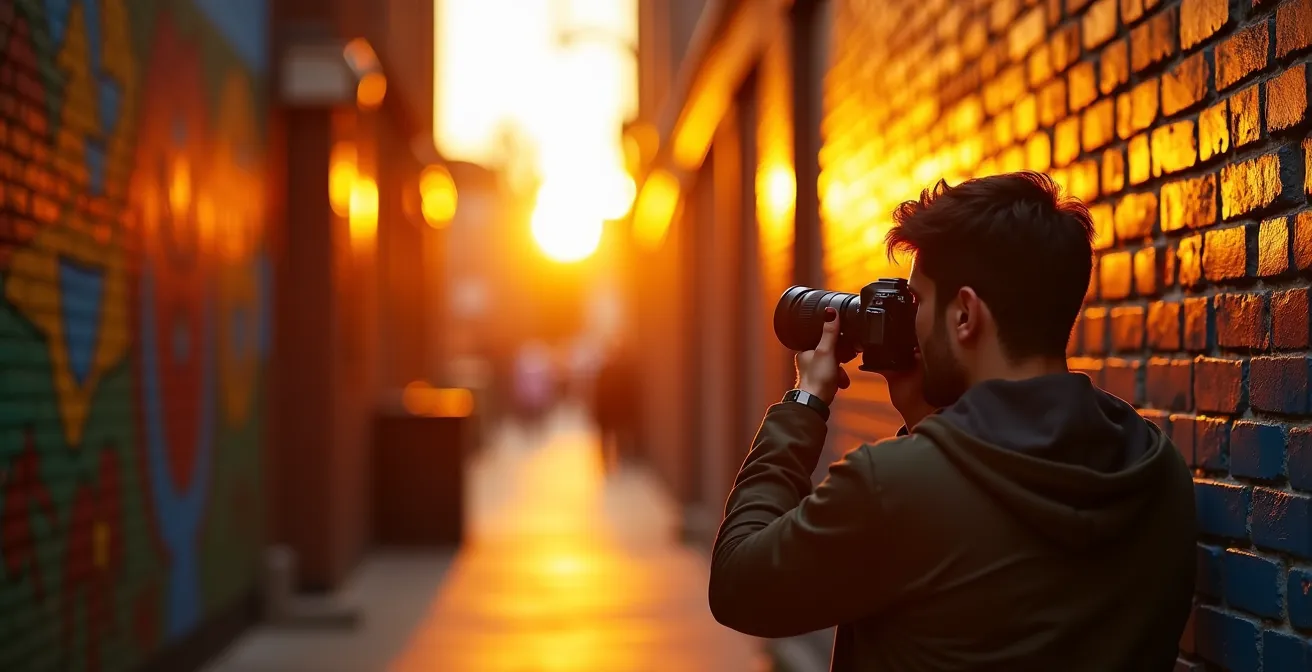
Here are some practical steps to map out your golden hour route:
- Target West-Facing Walls: For the classic evening golden hour, prioritize laneways with large, west-facing walls that will catch the setting sun directly.
- Plan a Directional Route: For sunset shots, consider a north-south laneway like Ossington Laneway. Starting at the south end and walking north allows you to shoot towards the setting sun’s glow.
- Pre-scout with Street View: Check your intended route online to identify potential shadow-casting buildings. A promising west-facing wall might be permanently shaded by a new condo tower.
- Embrace Overcast Days: Don’t dismiss cloudy days. Overcast conditions provide soft, even lighting that eliminates harsh shadows and can be excellent for capturing the true colours of a mural without glare.
- Know Your Location: Remember that Graffiti Alley itself runs east-west, parallel to Queen Street West between Spadina and Portland Avenues. The best light will be on the north-side walls in the morning and the south-side walls in the late afternoon.
Key Takeaways
- Legality is Contextual: Graffiti Alley’s legal status is a specific designation; the same art would be considered vandalism on most other Toronto properties, highlighting a deliberate city strategy.
- Respect is Action: Exploring respectfully goes beyond not trespassing; it means being aware of functional laneways, timing your visit to minimize disruption, and prioritizing residents’ access over your photo.
- Art is Ephemeral: The walls are a “living gallery” in constant flux. A piece’s value is in its current existence, as it may be painted over tomorrow as part of an ongoing artistic dialogue.
Why Does Emerging Canadian Art Cost More Than You Expect?
It can be surprising to see an artist whose work you discovered for free on a laneway wall commanding a high price in a gallery. This transition from street to studio involves significant costs that are often invisible to the public. When an artist like ELICSER or uber5000, whose work can be seen in Graffiti Alley, moves to create gallery pieces, the economics of their practice change dramatically. The price tag on their canvas work isn’t arbitrary; it reflects the substantial overhead of being a professional artist in a major city like Toronto.
First, there are the material costs. A spray can used on a brick wall is one thing; archival-quality canvases, gallery-grade paints, and framing materials needed for a piece to last for decades represent a much larger investment. Second is the immense cost of studio space. With studio rents in Toronto averaging thousands of dollars per month, this overhead must be factored into the price of each piece sold.
Finally, the gallery system itself adds a significant layer to the final price. Galleries typically take a commission of around 50% on any work they sell. This fee covers their own operational costs, including rent, staff, and marketing, but it means the artist receives only half of the sticker price. Therefore, a piece priced at $4,000 nets the artist only $2,000, from which they must then cover their studio rent, materials, and living expenses. This context is crucial for understanding the value and cost of emerging Canadian art.
How to Explore Toronto’s Hidden Laneways Without Trespassing?
Beyond the fame of Graffiti Alley, Toronto is crisscrossed with thousands of hidden laneways, many of them home to incredible, lesser-known murals. Exploring these is a rewarding experience, but it requires a clear understanding of the line between public right-of-way and private property. Trespassing, even unintentionally, is a quick way to create conflict and undermine the positive relationship between the public and the street art community. The City of Toronto’s StreetARToronto (StART) program has been successful in fostering this positive relationship by replacing vandalism with community-engaged art, and respecting boundaries is a visitor’s part of that pact.
The general rule is simple: most laneways are public thoroughfares, but the walls and the land behind them are private property. The physical wall itself often marks the boundary you should not cross. However, not all laneways are public. Some are effectively private driveways. The rise of laneway suite developments in Toronto since 2018 also means that more people now live directly in these spaces, increasing the expectation of privacy.
Learning to read the visual cues of a laneway is the most important skill for a respectful urban explorer. A gate, a “Private Property” sign, or a laneway that clearly serves as a dead-end driveway for a single home are all strong indicators that you should not enter. A public right-of-way will typically allow for through-traffic and lack any restrictive signage or barriers.
This table summarizes the key visual differences between public and private laneways.
| Feature | Public Access | Private/Restricted |
|---|---|---|
| Signage | No restriction signs | ‘Private Property’ or ‘No Trespassing’ |
| Physical Barriers | Open pathway | Gates, fences, chains |
| Usage Pattern | Through-traffic visible | Dead-end or single residence access |
| Legal Status | City right-of-way | Private driveway or yard |
By applying these principles of observation and respect, you can confidently and ethically explore the vast, hidden network of art that decorates Toronto’s laneways, ensuring your presence is a positive one.