In summary:
- Stop relying on maps and inconsistent signs; learn to read the PATH’s “rules of flow” based on time and crowd movement.
- Identify major “Chaotic Hubs” like First Canadian Place and avoid them during peak hours (12:00-1:30 PM).
- Master the Union Station to Eaton Centre route by sticking to the westernmost “flow artery” through the Fairmont and Scotia Plaza.
- Recognize the “Tower Trap” signs (usually corporate logos with no through-access arrows) to avoid dead ends.
- Save money by using grocery stores like Longo’s for lunch and avoiding the overpriced food court mains.
You’ve been there. One wrong turn in Toronto’s PATH and the familiar hum of the food court is replaced by the dead silence of a corporate lobby. The colourful signs that promised a clear path now seem to mock you from every direction. You check your phone, but GPS is useless down here. You’ve just lost 15 minutes and you’re officially late. Every tourist and new office worker has a similar story. The common advice—”follow the signs” or “use the map”—is well-intentioned but fundamentally flawed. It treats the PATH like a simple shopping mall, not the living, breathing circulatory system it is.
The truth is, mastering the PATH isn’t about memorizing a map. It’s about understanding its hidden logic, its rhythms, and its ‘rules of flow.’ The system wasn’t designed as a single, cohesive unit; it’s a patchwork of tunnels connecting over 70 buildings, each with its own agenda. To navigate it efficiently, you have to stop thinking like a tourist and start thinking like a seasoned “PATH Runner” who reads the environment, not just the signage.
This guide will not give you another confusing map. Instead, it will equip you with the tactical mindset to master the underground. We’ll deconstruct the most common navigation challenges, from the core Union-to-Eaton-Centre trek to avoiding the costly lunch traps. You’ll learn to identify the system’s chokepoints, leverage its off-peak quiet periods, and finally make the PATH work for you, not against you. Forget what you’ve been told; this is how you actually conquer the concrete labyrinth.
For those who prefer a visual introduction, the following video offers a great overview of the scale and feel of the underground network, complementing the tactical advice in this guide.
To help you conquer this subterranean city, we’ve broken down the essential strategies into a clear, actionable plan. This guide details everything from cost-saving tactics in the pricey food courts to the step-by-step mental model for a successful cross-downtown journey, all without ever seeing the sky.
Contents: How to Master Toronto’s Underground Labyrinth
- Why Is Food Court Lunch in the PATH More Expensive Than Street Level?
- How to Walk from Union Station to the Eaton Centre Entirely Indoors?
- Scotia Plaza vs. First Canadian Place: Which PATH Hub Is Less Chaotic?
- The Navigation Error That Traps You in a Dead-End Office Tower
- When to Use the PATH as a Climate-Controlled Gym for Walking?
- How to Find Healthy Lunch Spots Under $15 CAD in the PATH?
- When to Use the GO Train Instead of the Subway for Downtown Travel?
- How to Survive the Financial District Lifestyle on a Junior Salary?
Why Is Food Court Lunch in the PATH More Expensive Than Street Level?
The sticker shock is real. A generic salad bowl that costs $14 on the street can easily hit $19 in a PATH food court. This isn’t random price gouging; it’s a direct result of a captive audience and astronomical commercial real estate value. The PATH is a closed ecosystem where convenience is the primary currency. Retailers know that for the thousands of office workers trying to grab lunch in a 30-minute window, walking an extra 10 minutes to street level is a significant barrier, especially in a January blizzard or a July heatwave. This captive market allows for a ‘convenience tax’ on every item.
Furthermore, the PATH isn’t just a walkway; it’s a massive retail machine. According to City of Toronto data, the network is a powerful economic engine, which justifies the high leasing costs for vendors. Those costs are inevitably passed on to you, the consumer. You’re not just paying for the food; you’re paying for the prime, climate-controlled location that saves you from the elements. The entire business model is built on the premise that your time and comfort are worth a few extra dollars.
The key to beating this system is to recognize when the convenience is worth the cost and when it’s not. The price premium is highest during the peak lunch rush (12:00-1:30 PM) when demand is at its maximum. By simply shifting your lunch break to 11:30 AM or after 1:30 PM, you can often find better deals and avoid the worst of the crowds. The most effective strategy, however, is to bypass the prepared food vendors altogether and use the PATH’s hidden grocery stores to your advantage.
Understanding this economic reality is the first step to navigating the Financial District’s lifestyle on a budget. It’s not about avoiding the PATH, but using it strategically.
How to Walk from Union Station to the Eaton Centre Entirely Indoors?
This is the definitive challenge for any PATH novice. It’s a journey that thousands attempt daily, yet many end up lost in the bowels of a bank tower. The secret isn’t a map; it’s a simple rule: hug the western wall. The PATH isn’t a straight line; it’s a sprawling web. To get from Union to the Eaton Centre (Dundas), you must consistently favour the westward (left, if coming from the main station) and northward paths. The system’s signage, with its cardinal directions (N, E, S, W), is notoriously unhelpful when you have no windows for reference.
As one Tripadvisor user discovered while trying to follow an official guide, even with instructions, it’s easy to get turned around. The key is to treat the journey as a series of checkpoints, not a single path. Your route should be: Union Station -> Fairmont Royal York -> Brookfield Place -> Scotia Plaza -> Hudson’s Bay/Saks -> Eaton Centre. The most common mistake is veering too far east at Brookfield Place, which sends you into a confusing loop of bank towers. By consistently choosing the path that feels like it’s heading towards Bay Street (west), you stay on the main “flow artery.”
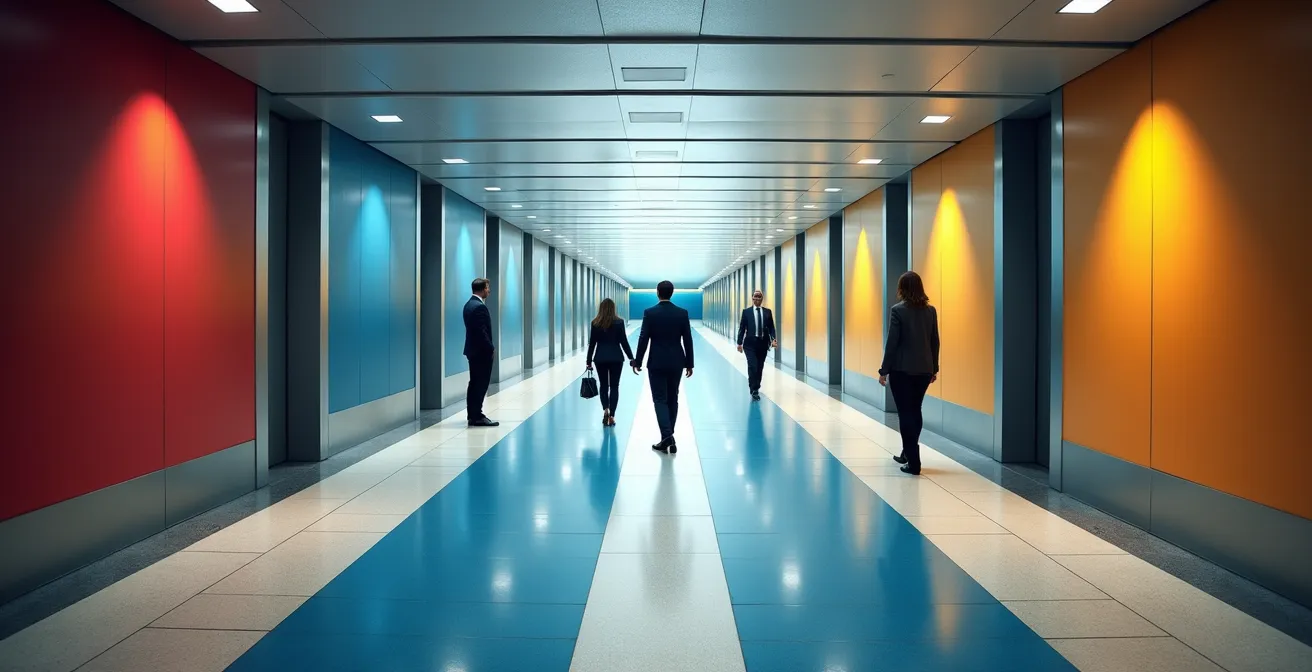
The signage system, like the one pictured, tries to simplify this with colours, but its inconsistency across the more than 70 buildings connected by the PATH makes it an unreliable primary tool. Instead, use building names as your main guideposts. Look for overhead signs pointing to the *next building* on the checkpoint list. If you see signs for “TD Centre” or “Commerce Court” when trying to reach the Eaton Centre from Union, you’ve gone too far east and need to backtrack. This checkpoint method turns a stressful maze into a manageable, linear sequence.
Once you conquer this specific route, you’ll have the confidence and mental model to tackle any other destination within the underground network.
Scotia Plaza vs. First Canadian Place: Which PATH Hub Is Less Chaotic?
Not all parts of the PATH are created equal. The system is a network of quiet, transitional “flow arteries” punctuated by massive, high-traffic “chaotic hubs.” Understanding the difference is key to a stress-free journey. Two of the biggest hubs are Scotia Plaza and First Canadian Place (FCP). While both are packed with some of the 200,000+ daily commuters, their brand of chaos is entirely different, and choosing the right one depends on the time of day and your objective.
First Canadian Place is the undisputed king of lunchtime chaos. Its massive food court acts as a gravitational centre for the entire western half of the Financial District. Between 12:00 PM and 1:30 PM, it’s a frantic sea of people, and navigating it is nearly impossible. However, during the morning rush, its wider concourse does a better job of dispersing crowds than Scotia Plaza. Scotia Plaza, by contrast, has a major bottleneck at its escalators connecting to the subway, making the 8:00-9:00 AM period intensely chaotic. Yet, its limited food options mean it’s significantly calmer during lunch.
This table breaks down the chaos levels, showing that the “less chaotic” hub is entirely situational. A savvy PATH Runner uses this knowledge to their advantage, cutting through Scotia Plaza during lunch and FCP in the early morning or late afternoon.
| Time Period | Scotia Plaza | First Canadian Place |
|---|---|---|
| Morning Rush (8:00-9:00 AM) | High chaos – escalator bottleneck to subway | Moderate – wider concourse disperses crowds |
| Lunch Hour (12:00-1:30 PM) | Moderate – limited food options | High chaos – massive food court crowds |
| Evening (after 6:00 PM) | Ghost town – most sections closed | Some activity – retail stays open longer |
| Weekends | Nearly empty | Moderate activity – retail and food court open |
As this comparative analysis shows, there is no single “best” hub. After 6:00 PM and on weekends, many sections of the PATH, particularly around Scotia Plaza and Commerce Court, become ghost towns with locked doors. FCP generally maintains more activity due to its larger retail presence. The answer to “which is less chaotic” is always: it depends on when you’re there.
By treating these hubs as obstacles to be timed correctly, you transform your commute from a reactive struggle into a proactive, strategic exercise.
The Navigation Error That Traps You in a Dead-End Office Tower
It’s the most common and frustrating mistake in the PATH: The “Tower Trap.” You’re following signs, feeling confident, and you take a turn into a quiet, carpeted hallway. Suddenly, the public-facing signage disappears, replaced by corporate logos. The hallway ends at a set of frosted glass doors that require a keycard for access. You’ve been lured into the private, street-level lobby of an office tower with no way out. This happens because the PATH seamlessly blends public thoroughfares with private building access points, and the signage doesn’t always make the distinction clear.
The key to avoiding the Tower Trap is to develop an eye for “exit signs” versus “destination signs.” A destination sign might say “First Canadian Place” with an arrow, but an exit sign will have a small, generic “Exit to Street” symbol. If you only see corporate branding and no generic PATH or directional symbols, you are likely walking into a trap. These are not through-routes. They are designed to bring employees into their building, not to help you get to the next one. After 6 PM, this becomes even more perilous as more of these secondary doors lock automatically.
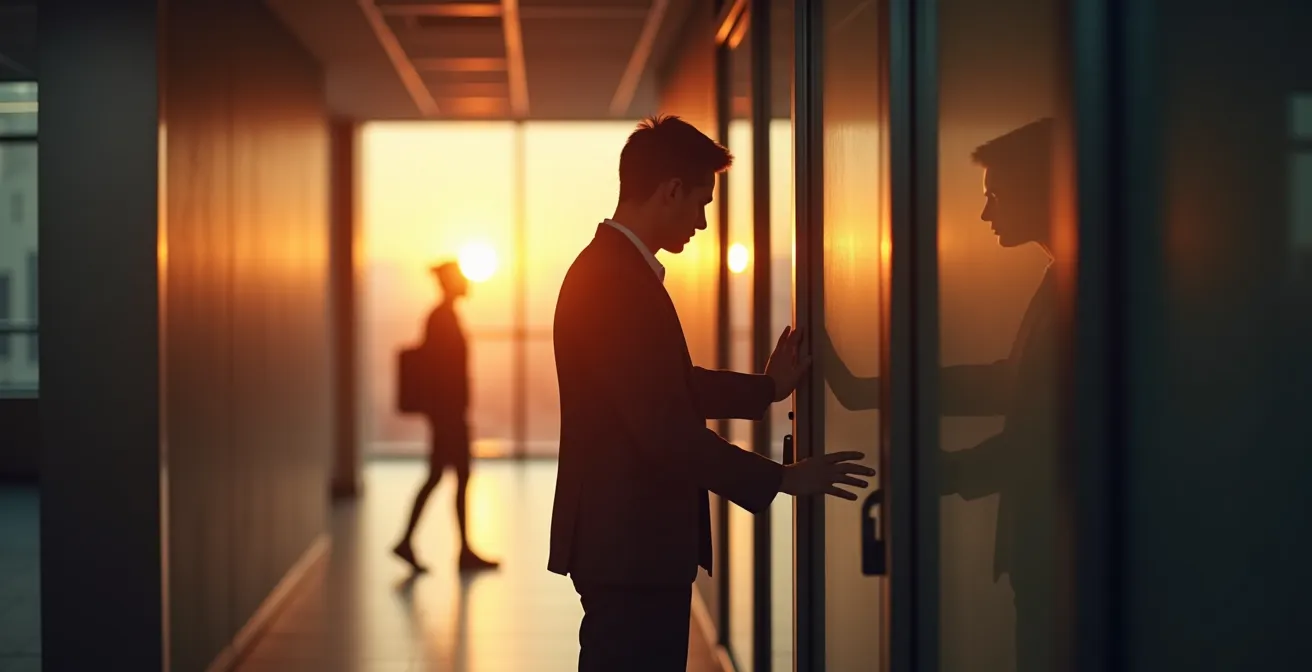
When you find yourself at a dead end like the one pictured, with no escape, panic is the worst response. You are not the first person this has happened to, and every building has a protocol. The goal is to get the attention of building security so they can let you out onto the street. Do not try to wander further into the building; backtrack immediately. If you can’t, follow a clear plan to get help.
Your Action Plan for Escaping a PATH Dead End
- Stay Calm: First, don’t panic. This is a common occurrence, and there’s always a way out.
- Locate Intercoms: Look for building security intercoms, typically located near elevator banks or locked doors.
- Use the Right Phrase: Press the button and clearly state, “I’m a pedestrian stuck on the PATH level, can you please let me out onto the street?”
- Backtrack if Possible: If there’s no intercom, retrace your steps immediately before more doors lock behind you.
- Find Security Numbers: As a last resort, look for building security phone numbers posted on small signs near fire exits or service doors.
Recognizing the subtle visual cues of a Tower Trap is a skill that separates the novice from the PATH Runner, turning a potential 20-minute delay into a non-issue.
When to Use the PATH as a Climate-Controlled Gym for Walking?
Beyond commuting, the PATH’s greatest untapped potential is as a massive, climate-controlled gym. When it’s -20°C in winter or a sweltering 35°C in summer, the idea of an outdoor walk is daunting. The PATH offers a consistent, weather-proof environment perfect for getting your daily steps in. With a network spanning nearly 30 kilometers, you can easily design a 5k or 10k walking loop without ever stepping outside or getting bored of the scenery.
The key is timing. Using the PATH for exercise during the morning or lunch rush is a recipe for frustration. However, during specific off-peak windows, the corridors are surprisingly empty. Based on the experience of fitness walkers, the optimal times are between 10:00 AM and 11:30 AM (after the morning commute) and from 2:00 PM to 4:00 PM (before the evening rush). During these periods, you have long stretches of the network almost to yourself, allowing you to maintain a brisk, uninterrupted pace.
A popular and effective walking circuit starts at Union Station’s south end (Scotiabank Arena), heads north through the main artery, loops east through the architecturally stunning Brookfield Place, continues north to FCP, and then returns south via the quieter tunnels under the Richmond-Adelaide Centre. This loop covers a significant portion of the Financial District and offers a mix of wide-open spaces and narrower corridors. A fascinating detail is that many core sections of the PATH remain open very late, with some connections accessible until 1:20 AM, making it a viable option for late-night walkers who prioritize safety and a controlled environment over outdoor ambiance.
This isn’t just a short stroll; the PATH’s retail component alone is immense. Thinking about the sheer scale of the network, with retail space spanning a massive area, gives you an idea of the distances you can cover. This transforms the PATH from a simple convenience into a valuable health and wellness tool for downtown residents and workers.
By understanding the system’s daily rhythms, you can unlock a free, accessible, and weather-proof fitness facility right in the heart of the city.
How to Find Healthy Lunch Spots Under $15 CAD in the PATH?
Finding a healthy, affordable lunch in the PATH feels like a quest for the Holy Grail, but it’s entirely possible if you ignore the flashy chain restaurants and think like a hunter-gatherer. The main food courts are designed for high-margin, “build-your-own” bowls that quickly escalate past $20. The secret to eating well for under $15 lies in two places: grocery store hot tables and the smaller, independent vendors tucked away in less-trafficked corridors.
Your first and best strategy is to target the grocery stores within the PATH. Longo’s at First Canadian Place and McEwan at TD Centre are gold mines. Instead of buying a pre-made meal, go to their hot tables or salad bars. You can assemble a balanced meal of protein and vegetables and pay by weight, giving you complete control over the portion size and final cost. A hearty, healthy plate often comes in between $12 and $14. The key is to visit during off-peak hours (before 11:45 AM or after 1:45 PM) to avoid the lines and get the freshest selection.
Your second strategy involves location arbitrage. Food courts are not priced equally. The main hubs at Union Station, the TD Centre, and First Canadian Place have the highest prices. Head to the quieter food courts in places like Commerce Court or the Metro Centre. Here, independent vendors have lower overhead and offer more competitive pricing. You can often find daily specials—like a soup and sandwich combo or a set rice bowl—for under $15, including tax. To maximize savings:
- Always choose the pre-set daily special over a customizable option; it’s almost always cheaper.
- Skip the $3 bottled water or soda and use the free water-filling stations located at the end of every food court.
- If your schedule is flexible, shop for prepared foods after 2:00 PM, when some vendors mark down items to clear them out.
By applying these simple rules, you can enjoy a healthy and satisfying lunch without feeling the financial sting of the PATH’s “convenience tax.”
When to Use the GO Train Instead of the Subway for Downtown Travel?
For many, the TTC subway is the default choice for moving around downtown. However, for a PATH Runner, the GO Train network originating from Union Station is a powerful and often superior tool for specific north-south movements, especially when combined with a PRESTO card. The decision to use GO versus the TTC isn’t about which is “better,” but which is smarter for your specific destination and circumstances. The dividing line is simple: Front Street.
If your destination is south of Front Street, the GO Train system is almost always the superior choice. This includes key locations like Scotiabank Arena, the Convention Centre, and the new CIBC Square towers. The GO concourses at Union Station are newer, wider, and significantly less crowded than the chaotic TTC subway entrance. They offer direct, climate-controlled access to these southern destinations without the bottlenecks and stairways of the subway. For anyone with accessibility needs, the modern ramps and spacious halls of the GO area are a massive advantage.
Here’s a quick decision guide:
- Choose the GO Train concourses for any destination south of Front Street or when you need a more accessible, less crowded path.
- Choose the TTC subway for any destination north of Front Street, as it provides a more direct underground route to hubs like First Canadian Place and the Eaton Centre.
- Leverage PRESTO fare integration. If your journey involves a GO trip into Union, your connecting TTC trip is often free or discounted, making a short subway ride from Union a cost-effective option.
- During extreme weather, the GO concourses can be a calmer, more controlled environment than the often-overwhelmed subway platforms.
Thinking of the GO and TTC systems as two different tools in your toolkit allows for more efficient travel. The GO network is a surgical instrument for southern destinations, while the subway is a broadsword for covering the northern part of the downtown core.
By making the right choice at Union Station, you can save valuable time and avoid unnecessary stress, truly optimizing your downtown travel.
Key Takeaways
- Mastering the PATH is about understanding its flow and timing, not memorizing maps.
- Avoid peak hours (12:00-1:30 PM) in major food courts like First Canadian Place to save time and money.
- The most reliable way to navigate is by following a sequence of building checkpoints, not the inconsistent color-coded signs.
- Recognize “Tower Traps” (hallways with only corporate logos) to avoid getting stuck in private office lobbies with no exit.
How to Survive the Financial District Lifestyle on a Junior Salary?
Surviving—and thriving—in Toronto’s Financial District on a junior salary is less about earning more and more about mastering the art of strategic inconvenience. The entire PATH ecosystem is a finely tuned machine designed to extract money from you in exchange for convenience. A coffee here, a quick lunch there, a forgotten item bought at a premium—these small, seemingly harmless transactions can accumulate with frightening speed. As one analysis of young professionals’ spending habits revealed, daily PATH convenience purchases can easily add over $1,000 to monthly expenses.
The fundamental mindset shift is to consciously assign a value to your time and decide when a 10-minute walk outside is worth saving $15. This means establishing clear, personal rules. For example: “I will only buy lunch in the PATH on Fridays” or “I will never buy coffee underground if the weather is above 5°C.” Without these guardrails, the pull of convenience is too strong. The goal isn’t spartan self-denial; it’s about making deliberate choices instead of defaulting to the easiest, most expensive option.
A critical tactic is to leverage the PATH’s “free” spaces. Instead of buying lunch, pack your own and eat it in a beautiful, public-access area. The Allen Lambert Galleria (the “crystal cathedral” in Brookfield Place) or the peaceful garden court in the TD Centre are fantastic, cost-free alternatives to a noisy food court. This single habit can save you over $300 a month. Surviving the financial pressures of downtown life is a game of inches, won by making dozens of small, smart decisions that prioritize your long-term financial health over short-term convenience.
By combining this financial discipline with the navigational and tactical skills covered earlier, you transform from a victim of the underground city into its master. Evaluate your daily habits today and start implementing these strategies to reclaim control of both your time and your budget.