The key to finding a productive sanctuary in Toronto isn’t about stumbling upon a “hidden gem,” but about intentionally curating your solitude in a laneway café.
- High prices are not a bug but a feature, reflecting the “economics of quiet” that filter out casual traffic and support a premium, focused environment.
- The difficulty in finding these spots acts as a natural barrier, preserving them for those who value the deep work ritual over convenience.
Recommendation: Treat the search for a laneway café as the first step of your deep work session—plan your visit, embrace the connectivity trade-offs, and invest in a space designed for focus.
For the freelancer or introvert in Toronto, the city hums with a relentless energy. The open-plan offices, the bustling chain coffee shops, the constant chatter on main avenues—it all conspires against the one thing you crave most: a pocket of uninterrupted silence to do your best work. The common advice is to find a library or a coworking space, but these often come with their own set of rules and distractions. You’ve probably heard whispers of “hidden gems,” those tiny cafés tucked away from the main streets, promising a quiet refuge. But the search often feels like a gamble, a frustrating wander through unfamiliar alleys.
Most guides will give you a simple list of addresses, focusing on the basics like Wi-Fi and outlet availability. They treat the problem as purely logistical. But what if the true value of these places isn’t just their location, but the entire philosophy behind them? What if the friction of finding them is part of their magic? This guide reframes the search. We won’t just tell you where to go; we’ll explore the mindset required to thrive in these spaces. The key to unlocking deep focus in Toronto lies not in finding a quiet café by accident, but in understanding the art of curating your solitude.
We’ll deconstruct why that espresso costs what it does, transform the hunt into a productive ritual, and weigh the very real trade-offs of working in these urban sanctuaries. This is your strategy for finding focus in the city’s secret spaces.
This article provides a complete roadmap for the urban explorer seeking focus. From understanding the unique economy of these spaces to mastering the art of discovery, you’ll find everything you need to make Toronto’s laneways your new office.
Table of Contents: A Guide to Curating Your Laneway Solitude
- Why Is Your Latte $7 in a Hard-to-Find Alleyway Shop?
- How to Find “The tiny café behind the shop” Without Getting Lost?
- Laneway Coffee vs. Hotel Lobbies: Which Is Better for Working?
- The Connectivity Risk of Working in Concrete Laneway Buildings
- When to Arrive at Tiny Cafés to Guarantee a Table?
- High Park vs. The Junction: Which Neighborhood Suits Creative Freelancers?
- How to Map a Laneway Photo Walk for Golden Hour Lighting?
- How to Explore Toronto’s Hidden Laneways Without Trespassing?
Why Is Your Latte $7 in a Hard-to-Find Alleyway Shop?
That initial sticker shock when you see a $7 latte on the menu of a tiny, hard-to-find café isn’t an anomaly; it’s the core of the business model. This isn’t just coffee; you’re paying for a slice of peace in one of the world’s most expensive cities. This is the economics of quiet. These establishments operate with significantly lower foot traffic than their main-street counterparts, meaning each transaction must carry a higher margin to be viable. It’s a premium justified by the reality of Toronto’s real estate, where a recent report shows that an average of $37.2 per square foot is the asking rent for downtown office space.
Beyond rent, you are investing in a curated experience. Many of these spaces, like the Boxcar Social Laneway, are inspired by the focused atmosphere of Japanese listening bars, where environment and quality are paramount. The price tag supports this meticulous design, the high-grade espresso beans, and a more sustainable employment model. In some cases, that cost directly benefits the person serving you. At Boxcar Social’s laneway location, for instance, a unique flat hierarchy means baristas receive 50% of the profits on top of their wages. This fosters a sense of ownership and uncompromising quality.
So, when you buy that latte, you’re not just getting a drink. You are casting a vote for a different kind of commerce—one that values silence, quality, and fair compensation over high volume and fast turnover. You are paying to keep the space quiet and exclusive for those who, like you, truly need it.
How to Find “The tiny café behind the shop” Without Getting Lost?
The search for a true laneway café is a ritual in itself, an intentional act that filters out the uncommitted. This friction of discovery is a feature, not a bug. Forget stumbling upon these places; finding them requires a plan. Your primary tools are a combination of hyper-local blogs, Instagram geo-tags, and a healthy dose of urban curiosity. Start with specific search terms like “hidden café The Junction” or “laneway coffee Queen West” to narrow your focus.
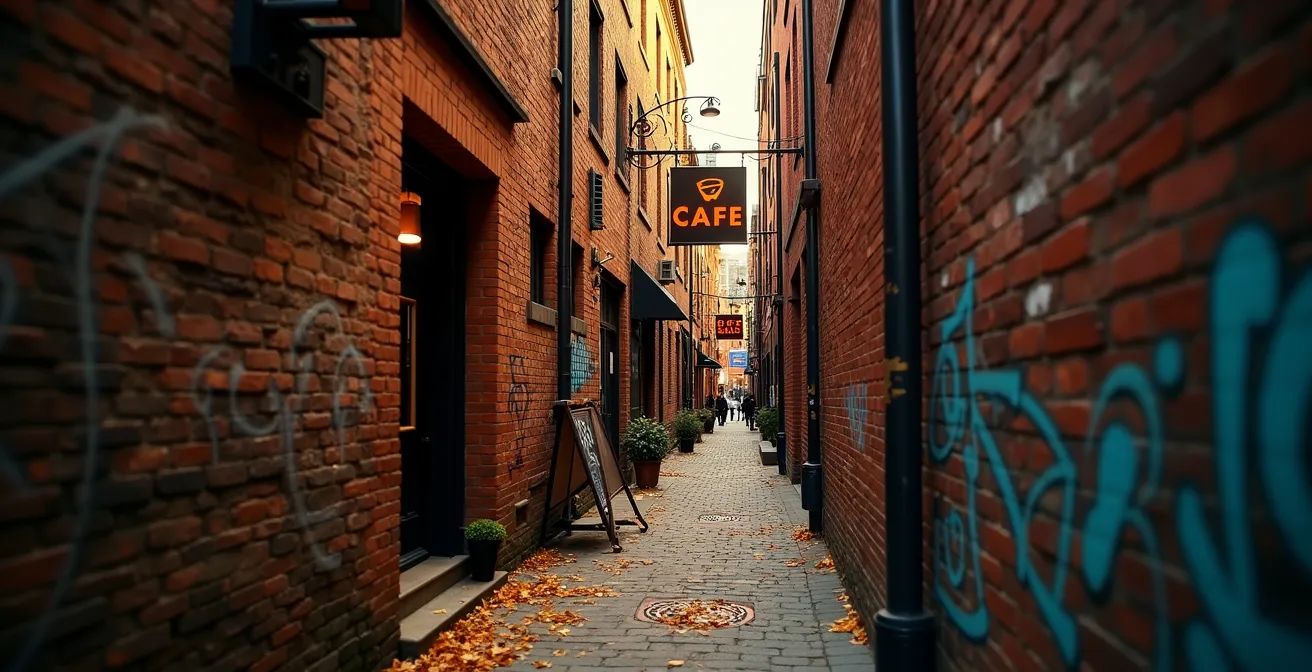
Once you have a target, like the Boxcar Social Laneway near Bathurst and College, switch to satellite view on your map application. Look for the tell-tale signs: an unmarked alley, a break between buildings, or a path leading behind a main storefront. For example, to find this specific spot, you’d navigate to 298 Markham Street and then look west for the graffiti-lined alleyway that serves as its entrance. It feels like a secret, because it is.

As the image above illustrates, the journey can be part of the atmosphere, especially as evening falls. Embrace the feeling of being an urban explorer. Pay attention to the textures of the city you normally miss: the worn brick, the sanctioned street art, the distant glow of a warm light at the end of a dark path. This deliberate navigation primes your brain for the focused work to come. You’ve earned your seat, and the solitude feels all the more valuable for it.
Laneway Coffee vs. Hotel Lobbies: Which Is Better for Working?
As a freelancer, you have options for quiet workspaces. Besides laneway cafés, the modern hotel lobby has emerged as a popular alternative. Both offer a refuge from the typical coffee shop buzz, but they cater to fundamentally different needs and mindsets. The choice between them depends entirely on the kind of work you need to accomplish and the atmosphere you require to do it.
A laneway café is an intimate, creative cocoon. The limited seating and hushed tones create an environment of shared, unspoken purpose. It’s a space for deep, creative thinking, writing, or conceptualizing. As Boxcar Social founder John Baker noted in an interview with blogTO, “Being tucked away in the alley makes it a slower, more intimate space.” This is its greatest strength and its primary limitation. It’s ideal for a focused 2-3 hour session, but the social pressure to free up a table can be a factor.
Hotel lobbies, in contrast, are built for transient professionalism. They offer anonymity, excellent amenities, and the social permission to stay for extended periods. The atmosphere is more corporate and less intimate, making it better suited for administrative tasks, long calls, or marathon work sessions. The trade-off is a higher cost and a less personal, less inspiring environment.
The following table breaks down the core differences, based on insights from local observers who have frequented both.
This comparison, based on a recent analysis of Toronto’s alternative work environments, helps clarify the decision.
| Factor | Laneway Cafés | Hotel Lobbies |
|---|---|---|
| Atmosphere | Slower, more intimate space | Professional, business-oriented |
| Seating Capacity | Limited (15-30 seats) | Extensive (50+ seats) |
| WiFi Reliability | Variable (check reviews first) | Generally excellent |
| Average Cost | $7-9 per drink | $10-15 per drink |
| Work Duration Comfort | 2-3 hours optimal | 4+ hours acceptable |
The Connectivity Risk of Working in Concrete Laneway Buildings
Embracing the laneway café as your office means accepting the connectivity gamble. These havens of quiet are often nestled in old brick and concrete buildings, materials notorious for blocking cellular signals. While many offer Wi-Fi, its reliability can be inconsistent, a stark contrast to the high standards of commercial spaces where over 90% of downtown properties boast high-speed internet. For a digital nomad, a dropped connection can derail an entire afternoon.
However, this perceived weakness can be reframed as a strength. In an always-on world, the enforced disconnect can be a powerful tool for deep focus. If your task for the day is writing, editing, or creative thinking that doesn’t require an internet connection, a spotty signal is a blessing in disguise. It removes the temptation of social media, email, and endless notifications, forcing you to engage fully with the task at hand. It’s an opportunity to practice true, uninterrupted deep work.
Of course, for tasks that demand a stable connection, this gamble is a serious risk. The key is to be strategic and prepared. Before you commit to a long trek, you must do your due diligence. Mitigating the connectivity risk is a non-negotiable part of the laneway work ritual.
Your Pre-Visit Connectivity Checklist
- Check recent Google Reviews for specific mentions of “Wi-Fi” or “internet” stability before you leave.
- Test your cellular data signal immediately upon entering the laneway, before you even go inside the café.
- Ask the barista directly about Wi-Fi stability and speed upon ordering. They know the reality of their connection.
- Always bring offline work as a backup. Have a document to write in or a book to read if connectivity fails.
- Consider visiting during off-peak hours (mid-mornings, mid-afternoons) for potentially better bandwidth as fewer people are connected.
When to Arrive at Tiny Cafés to Guarantee a Table?
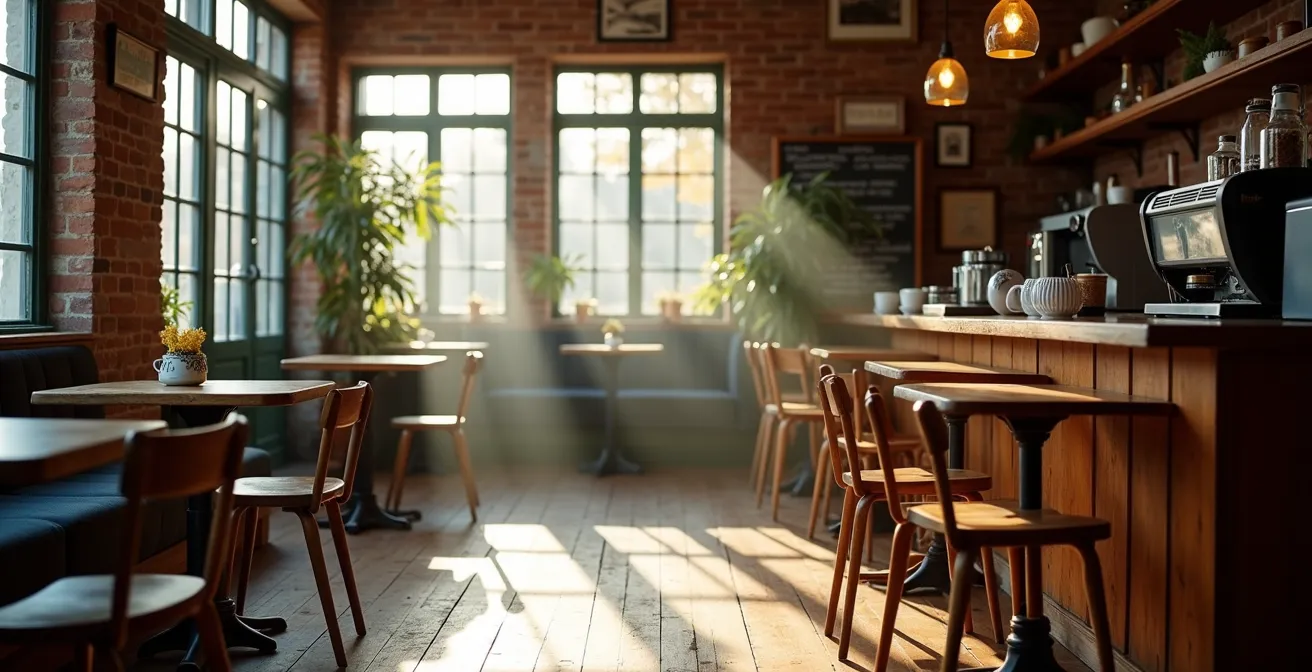
In a café with only a handful of tables, timing isn’t just a suggestion—it’s everything. The quiet solitude you seek is a finite resource, and securing your spot requires a strategic approach. The goal is to arrive just as the initial morning rush subsides or well before the afternoon wave begins. This maximizes your chance of finding an empty table and minimizes the social pressure of seeing others waiting.
Based on observations of popular but hidden spots, the golden window for freelancers is typically between 9:30 AM and 11:30 AM on a weekday. The early birds have had their caffeine fix and are off to their offices, and the lunch crowd has yet to arrive. Another prime time is the mid-afternoon lull, roughly from 2:00 PM to 4:00 PM, although you risk encountering the post-class student rush near university-adjacent neighborhoods. Weekends are a different beast entirely; your only real shot at a quiet table is to arrive within the first 30 minutes of opening.
Before you even head out, leverage technology. Use the “Popular Times” feature on Google Maps to get a live or predictive snapshot of how busy a café is. This simple check can save you a wasted trip. As one laneway café owner mentioned, it can take months for a truly hidden spot to be discovered by the masses. Your mission is to become a regular before everyone else does, and mastering the art of arrival is the best way to do it.
High Park vs. The Junction: Which Neighborhood Suits Creative Freelancers?
Choosing a neighborhood to work from is as important as choosing the café itself. The vibe of the area seeps into its workspaces, influencing your creative energy. For freelancers in Toronto’s west end, two neighborhoods offer distinct but equally appealing atmospheres: the nature-infused calm of High Park and the industrial-chic buzz of The Junction. Your choice depends on the kind of creative stimulation you seek.
High Park offers a quieter, more contemplative environment. The cafés are more spread out, often serving as jumping-off points for walks through the park. The creative community here is more solitary, inspired by the surrounding nature. It’s the perfect setting for a writer, a poet, or anyone whose work benefits from peaceful reflection. The pace is slower, and so is the café culture. It’s less about networking and more about quiet introspection.
The Junction, by contrast, is a hub of collaborative energy. Its history as an industrial center has given way to a dense ecosystem of art studios, design shops, and high-concept cafés. The area boasts a higher concentration of coffee shops, including innovative spots like the Boxcar Social Laneway, making it a prime destination for “café-hopping” work sessions. The creative community is more visible and collaborative, making it ideal for designers, entrepreneurs, and anyone who thrives on ambient energy and the potential for spontaneous connection. This vibrant scene is supported by excellent transit access via the Dundas West subway station.
This comparative data, drawn from a local Toronto rent and lifestyle report, highlights the practical differences for a working freelancer.
| Factor | High Park | The Junction |
|---|---|---|
| Average Coffee Price | $5-6 | $6-7 |
| Café Density | Lower (spread out) | Higher (concentrated) |
| Creative Community | Nature-inspired, quieter | Industrial-chic, collaborative |
| Transit Access | Subway line but spread out | Highly accessible via Dundas West subway |
| Working Lunch Cost | $15-18 | $18-22 |
How to Map a Laneway Photo Walk for Golden Hour Lighting?
The appeal of Toronto’s laneways extends beyond quiet workspaces; they are also a canvas for urban photographers. The same qualities that make them great for focus—seclusion, unique textures, and dramatic lighting—also make them perfect for photography. Planning a photo walk through these alleys, especially during the golden hour, can be a profoundly creative exercise, a way to see the city’s hidden geometry.
The key to a successful laneway photo walk is to understand how light interacts with the narrow spaces. Your route and timing must be deliberate. For east-west running laneways, like the famous Graffiti Alley in the Fashion District, the best light occurs in the early morning and late afternoon when the sun is low, casting long, dramatic shadows and illuminating the vibrant murals. North-south alleys, on the other hand, are best shot around midday when the sun is high enough to penetrate the narrow corridor without being blocked entirely by buildings.
A classic golden hour route through the west end could start in the laneways around Ossington Avenue about 90 minutes before sunset. As the sun begins to drop, you can move towards Graffiti Alley to capture the warm light hitting the expansive murals. Finally, as the golden hour fades into the blue hour, the alleys around Portland Street offer fantastic opportunities to play with the mix of ambient twilight and the artificial glow from windows and streetlights. It’s in these spaces that you’ll find what local explorers call a “palimpsest of Toronto history”—old coach houses and garages adorned with impressive art.
Key Takeaways
- The high price of a laneway café latte is a feature, not a flaw, funding the quiet, low-traffic environment essential for deep work.
- Finding these hidden spots is a “friction of discovery” that acts as a natural filter, preserving their solitude for the dedicated.
- Always have a backup plan for connectivity; the same concrete walls that ensure quiet can also block digital signals.
How to Explore Toronto’s Hidden Laneways Without Trespassing?
The final piece of the laneway puzzle is exploration etiquette. The line between a public thoroughfare and private property can be blurry in these back passages. To be a responsible urban explorer, you must learn to read the signs—both literal and implicit—to ensure your quest for solitude or the perfect photo doesn’t become an act of trespassing.
Your safest bet is to stick to named laneways that appear on city maps or those featuring sanctioned public art. The presence of StreetARToronto (StART) murals is a strong indicator of public access, as these projects are commissioned to revitalize public spaces. Laneways like Croft Street, known for its length and architectural diversity, are explicitly public and ripe for exploration. As a guide from a local publication on Toronto’s secret laneways points out, these public corridors are where you’ll find impressive murals and fine contemporary laneway houses.
Conversely, exercise extreme caution with unmarked alleys. Be vigilant for “Private Parking” or “No Trespassing” signs. A dead-end alley that terminates at residential garage doors is almost certainly private property. The goal is to be a respectful observer, not an intruder. By staying on public land, you not only avoid legal trouble but also help maintain a positive relationship between explorers and the residents who live and work along these hidden arteries. Responsible exploration ensures these unique urban spaces remain accessible and appreciated by all.
Your personal map of Toronto’s quiet corners awaits. Start by picking one neighborhood, plan your timing, and embark on the hunt. The perfect espresso in a silent room is your reward for a journey well-planned.