
In summary:
- Unlock Toronto’s most authentic food by learning the unwritten rules of its suburban strip malls, where flavour trumps decor.
- Master practical skills like navigating cash-only restaurants, ordering from non-English menus, and calibrating your spice expectations.
- Understand that a restaurant’s location and business practices are clues to its authenticity, often tied to specific immigrant histories.
- Focus on weekday lunch hours for the best value and follow sensory cues, like the sight of an oil drum grill, to find hidden gems.
For many, Toronto’s food scene is defined by the polished, high-rent restaurants of King West or the historic charm of the St. Lawrence Market. But the true culinary heart of the city beats in a different setting entirely: the humble suburban strip mall. Across Scarborough, North York, and Etobicoke, these unassuming plazas—many of which are part of the 400+ strip plazas developed between the 1950s and 1980s—are living museums of global cuisine. They house restaurants where recipes are measured in generations, not grams, and success is built on community reputation, not flashy marketing.
The common advice is to “be adventurous,” but that’s not a strategy. It doesn’t help you when the menu is in a different script, the only accepted payment is cash, or the “medium” spice level feels like a volcanic eruption. These are not obstacles; they are codes. And learning to crack them is the key to unlocking an entire world of flavour that most of the city misses. This isn’t just about finding good food; it’s about understanding the economic and cultural systems that protect its authenticity.
Instead of just giving you a list of places to visit, this guide will equip you with the practical knowledge of a seasoned food scout. We’ll explore the logic behind cash-only establishments, the art of ordering without a common language, the crucial differences between regional cuisines like Hakka and Cantonese, and how to eat your way around the world without breaking the bank. Get ready to leave the downtown core behind and discover where Toronto’s real flavour lives.
Summary: Your Field Guide to Toronto’s Strip Mall Cuisine
- Why Do the Best Dim Sum Spots Only Accept Cash?
- How to Order from a Menu That Isn’t in English?
- Hakka vs. Cantonese: What is the Difference in Toronto Chinese Food?
- The “Medium Spice” Mistake That Burns Unprepared Diners
- When to Visit Strip Mall Joints for the Best Lunch Combos?
- Etobicoke vs. Scarborough: Which Suburb Has Better Subway Access?
- How to Find the Best Caribbean Street Food in Scarborough Strip Malls?
- How to Eat Your Way Around the World in Toronto for Under $20 CAD?
Why Do the Best Dim Sum Spots Only Accept Cash?
Walking into a bustling dim sum restaurant in Scarborough or Markham and seeing a “Cash Only” sign can feel like a barrier. But for a food scout, it’s the opposite: it’s often the first signal of authenticity. This practice isn’t about inconvenience; it’s a window into the economic archaeology of first-generation immigrant businesses. By avoiding credit card processing fees (which can be 2-3% of every transaction), these family-run spots can keep their overheads razor-thin. This allows them to focus their resources where it matters most: on high-quality ingredients and traditional cooking techniques.
The cash-only model is a relic of a business ecosystem built on trust, community, and volume. The goal isn’t to cater to the occasional visitor but to serve the local community that comes day in and day out. As a result, you’ll find that while cash is king, some places might accept Visa or Mastercard for larger orders, often with a minimum purchase of $20. However, don’t expect to use tap-to-pay or mobile wallets like Apple Pay. It’s a smart practice to always carry cash and a physical card as a backup. Also, be prepared for small, cash-only fees that might not be on the main menu, such as the common $1 per person tea service charge.
Ultimately, treating the cash-only rule as a feature, not a bug, reframes the entire experience. It’s a small price to pay for access to recipes and an atmosphere that haven’t been diluted by the pressures of modern, high-margin restaurant economics. It’s a sign that the priority is the food on the plate, not the payment terminal.
How to Order from a Menu That Isn’t in English?
The second great filter for many food adventurers is a menu they can’t read. Staring at a wall of characters in a language you don’t understand can be intimidating. But again, this is a clue. A menu that hasn’t been fully translated often means the restaurant’s primary audience is the local community, a strong indicator that the flavours haven’t been compromised for a Western palate. The key is to shift from reading to observing. Your eyes become your most important tool in a strategy of observational ordering.
Before you even sit down, look at what others are eating. The best dishes are often the most popular. Arriving during peak hours when local families are dining is a prime opportunity to see what’s truly good. Don’t be shy; polite pointing is an accepted and common practice. Point to a steaming plate at a nearby table and gesture to your server. This simple act communicates your interest far more effectively than fumbling with a translation app. Look for handwritten specials on the walls; these are often the freshest or most popular items of the day.
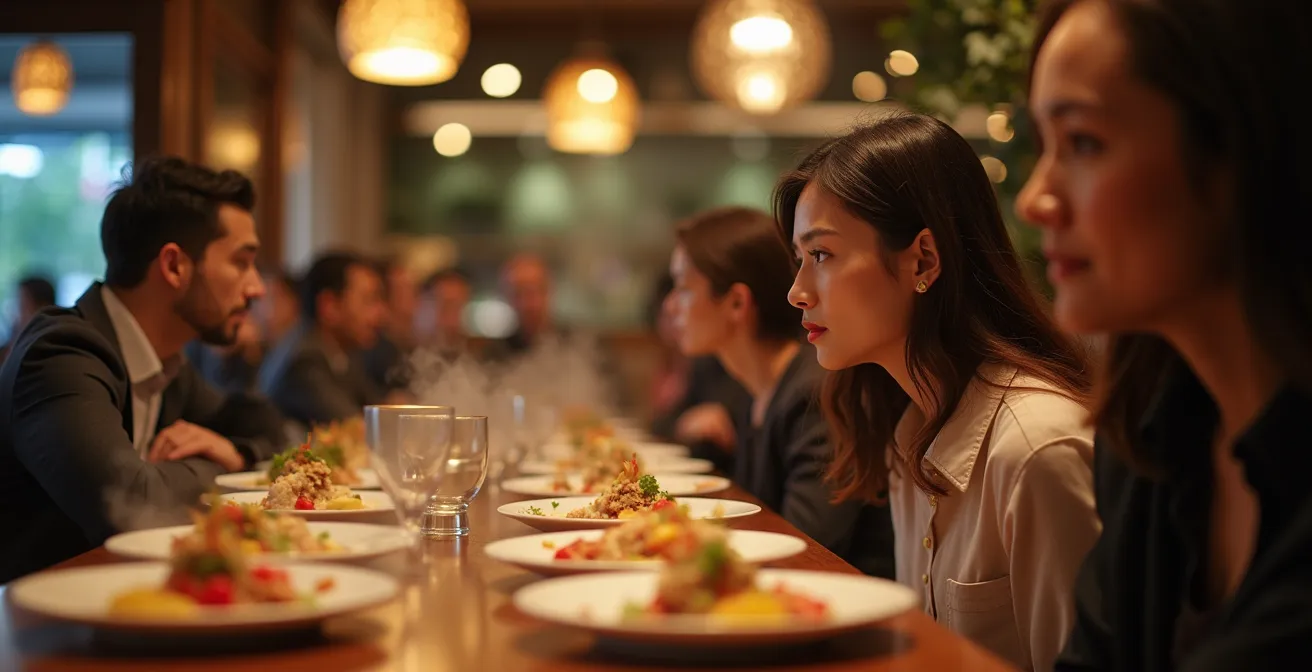
As this scene illustrates, the dining room itself is a living menu. For more tech-savvy approaches, apps like WeChat have a built-in camera function for real-time translation, and specialized Chinese food apps like Dianping or Xiaohongshu can provide reviews and photos of specific dishes. But the most reliable method remains the most human: watch, point, and enjoy the surprise. It’s a skill that turns a potentially stressful situation into an exciting part of the culinary discovery.
Hakka vs. Cantonese: What is the Difference in Toronto Chinese Food?
Saying you’re going for “Chinese food” in Toronto is like saying you’re going for “European food.” The reality is a mosaic of deeply distinct regional cuisines shaped by waves of immigration. Two of the most prominent styles you’ll encounter in Toronto’s suburbs are Cantonese and Hakka, and understanding the difference is crucial. Cantonese cuisine, with its roots in Hong Kong and the Guangdong province, is what many North Americans think of as traditional Chinese food. It emphasizes freshness, subtlety, and the mastery of techniques like steaming and achieving “wok hei”—the prized, smoky essence imparted by a searing hot wok.
Hakka cuisine in Toronto, however, tells a different story of migration. It’s a unique fusion born from the Hakka people’s journey from China to India and then to the Caribbean before arriving in Canada. This style, heavily concentrated in Scarborough and Markham, is bold, spicy, and deeply influenced by Indian spices and cooking methods. The result is a beloved Toronto-specific cuisine with signature dishes like Chilli Chicken and Manchurian Beef, which you won’t find on a traditional Cantonese menu.
This culinary cartography extends beyond Chinese food. As immigrant communities prosper and move, their cuisines evolve. For example, as the New York Times noted, some of the most exciting Sri Lankan food is now found in Ajax, as second and third-generation families have moved east from their initial hubs in Scarborough. Understanding these movements helps you find the most vibrant culinary scenes. To clarify the distinction between Hakka and Cantonese, this table breaks it down.
| Aspect | Cantonese Style | Hakka Style (Toronto) |
|---|---|---|
| Origin | Hong Kong/Guangzhou traditions | Chinese-Indian-Caribbean fusion |
| Key Techniques | Steaming, pursuit of ‘wok hei’ | Deep frying, Indo-Chinese spices |
| Signature Dishes | Dim sum, BBQ pork, steamed fish | Chilli Chicken, Manchurian dishes |
| Flavor Profile | Subtle, fresh, seafood-focused | Spicy, bold, curry influences |
| Toronto Locations | Downtown Chinatown, Richmond Hill | Scarborough, Markham |
The “Medium Spice” Mistake That Burns Unprepared Diners
mixing memory and desire — spring from recipes that were popular in their owners’ home countries decades ago
– New York Times, The Story of Multicultural Canada, Told in Humble Strip Mall Eateries
These decades-old recipes come with their own set of rules, and nowhere is this more apparent than in the realm of spice. One of the most common rookie mistakes is ordering “medium spicy” at a Hakka, Sichuan, or Caribbean restaurant and expecting a gentle warmth. In many of these culinary traditions, “medium” is calibrated for a palate accustomed to daily, intense heat. A Hakka medium can feel like an extra-hot elsewhere, leading to a meal that’s more about survival than enjoyment. This isn’t a mistake by the restaurant; it’s a cultural mistranslation by the diner.
True spice calibration requires a more nuanced vocabulary. It’s essential to understand that not all heat is the same. The numbing, tingling fire of Sichuan málà is completely different from the fruity, sharp burn of a Jamaican Scotch Bonnet pepper or the earthy heat of dried chilies in a South Indian curry. Instead of using generic terms like “medium,” try providing reference points. Saying “a little spicier than a jalapeño” gives the kitchen a much clearer benchmark. A pro-move is to ask for the sauce on the side, allowing you to control the heat level yourself. And always order a cooling accompaniment specific to the cuisine—a Mango Lassi for South Asian food, or a sweet Hong Kong milk tea to cut the heat of a Cantonese chili dish.
Your Action Plan: Heat Level Calibration
- Understand that ‘medium’ varies dramatically between cuisines; a Hakka medium can equal ‘very hot’ elsewhere.
- Differentiate heat types: Sichuan numbing málà vs. Scotch Bonnet’s fruity fire vs. dried chili’s earthy heat.
- Order cooling accompaniments specific to each cuisine: Mango Lassi for South Asian, Hong Kong milk tea for Cantonese.
- Request sauce on the side initially to gauge the heat level before committing.
- Provide reference points when ordering (e.g., “spicier than a jalapeño”) rather than just “medium” for better accuracy.
When to Visit Strip Mall Joints for the Best Lunch Combos?
While dinner offers the full breadth of a restaurant’s menu, the savvy food scout knows that the best value is often found during the weekday lunch rush. This is when strip mall eateries cater to the area’s working population with incredible lunch specials and combos. The prime window for these deals is typically between 11:30 AM and 1:30 PM on weekdays only. During this time, you can often get a substantial, multi-item meal for a fraction of the dinner price. It’s also when the food is at its freshest, as the high turnover ensures ingredients are constantly being replenished.
Be aware that this rhythm changes dramatically on weekends. Most restaurants revert to their full-price dinner menu all day, as they cater more to families and larger groups. However, some dim sum establishments offer “early bird” specials, usually between 9 AM and 11 AM daily, where certain dishes are offered at a reduced price. These deals can be a fantastic way to sample a wide variety, as typical dim sum pricing in Toronto ranges from $6-$10 per order, and costs can add up quickly. Another niche to look out for is the “afternoon tea special” at many Hong Kong-style cafes, typically from 3 PM to 5 PM, offering light meals and drinks at a great price.
To make the most of it, plan to arrive just before noon. This allows you to beat the peak lunch line-ups and ensures you get the best selection before popular items run out. Timing your visit isn’t just about saving money; it’s about tapping into the daily rhythm of the community and experiencing these places at their most vibrant.
Etobicoke vs. Scarborough: Which Suburb Has Better Subway Access?
The question of which suburb has better subway access is a classic Toronto debate. Etobicoke is serviced by the western portion of Line 2, while Scarborough has several stops on the eastern end of the same line, along with the soon-to-be-replaced Line 3 RT. On paper, both offer entry points. However, for a food scout, “access” isn’t just about the nearest subway station. The most authentic culinary clusters are rarely right outside the station doors. True access means understanding how to navigate the bus routes that fan out from these subway hubs into the heart of residential and commercial neighbourhoods.
The real story of Toronto’s suburban food scene is written in its settlement patterns. Immigrant entrepreneurs have revitalized these areas by opening small businesses, creating what one study identified as over 100 ethnic retail clusters in Toronto’s suburbs. These clusters are the destinations you’re looking for. For example, a trip to Lawrence East station in Scarborough puts you within a short bus ride of dozens of Hakka, Filipino, and Sri Lankan restaurants. Similarly, getting off at Kipling station in Etobicoke is just the first step to exploring the Polish and Ukrainian bakeries and delis further south.
Therefore, the “better” suburb is the one whose culinary offerings align with your interests. Scarborough is an undeniable powerhouse for South and East Asian, Caribbean, and Hakka cuisines. Etobicoke offers incredible Eastern European, Somali, and Vietnamese food. The key is to use the subway as your starting point, not your final destination. A TTC day pass and a willingness to hop on a bus are your most valuable tools for this kind of exploration.
How to Find the Best Caribbean Street Food in Scarborough Strip Malls?
Located at the center of the suburban experience is the strip mall. As people of color continue to populate the suburbs, strip malls have taken on new life, becoming places for community building and class and cultural expression.
– Planners Network, A Sense of Place in Toronto’s Inner Suburban Strip Mall
Nowhere is this community expression more vibrant than in the Caribbean food scene in Scarborough. Finding the best spots goes beyond reading online reviews; it requires using all your senses. The single most powerful signal of authentic jerk chicken is an oil drum grill set up in the parking lot, smoke billowing into the air. If you see one, especially around intersections like Eglinton East and Midland, you’re in the right place. The smoke is not just for show; it imparts a crucial layer of flavour that can’t be replicated indoors.
To dig deeper, visit on a Friday or Saturday when many spots offer special weekend soups like Mannish Water or Fish Tea. These are complex, slow-simmered broths that represent a deeper level of culinary tradition. Don’t just stick to jerk, either. Explore the full range of offerings: tender oxtail, rich curry goat, and Trinidadian staples like doubles and roti. It’s worth noting the distinction between Trinidadian roti (often filled with a split pea powder and served with a curry stew) and the plainer, denser Jamaican-style roti.
Finally, don’t underestimate the details. A key indicator of a quality Jamaican patty is the flakiness of the pastry. A truly great patty should shatter slightly when you bite into it. Ask locals or even the vendors themselves; engaging in conversation is part of the experience and can lead you to the best dishes of the day. Sampling from multiple vendors in the same plaza can also reveal subtle but important differences in style and seasoning.
Key Takeaways
- Look beyond decor: Unassuming business practices like “cash only” are often signs of authenticity and a focus on flavour over high margins.
- Become an active observer: Use visual cues from other diners and handwritten wall menus to navigate when you don’t share a common language.
- Understand the history: Recognize that different “Chinese” or “Caribbean” foods tell different stories of migration, resulting in unique fusion cuisines specific to Toronto.
How to Eat Your Way Around the World in Toronto for Under $20 CAD?
The ultimate reward for becoming a suburban food scout is the incredible value. Because these restaurants have lower overheads and cater to a local clientele, you can embark on a global culinary tour for less than the cost of a single downtown entrée. The strategy is to think in terms of snacks and shared plates rather than a single, large meal. A budget of $20 is more than enough to sample multiple cuisines if you know where to look.
Food courts in massive suburban malls like Pacific Mall are a great starting point. You can create a multi-regional meal by grabbing a few items from different stalls. Another effective strategy is a “global snack tour.” You could start with a Portuguese pastel de nata ($3), grab a Balkan burek ($4), and finish with a fresh churro ($3), all from different specialty shops, sometimes within the same plaza. For a more substantial meal, look for by-the-pound buffets at large international grocery stores like Iqbal Halal Foods or Nations Experience, where you can control your portion size and cost precisely.
Sharing is also key. A family-style dim sum meal, especially during early bird hours when dishes can be as low as $4.98, allows a group to sample a dozen different flavours for a very reasonable per-person cost. Pairing a cheap and delicious transit-accessible meal, like a $6 Banh Mi in Long Branch, with a stop for momos in Parkdale on the way home is another classic Toronto food adventure. This approach transforms eating into an act of exploration, where the journey between spots is as much a part of the experience as the food itself.
Now that you have the tools and strategies of a suburban food scout, the next step is to put them into practice. Pick a neighbourhood, set a small budget, and start your own delicious exploration of Toronto’s strip malls.