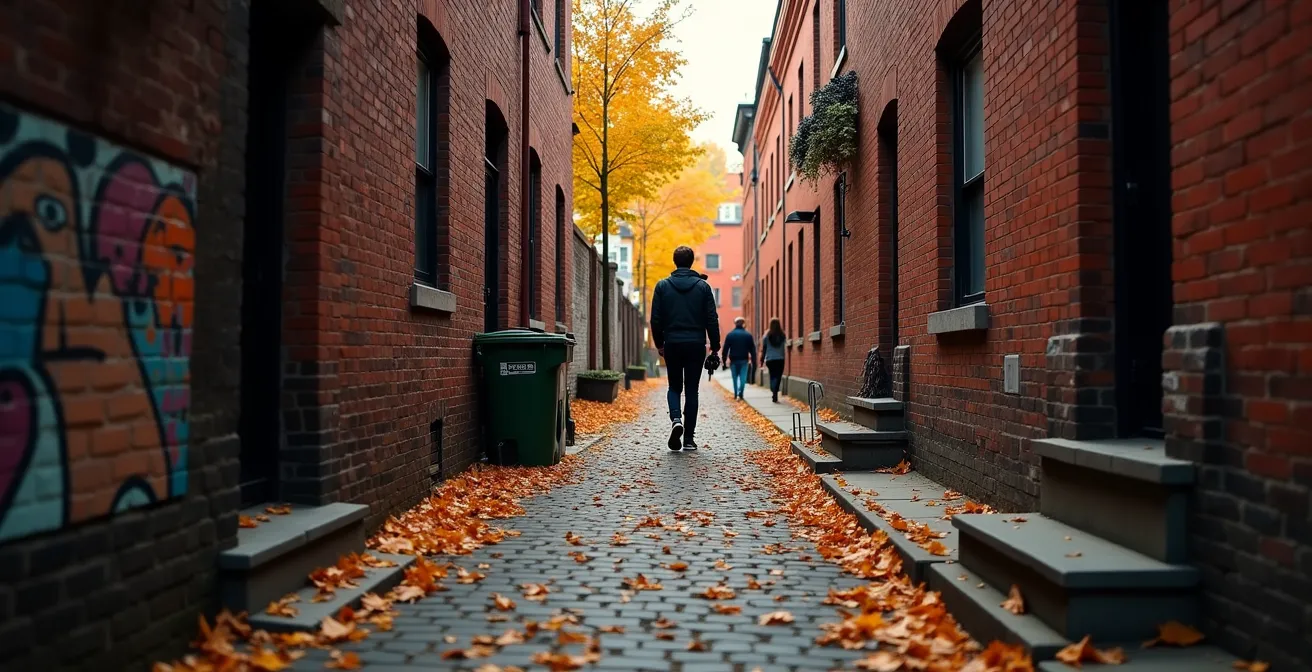
Exploring Toronto’s laneways isn’t about finding a list of ‘secret spots’; it’s about learning to read the city’s hidden history written in cobblestone, brick, and bylaw. This guide provides a framework for urban explorers and photographers to discover the authentic character of areas like Cabbagetown and Leslieville ethically, by understanding the line between public right-of-way and private property. The best photos come not from trespassing, but from understanding the story you’re standing in.
For any urban explorer or photographer in Toronto, the allure of the city’s laneways is magnetic. It’s a promise of discovering a hidden texture, a quiet narrative away from the bustling main streets. While Graffiti Alley offers a vibrant, well-documented experience, the real treasure lies in the residential warrens that evoke the historic grit of the Distillery District. The common advice is often to “just wander” and “be respectful,” but this vague guidance quickly runs into a critical barrier: the fear of trespassing. How do you capture the soul of these spaces without crossing a legal or ethical line?
The solution isn’t found in a simple list of locations. Many articles point you to a few photogenic spots, but they fail to equip you with the knowledge to find your own or to understand what you’re even looking at. They don’t explain the difference between a public thoroughfare and someone’s backyard access, a distinction that is crucial for any ethical explorer. This uncertainty can lead to missed opportunities or, worse, uncomfortable confrontations with residents.
But what if the key to unlocking these hidden spaces wasn’t about being stealthy, but about being knowledgeable? This guide proposes a different approach. We will treat Toronto’s laneways as an urban palimpsest—a canvas of layered history waiting to be read. By understanding the architectural DNA, the historical context, and the unwritten rules of these arteries, you can transform a simple photo walk into a form of urban archaeology. You’ll learn not just where to look, but *how* to see, enabling you to capture profound images while remaining firmly and confidently on public ground.
This article will guide you through the history that shaped these alleys, the techniques to map a perfect photo walk, the subtle etiquette that separates a welcome visitor from an intruder, and the safety protocols for exploring with confidence. Let’s delve into the framework for a more meaningful exploration.
Summary: How to Explore Toronto’s Hidden Laneways Without Trespassing?
- Why Does the East End Have So Many Cobblestone Alleyways?
- How to Map a Laneway Photo Walk for Golden Hour Lighting?
- Leslieville vs. Cabbagetown: Which Laneways Are More Scenic?
- The Etiquette Error That Gets Photographers Chased Out of Laneways
- When to Avoid Laneways to Dodge Mud and Poor Lighting?
- The Safety Risk of Exploring Laneways After Dark
- Why Was Only Half of 54 1/2 St. Patrick Street Demolished?
- How to Respectfully Explore Toronto’s Graffiti Culture?
Why Does the East End Have So Many Cobblestone Alleyways?
The charming, uneven cobblestone surfaces found in many of Toronto’s east-end laneways aren’t just an aesthetic choice; they are a direct historical artifact. Their prevalence is a legacy of the Great Fire of Toronto in 1904, a cataclysmic event that razed a huge portion of the downtown core. In the aftermath, the city implemented stricter building codes to prevent a similar disaster. One of the key mandates was the use of fire-resistant materials, not only for buildings but also for the service lanes behind them.
These laneways were the city’s functional arteries, used for coal delivery, ice transport, and waste removal, often servicing stables and small industrial workshops. According to a study of Toronto’s urban arteries, many of the city’s over 250 kilometres of laneways date back to this post-fire rebuilding period. Cobblestone and brick were chosen for their durability and fire-retardant properties, creating the textured ground that photographers now seek out. This historical context turns a simple photo of a cobblestone path into a story about urban resilience and planning.
Understanding this “why” is the first step in becoming an urban archaeologist. You can actively research the original purpose of a laneway you discover, which adds immense depth to your exploration. By looking for clues like old coach houses, remnant stable doors, or unusually wide industrial paths, you are reading the laneway’s past life. This isn’t just about finding a pretty spot; it’s about connecting with the city’s deep history, a process that can be done entirely from public archives.
Your Action Plan: Researching a Laneway’s History
- Access Toronto Public Library’s digital archives to find historic fire insurance maps.
- Search for Goad’s Atlas of Toronto, which details the original purpose of buildings and laneways.
- Look for historical designations like ‘Livery’, ‘Stables’, or ‘Yard’ on the maps to understand a lane’s original function.
- Compare the narrow Cabbagetown service lanes (designed for coal/ice delivery) with the wider industrial laneways near the Distillery District.
- Walk the laneway yourself to observe how original coach houses, new murals, and contemporary laneway houses create a palimpsest of Toronto history.
How to Map a Laneway Photo Walk for Golden Hour Lighting?
While the “golden hour” is a photographer’s default setting, Toronto’s laneways demand a more sophisticated approach to light. Their narrow, canyon-like structure creates unique lighting challenges and opportunities that a simple sunrise/sunset schedule won’t capture. The key is to move from chasing golden hour to strategic light-mapping, planning your route based on the sun’s angle relative to the laneway’s orientation.
For east-west running lanes, the golden and blue hours are indeed spectacular. The low sun can stream directly down the alley, creating long, dramatic shadows and backlighting subjects beautifully. However, for the more common north-south lanes, the magic happens at different times. High noon, often considered the worst time for photography, can produce stunning geometric shadows as the sun passes directly overhead, casting sharp, abstract patterns from fire escapes and rooflines onto brick walls. Early morning light in tight alleys offers a soft, natural illumination that is perfect for capturing detail without harsh contrast.
Don’t neglect the power of artificial light. During the blue hour, after the sun has set, the warm glow from garage lights and Victorian-era windows creates a cinematic and moody atmosphere. Planning a shoot for this time can yield images with a rich contrast between the cool ambient twilight and the warm interior lights, telling a story of life happening just beyond the public space.
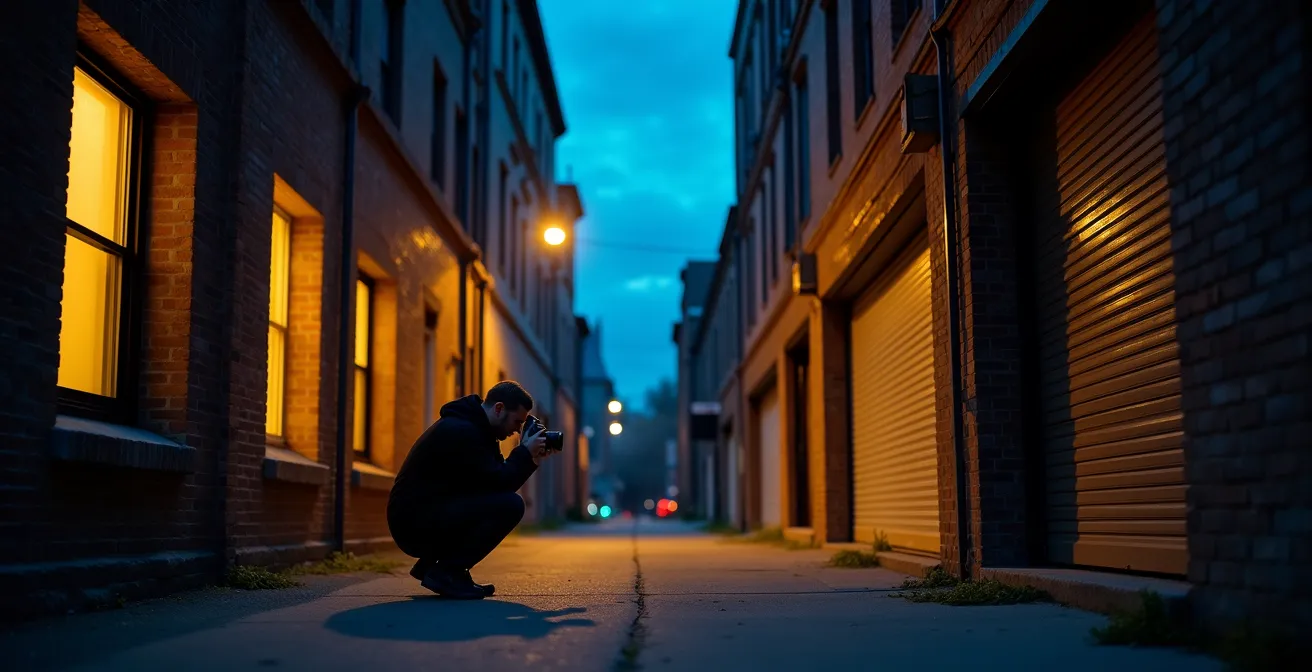
As you can see, the best light isn’t always natural. Apps like PhotoPills or The Photographer’s Ephemeris are invaluable tools for this kind of planning. They allow you to predict exactly when and where the sun will align with a specific laneway, helping you create two distinct routes: a sunrise walk in the East End to catch the first light on Cabbagetown’s red brick, and a sunset walk in the West End for backlit shots in areas like Graffiti Alley.
Leslieville vs. Cabbagetown: Which Laneways Are More Scenic?
Deciding between Leslieville and Cabbagetown for a photo walk is less about which is “better” and more about what kind of story you want to tell. Both neighbourhoods boast some of Toronto’s most captivating laneways, but they offer distinctly different characters. Cabbagetown is an exercise in preservation, while Leslieville is a canvas of community expression.
Cabbagetown’s laneways are steeped in Victorian grit and ghostly charm. Here, you’ll find a higher concentration of preserved coach houses and a palpable sense of historical integrity. The alleys feel quieter, more solitary, offering a glimpse into the 19th-century service corridors they once were. The visual language is one of weathered brick, wrought iron, and a certain elegant decay, making it ideal for photographers seeking texture and historical authenticity. The recent rise of modern laneway houses adds another layer to this urban palimpsest, showing how history adapts.
Leslieville, by contrast, feels more vibrant and lived-in. Its laneways are characterized by eclectic community art, colourful garage doors, and lush, resident-created gardens that spill out into the public right-of-way. It’s a testament to a community actively shaping its environment. The photographic opportunities here are more about colour, personality, and the interaction between residents and their shared space. This evolution is happening city-wide, as evidenced by the over 200 building permit applications for new laneway suites submitted by May 2021, a trend that is rapidly changing the face of these hidden streets.
The following table breaks down the key differences to help you choose your next destination:
| Criteria | Cabbagetown | Leslieville |
|---|---|---|
| Character | Victorian Grit & Ghostly Charm | Eclectic Community & Colour |
| Historical Integrity | Old coach houses, finest contemporary laneway houses, palimpsest of Toronto history | Modern artistic interventions |
| Artistic Expression | Minimal, preserved heritage | Vibrant garage door art, resident installations |
| Greenery & Landscaping | Limited, traditional | Lush resident-created gardens |
| Photographic Quietness | Less foot traffic, more solitude | More community activity |
The Etiquette Error That Gets Photographers Chased Out of Laneways
The single most important factor that separates a welcome explorer from an unwelcome intruder is understanding and respecting the boundary between public and private space. The critical error photographers make is assuming everything visible is fair game. A laneway is a public right-of-way, but the moment your lens points past a gate, over a fence, or into a window, you are crossing a legal and ethical line into someone’s private property. This is the action that most often leads to confrontations.
True laneway etiquette goes beyond this fundamental rule. It involves a set of behaviours that demonstrate your respect for the residents who live there. One key principle is to avoid ‘photographic loitering.’ Instead of setting up a tripod and staying in one spot for an extended period, adopt a ‘shoot and move’ approach. This minimizes your presence and makes you feel less like an intrusion. Another crucial aspect is acoustic courtesy; laneways are echo chambers. Keep your voice low and, if possible, disable the electronic sounds on your camera. This small act shows immense consideration.
Being transparent is also vital. As Toronto street photographer Ravi Maharaj advises, you should never try to hide what you’re doing. His experience confirms that an open and deliberate approach is always better.
Be upfront and deliberate in your approach – don’t hide. Any effort to hide or conceal yourself will signal to your subject that you know you are doing something they might not be comfortable with.
– Ravi Maharaj, Toronto Street Photographer Interview
This confidence comes from knowing you are within your rights. Before you go, check the City of Toronto’s public laneway list to confirm the spaces you plan to visit are indeed public. If a resident does approach you and asks you to stop or delete an image (even if you’re legally in the right), the most respectful and de-escalating action is to comply. Maintaining goodwill is more valuable than any single photograph.
When to Avoid Laneways to Dodge Mud and Poor Lighting?
Just as important as knowing when to go is knowing when to stay away. The same features that make laneways charming—their narrowness, uneven surfaces, and secluded nature—can also make them treacherous or frustrating under certain conditions. Strategic avoidance is a pro-level skill that saves you from wasted trips and potentially hazardous situations.
Weather is the most significant factor. Many of Toronto’s older laneways have poor drainage. Immediately after one of the city’s heavy summer thunderstorms, they can become flooded and muddy, making them impassable and messy. Similarly, the infamous ‘January thaw’ in mid-winter creates a nightmare scenario of slush and treacherous black ice, which is often hidden in the perpetual shade of the narrow alleys. It’s best to give these spaces a day or two to dry out or refreeze.
Beyond weather, logistics play a huge role. Before heading out, check the neighbourhood-specific garbage collection schedule for your target area. Nothing ruins a potentially great shot more than a laneway completely clogged with recycling and garbage bins. Another consideration is local events. If there’s a festival near Trinity Bellwoods Park or a game at the Rogers Centre, nearby laneways often become unofficial—and very busy—parking lots, destroying the quiet, abandoned atmosphere you’re seeking.

However, what some consider “poor” conditions can be reframed as atmospheric lighting. A foggy spring morning or the blue hour during a gentle snowfall can transform a mundane laneway into a moody, cinematic scene. The key is to be intentional. Don’t get caught by bad conditions; choose to embrace them for their unique photographic potential. This mindset shift separates a reactive photographer from a proactive artist.
The Safety Risk of Exploring Laneways After Dark
While the moody glow of blue hour can be alluring, exploring laneways after dark introduces a new set of risks that demand careful consideration. Their isolation, often-poor lighting, and limited escape routes can make them unsafe, particularly if you’re alone. However, this doesn’t mean night photography is off-limits; it simply means you need a structured way to assess and mitigate the risk before you enter.
A professional framework for this is CPTED (Crime Prevention Through Environmental Design). This approach uses simple observational cues to evaluate a space’s safety. Before entering a laneway at night, assess for “natural surveillance”: are there windows overlooking the lane? These “eyes on the street” are a powerful deterrent. Next, check “access control”: is it a dead-end, trapping you, or does it have multiple entry and exit points? Well-maintained lanes with good, functional lighting are always a safer bet than dark, neglected ones.
Risk also varies significantly by neighbourhood. The well-lit laneways in The Annex, increasingly populated with new Laneway Suites, are generally safer than the dark, unmonitored industrial lanes in the Port Lands. When you do go, carry appropriate safety equipment. A headlamp is superior to your phone’s flashlight as it keeps your hands free, and a personal safety alarm can be a valuable deterrent. Interestingly, experts often recommend wearing neutral, dark clothing to avoid drawing unwanted attention, rather than high-visibility gear which can signal you as a target with expensive equipment. The city itself is working to improve conditions, with projects like the Laneways as Bikeways initiative aiming to enhance safety for cyclists and pedestrians alike.
Checklist: CPTED Safety Assessment for Night Photography
- Assess natural surveillance: Look for windows overlooking the lane (‘eyes on the street’).
- Check access control: Identify if it’s a dead-end or has multiple escape routes.
- Evaluate maintenance: Are the lane and lighting well-maintained, indicating regular use and oversight?
- Differentiate risk by neighbourhood: A well-lit Annex lane with homes is safer than an unlit Port Lands industrial lane.
- Carry safety equipment: A headlamp for hands-free lighting and a personal safety alarm are recommended.
Why Was Only Half of 54 1/2 St. Patrick Street Demolished?
The curious case of 54 1/2 St. Patrick Street, where a semi-detached home was literally sheared in half, leaving one side standing, is a dramatic visual. While the specific story involves a complex property dispute, it serves as a perfect, albeit extreme, example of a core phenomenon shaping Toronto’s urban fabric: property assembly and holdouts. This process is a constant, invisible force behind the evolution of the city’s hidden spaces.
Developers looking to build larger projects often need to acquire multiple adjacent lots. This process, known as property assembly, can take years. Sometimes, a single owner will refuse to sell, either due to emotional attachment or as a financial negotiation tactic. This “holdout” property can force developers to build around it, creating the strange architectural juxtapositions we see across the city. The half-demolished house on St. Patrick Street is a ghost of a failed assembly, a monument to a deal that fell through.
This dynamic is at play throughout Toronto’s network of over 2,400 laneways. On streets like Croft Street, you can see the entire history of this evolution. The street features modern townhouses designed by renowned architects built on former industrial sites, right next to older, smaller structures. It’s a physical timeline of development, decay, and rebirth. Understanding this economic and social pressure adds a fascinating layer to your exploration. When you see a sleek modern laneway suite next to a crumbling brick garage, you’re not just seeing two buildings; you’re seeing the outcome of a complex negotiation over land value, heritage, and the future of the city itself.
Key Takeaways
- Ethical exploration hinges on respecting the boundary between public right-of-way and private property.
- The character of Toronto’s laneways is a direct result of historical events like the 1904 fire and ongoing urban development pressures.
- Effective laneway photography requires strategic light-mapping and situational awareness, not just following generic advice.
How to Respectfully Explore Toronto’s Graffiti Culture?
Exploring Toronto’s graffiti culture respectfully requires moving beyond simply taking pictures and toward an appreciation of the art form’s context and codes. The first step is to learn the language. It’s crucial to distinguish between Street Art (often commissioned or permitted murals), Graffiti Art (complex, stylized pieces or “burners”), and Tags (which are primarily about marking territory). Treating them all the same is a common mistake that signals a lack of understanding.
The most important unwritten rule is to respect memorial pieces. If you see “RIP” (Rest in Peace) or dates incorporated into a piece, it’s a tribute to a fallen member of the community. These are sacred spaces, not backdrops for a fashion shoot. Photographing them is generally considered poor form, and defacing them is a grave offense within the culture.
To deepen your exploration, venture beyond the well-trodden path of Graffiti Alley. Spaces like Underpass Park, located beneath the Eastern Avenue bridge, offer a completely different aesthetic and a curated collection of street art in a unique architectural setting. When you photograph any work, the most respectful practice is to focus on the art itself. If the artist’s name is visible, credit them when you post the image online. This simple act of recognition shows respect for their skill and effort. If you are lucky enough to encounter an artist at work, always ask for permission before taking their photo—it’s their creative space, and your courtesy will be appreciated.
By shifting your perspective from that of a tourist to that of an urban archaeologist, you unlock a much deeper, more rewarding way to experience Toronto. You move beyond taking pictures of things to telling the stories behind them, all while navigating the city with confidence and respect.
Frequently Asked Questions about How to Explore Toronto’s Hidden Laneways Without Trespassing?
Are all Toronto laneways public property?
While many are public rights-of-way, some are private property. Initiatives like The Laneway Project’s map are helping communities identify and transform public laneways into vibrant community spaces, but it’s always wise to be cautious. For example, the tiny laneways in Riverdale between 77-79 Riverdale Avenue or 32-34 Langley Avenue are on private property and require utmost respect if explored.
What makes Toronto laneways unique for photography?
Toronto’s laneways are a dynamic stage. The constant movement of people and the interplay of light and shadow between tall buildings create a scene that never repeats. Every corner holds the potential for a fleeting human expression, a hidden architectural detail, or a momentary pattern of light hitting the pavement, forcing photographers to remain attentive and observant.
How can I find lesser-known Toronto laneways?
The best way is through historical research and careful on-the-ground exploration. Using digital archives like Goad’s Atlas to identify old service lanes is a great starting point. Then, explore neighbourhoods known for their historic housing stock, like Cabbagetown or The Annex, on foot. Pay attention to the small gaps between buildings—these often lead to the most interesting discoveries.