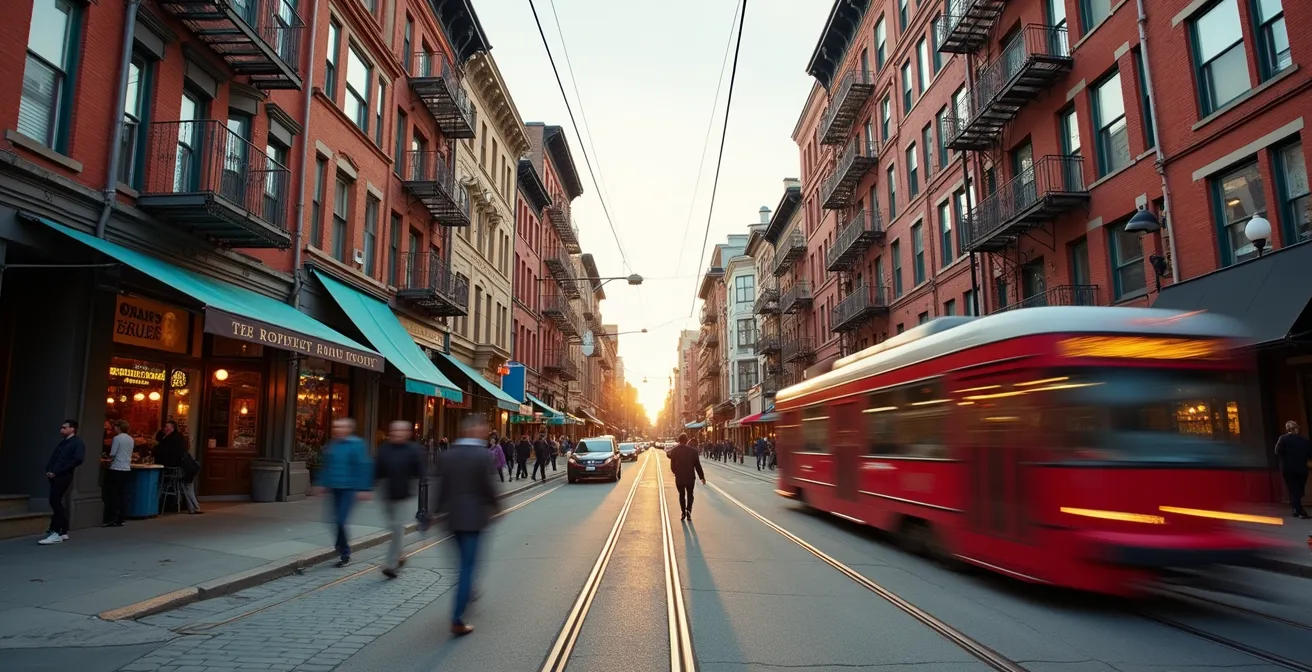
The soul of Queen West isn’t dead; it has simply migrated from the main-street storefronts to the spaces in between.
- Economic pressures like soaring property values and tax hikes have forced out many indie businesses, but not the creative spirit.
- Authentic experiences now thrive in the laneways, on parallel streets, in artist studios, and during off-peak hours at community hubs.
Recommendation: Stop mourning the Queen West that was and start actively navigating the neighborhood’s new cultural ecosystem with the strategies in this guide.
There’s a specific type of urban grief familiar to any long-time Torontonian. It’s the feeling you get when you walk down Queen Street West, looking for that beloved indie coffee shop or cluttered vintage store, only to find a multinational bank or a fast-food chain in its place. You remember the scuffed floors, the eccentric owner, the raw energy that made this strip the artistic heart of the city. Now, faced with a wall of homogenous glass and steel, it’s easy to feel alienated, as if a part of your own history has been overwritten. The common advice—”shop local” or “explore the laneways”—feels hollow, a platitude that doesn’t acknowledge the depth of the change.
The street that was once the epicentre of counter-culture, the home of MuchMusic, and a haven for artists now seems to cater more to tourists and fast-fashion consumers. This transformation isn’t just about rising rents; it’s a fundamental shift in the neighborhood’s cultural ecosystem. But what if the accepted narrative of “selling out” is incomplete? What if the real Queen West hasn’t vanished but has simply become harder to see, retreating from the high-traffic storefronts into the capillaries of the neighborhood? This guide is for those who feel that loss. It’s not a lament for what’s gone, but a pragmatic toolkit for rediscovering the neighborhood’s enduring soul. We will delve into the forces reshaping the street and provide concrete strategies for navigating this new reality, proving that an authentic experience is still possible—if you know where and how to look.
This article provides a new lens for seeing a familiar place. It’s a guide to intentional navigation, helping you bypass the superficial to find the culture that still beats just beneath the surface. Let’s explore the map to the real Queen West.
Summary: A New Guide to Navigating Queen West’s Evolution
- Why Did Your Favorite Indie Coffee Shop Become a Taco Bell?
- Why Do Independent Shops on Queen Street Keep Closing Down?
- Why Are Coffee Shops the First Sign of Gentrification in East York?
- How to Bypass the Queen Street Traffic Jam on Saturday Afternoons?
- Queen West vs. West Queen West: Which Strip Fits Your Saturday Night?
- The “Instagram Trap” Mistake That Ruins Dinner on Queen West
- When to Visit Trinity Bellwoods Park to Avoid the Day-Drinking Crowds?
- How to Shop Local in Toronto Without Blowing Your Monthly Budget?
Why Did Your Favorite Indie Coffee Shop Become a Taco Bell?
The transformation of a cherished local haunt into a corporate franchise is the most visceral symptom of Queen West’s evolution. It’s not a random occurrence but the end result of immense economic pressure. This process, a form of “gentrification archaeology,” reveals how rising commercial real estate values effectively push out the very culture that made the street desirable in the first place. When a neighborhood gains a reputation for being “cool,” investment follows, property values surge, and landlords can command rents that are simply unsustainable for a small-margin business like an independent café or gallery. The only businesses that can afford such prime real estate are large, well-capitalized corporations.
This isn’t just a feeling; it’s a documented phenomenon. The art galleries that once defined the area have been particularly hard-hit. A revealing study on the gallery exodus from West Queen West found that the strip lost more than 76% of its galleries in the last decade, with property values surging by over 50% since 2013. These artists and curators were the pioneers, the catalysts for change, and ultimately the first victims of the “success” they helped create. To resist this tide as a consumer requires becoming a more discerning navigator, able to distinguish authentic local businesses from chains co-opting an indie aesthetic. It means looking for the subtle signs of true independence.
Action Plan: Identifying Genuine Indie Businesses
- Owner Presence: Look for the owner working behind the counter. Genuine indie shops often have the proprietor present daily, which is a strong sign of personal investment.
- Business Backstory: Investigate the business’s origin. Authentic indies often have personal founding stories deeply rooted in the neighborhood’s history.
- Aesthetic Scrutiny: Be wary of chains adopting the “distressed-wood-and-exposed-brick” look to blend in. Examine if the decor feels curated and personal versus formulaic.
- Inventory Turnover: Notice the product rotation. Indies typically feature unique, rotating stock from various small suppliers, unlike the standardized offerings of corporate chains.
- Building Ownership: Ask about the property. Many long-standing indie businesses have survived because they own their building, insulating them from crippling rent hikes.
Why Do Independent Shops on Queen Street Keep Closing Down?
Beyond the general rise in property values, a more insidious force is at play: the mechanics of commercial property taxes and developer-led consolidation. The heartbreaking closure of a 50-year-old family-run grocery or a beloved bookstore is often the direct result of a property tax bill that has suddenly become untenable. In Toronto, property assessments by MPAC can trigger dramatic increases in tax obligations for commercial tenants, even if their own revenue hasn’t grown. Recent data shows this is a widespread issue, with provincial assessments indicating that 57% of business properties saw assessment increases in 2024, squeezing already-thin margins.
Simultaneously, the street’s “hotness” attracts real estate developers who see more value in the land than in the businesses operating on it. They purchase buildings, often from older landlords, with the intent to demolish and build lucrative condominium towers. This strategy was seen clearly when developer Urbancorp applied to demolish buildings housing MOCA and other galleries for a condo project back in 2013, a pivotal moment in the area’s transformation. As journalist Marcus Gee lamented in The Globe and Mail about one such closure, the story is tragically common:
Cities are always evolving and even Queen’s Grocery couldn’t resist forever. Real estate values have soared on Queen, one of the hottest streets on the continent. Someone bought the building from their old landlord last spring.
– Marcus Gee, The Globe and Mail
This combination of tax pressure and developer acquisition creates a perfect storm where only the largest, most financially fortified businesses can survive. The independent shop isn’t just competing with a chain for customers; it’s competing with a global real estate market for its very right to exist.
Why Are Coffee Shops the First Sign of Gentrification in East York?
While this guide focuses on Queen West, understanding its history provides a blueprint for decoding changes across Toronto, such as in East York. The “third-wave coffee shop” is often cited as the canary in the coal mine for gentrification, but why? It’s because it signals a demographic shift. The arrival of a business that sells $6 artisanal lattes indicates the presence of a new class of residents with the disposable income and cultural values to support it. Queen West wrote the playbook for this pattern over the last 40 years. It began with artists and the LGBTQ+ community (the original “Queer West”) seeking cheap rent, whose presence created a vibrant cultural scene.
This scene, in turn, attracted mainstream interest and “upper-middle-class” investment, pricing out the original pioneers who then migrated to areas like Parkdale and the Junction. The artists and nightlife served as the “catalysts for change,” making the area safe and desirable for the wave of gentrifiers that followed. Today, we see this pattern repeating in East York, but with a different cast. The “pioneer gentrifiers” are not artists, but young millennial families seeking relatively affordable housing. The first businesses to follow them aren’t galleries, but stroller shops and, yes, third-wave coffee shops. The table below illustrates how the pattern adapts to a new context.
| Aspect | Queen West (1980s-2000s) | East York (2020s) |
|---|---|---|
| Pioneer Gentrifiers | Artists and musicians | Young millennial families |
| Initial Draw | Cheap warehouse spaces | Relatively affordable houses |
| First Wave Business | Art galleries, music venues | Third-wave coffee shops |
| Resulting Development | Condos, boutique hotels | Stroller shops, family services |
| Timeline to Full Gentrification | 15-20 years | Currently mid-stage |
By studying Queen West, we gain the literacy to read the urban landscape across the city. The coffee shop isn’t the cause; it’s a symbol of a deeper demographic and economic transformation that Queen West experienced first.
How to Bypass the Queen Street Traffic Jam on Saturday Afternoons?
The most immediate frustration on Queen West is often not existential but physical: the gridlock. The sidewalks are packed, the 501 streetcar is a sardine can, and the joy of exploration is lost to the stress of crowd navigation. The pragmatic solution is to embrace the “in-between spaces.” The soul of the neighborhood has migrated off the main drag and into its circulatory system: the laneways and parallel streets that locals use as their personal highways. These routes aren’t just faster; they are destinations in their own right, offering a glimpse into a more authentic, uncommercialized version of the area.
The laneways south of Queen, especially between Bathurst and Spadina, have become de facto open-air art galleries, their brick walls covered in murals and graffiti. Walking them is an act of intentional navigation, a choice to trade the polished storefronts for a grittier, more surprising experience. Similarly, streets like Richmond and Adelaide, just a block or two away, offer a completely different rhythm. They are home to hidden design studios, post-work drink spots favored by office workers, and a calmer atmosphere. Mastering these alternate routes is the first step in reclaiming your experience of the neighborhood.
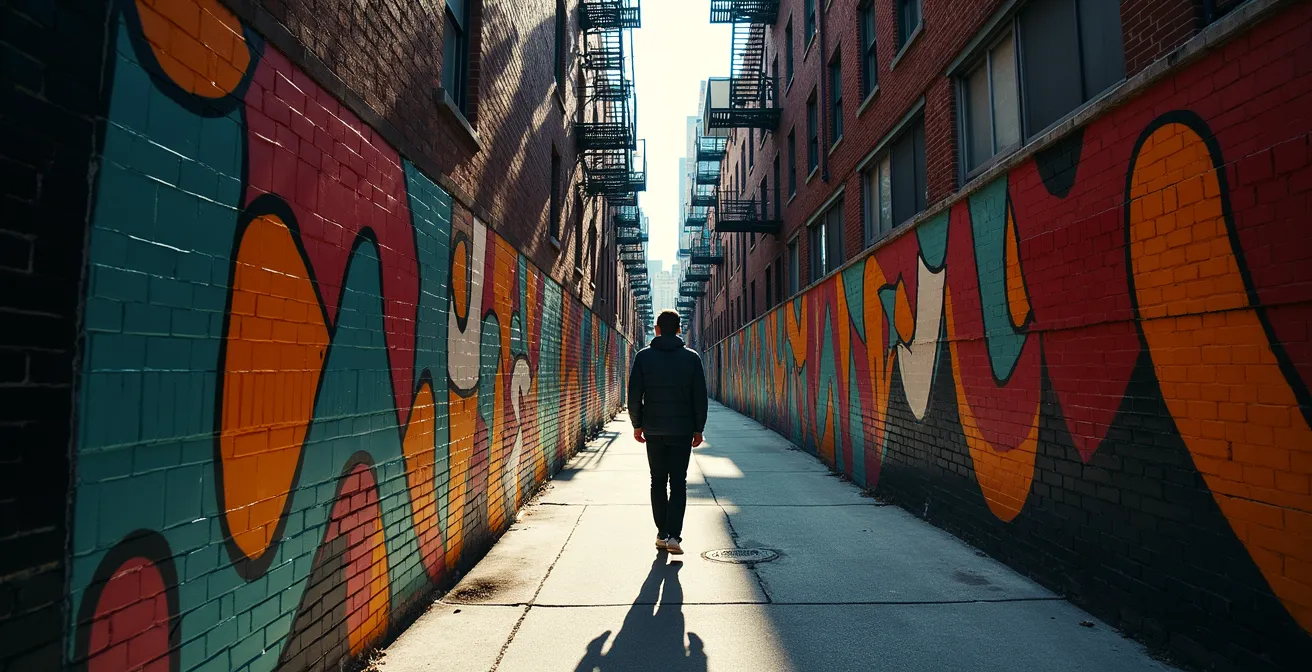
As this image suggests, these laneways are not just shortcuts; they are vibrant corridors of creativity. Instead of fighting the crowds on the 501 streetcar, consider these strategies:
- Use the parallel laneways south of Queen from Bathurst to Spadina as pedestrian highways and open-air art galleries.
- Master the 501 streetcar ‘short turn’—exit at designated loops when the car gets too crowded and wait for the emptier one that often follows.
- Take the 504 King streetcar as a faster alternative running just one block south for much of the route.
- Explore Richmond Street to discover hidden design studios and witness the neighborhood’s agency life.
- Walk along Adelaide Street to find post-work drink spots that are frequented by locals rather than tourists.
Queen West vs. West Queen West: Which Strip Fits Your Saturday Night?
A common mistake for returning visitors is treating “Queen West” as a single, monolithic entity. In reality, the street has a distinct split personality, with Bathurst Street serving as the unofficial dividing line. Understanding the difference between Queen West (east of Bathurst) and West Queen West (WQW) is crucial for curating your experience and avoiding a vibe mismatch. The former is now largely a mainstream Fashion District, dominated by international brands and feeding off the proximity to the Eaton Centre. The latter, officially designated the Art + Design District, still retains a significant portion of its independent, bohemian spirit, even with the encroaching gentrification.
West Queen West’s reputation as a cultural hub is not just marketing; it’s historically rooted and was famously validated when Vogue Magazine declared it one of the coolest neighbourhoods in the world. This was due to its high concentration of galleries (now diminished, but still present) and its connection to the OCAD University arts community. Its energy is anchored by legendary music venues like the Horseshoe Tavern and the Cameron House, which dictate a later, more local nightlife rhythm. Choosing which strip fits your Saturday night is an act of intentional navigation. Are you looking for familiar brands and pre-theatre buzz, or are you seeking local music and the chance to rub shoulders with the city’s creative class?
The following table breaks down the key differences to help you make an informed choice for your next outing.
| Aspect | Queen West (East of Bathurst) | West Queen West (West of Bathurst) |
|---|---|---|
| BIA Designation | Fashion District | Art + Design District |
| Historical Anchor | Former MuchMusic HQ at 299 Queen | OCAD University proximity |
| Peak Hours | 7-9 PM (pre-theatre, fast-fashion) | 10 PM-2 AM (music venues, local bars) |
| Dominant Retail | International brands, chain stores | Independent galleries, boutiques |
| Crowd Type | Tourist-heavy thoroughfare | Local, artistic community |
| Key Venues | Eaton Centre proximity | Horseshoe Tavern, Cameron House |
The “Instagram Trap” Mistake That Ruins Dinner on Queen West
In an area as heavily photographed as Queen West, it’s easy to fall into the “Instagram Trap”: choosing a restaurant based on its photogenic decor rather than the quality of its food or its connection to the community. These establishments often prioritize aesthetics over authenticity, resulting in mediocre, overpriced meals in a room full of people taking photos of their food instead of talking to each other. Avoiding this trap requires a more critical eye and a willingness to step off the beaten path. The most authentic dining experiences are rarely the ones with a lineup of influencers out front.
One of the most effective strategies is the “Three-Block Rule.” Walk three blocks north or south of Queen Street itself. This simple act takes you out of the high-rent, high-traffic tourist zone and into residential neighborhoods where restaurants must rely on repeat business from locals to survive. Here, the focus is on quality, value, and community. You can also learn to read the menu as a cultural artifact. A huge, laminated, multi-language menu is a major red flag, signaling a business designed for mass tourism. A small, seasonal paper or chalkboard menu, on the other hand, is a green flag, showing a chef who is responsive to local suppliers and cares about freshness.
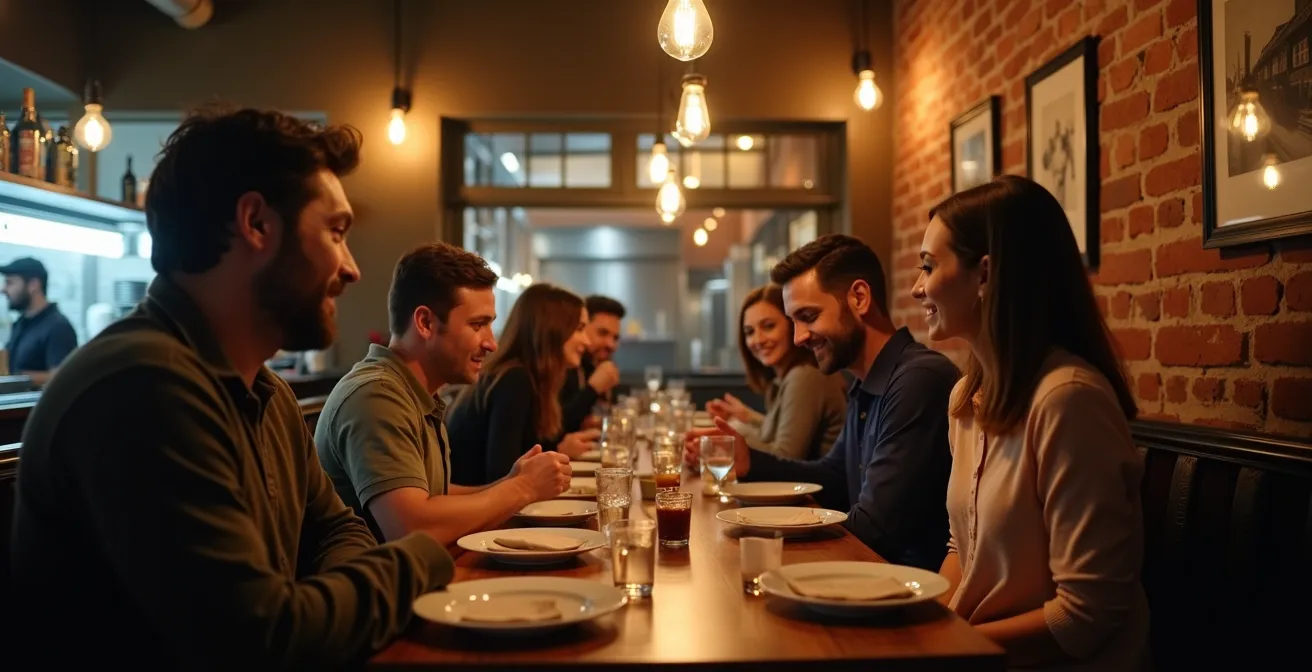
The goal is to find a place with the warm, genuine atmosphere seen above, where the connection between staff, food, and community is palpable. Look for these signs:
- Green Flag: Small, seasonal paper or chalkboard menus indicate a focus on fresh, local ingredients.
- Red Flag: Huge, multi-page laminated menus, often in several languages, suggest catering to mass tourism.
- Look for establishments where the owner or chef has been a neighborhood fixture for years, demonstrating a genuine connection to the community.
- Apply the ‘Three-Block Rule’: walk three blocks north or south from Queen Street to discover hidden gems that cater to locals.
- Trust your gut: does the place feel like a community hub or a stage set?
When to Visit Trinity Bellwoods Park to Avoid the Day-Drinking Crowds?
Trinity Bellwoods Park is the sprawling green heart of the neighborhood, but on a sunny Saturday, it can feel more like a music festival than a relaxing urban oasis. The vast lawns become packed with day-drinkers and picnickers, making it hard to find a quiet patch of grass. For the returning local who remembers a calmer park, this scene can be alienating. However, experiencing the park’s true neighborhood rhythm doesn’t require avoiding it altogether; it simply requires strategic timing. The park has different personalities at different times of the day and week.
To experience the authentic, local-centric park, visit during the “Dog Walker’s Paradise” window between 7 AM and 10 AM on a weekday. The light is beautiful, the air is fresh, and the park is filled with actual neighborhood residents starting their day. The “Dog Bowl” at the south end is almost always a quieter alternative to the main, central expanse. Another excellent time is the “Golden Hour,” around 6 PM on a weekday, when locals unwind after work. The demographic shifts from the weekend frenzy to a more relaxed, communal vibe. As one study noted, the park’s user base is changing, and you now see more families and a wider range of activities beyond just picnicking.
By choosing your moment, you can align your visit with the community’s natural pulse. Here is a timing strategy to reclaim your Trinity Bellwoods experience:
- Visit during the ‘Dog Walker’s Paradise’ window (7 AM – 10 AM) for an authentic neighborhood rhythm.
- Explore the ‘Dog Bowl’ at the south end for a consistently quieter experience away from the main crowds.
- Attend the Tuesday Farmers’ Market (afternoon/evening) to interact directly with local vendors and the community.
- Discover the quiet community greenhouse on the park’s western edge for a peaceful escape.
- Choose the weekday 6 PM ‘Golden Hour’ when locals unwind after work, instead of the chaotic weekend frenzy.
Key Takeaways
- The “real” Queen West hasn’t disappeared; it has migrated from main-street storefronts into laneways, parallel streets, and community hubs.
- Economic forces like soaring property taxes and developer acquisitions are the primary drivers displacing independent businesses, not a simple lack of customers.
- Authentic experiences require intentional navigation: choosing the right time to visit, the right street to walk on, and learning to distinguish genuine local spots from corporate imitations.
How to Shop Local in Toronto Without Blowing Your Monthly Budget?
One of the biggest misconceptions about supporting local is that it’s prohibitively expensive. While you can certainly spend a fortune on a piece of art from a gallery, “shopping local” on Queen West can be reframed as an act of consumption as curation. It’s about directing your dollars, big or small, toward the businesses and activities that form the neighborhood’s cultural ecosystem. This approach is not only budget-friendly but also often more meaningful. It’s about investing in experiences and affordable, locally-made goods rather than just high-ticket items.
Instead of lamenting that you can’t afford a large canvas, create a “Consignment Crawl” route. Queen West and nearby Ossington are packed with some of the city’s best second-hand and vintage stores, where you can find unique, high-quality pieces for a fraction of retail prices. This is sustainable, affordable, and directly supports small business owners. Supporting the arts doesn’t have to mean buying a sculpture. Buy a ticket to a show at The Horseshoe Tavern or The Cameron House; you’re paying local musicians and the venue staff. Buy an art zine, a postcard, or a print from a gallery shop like Swipe Books at 401 Richmond. These small purchases provide vital income to artists.

Even your daily coffee can be a political act. Instead of grabbing a cup from a global chain, buy a bag of beans from a local roaster to brew at home. You support a neighborhood business and often get a superior product. The key is to shift your mindset from high-cost ownership to low-cost participation.
- Create a ‘Consignment Crawl’ through Queen West and Ossington’s top-tier vintage stores for budget-friendly fashion.
- Support local art through affordable prints, zines, and artist-made cards at places like the AGO shop or Swipe Books at 401 Richmond.
- Buy tickets to shows at The Horseshoe Tavern instead of expensive art pieces to support the live music scene.
- Shop directly from makers at 401 Richmond during open-studio days for ‘studio discount’ prices.
- Purchase coffee beans from local roasters as a consumable, repeatable way to support neighborhood businesses.
The real Queen West still exists, but it demands more from you now. It asks for your curiosity, your critical eye, and your intentional participation. By applying these navigational strategies, you can move beyond the surface-level changes and reconnect with the creative, resilient, and authentic spirit that has always defined this iconic Toronto street. Your next visit doesn’t have to be an exercise in nostalgia and loss; it can be an act of rediscovery.