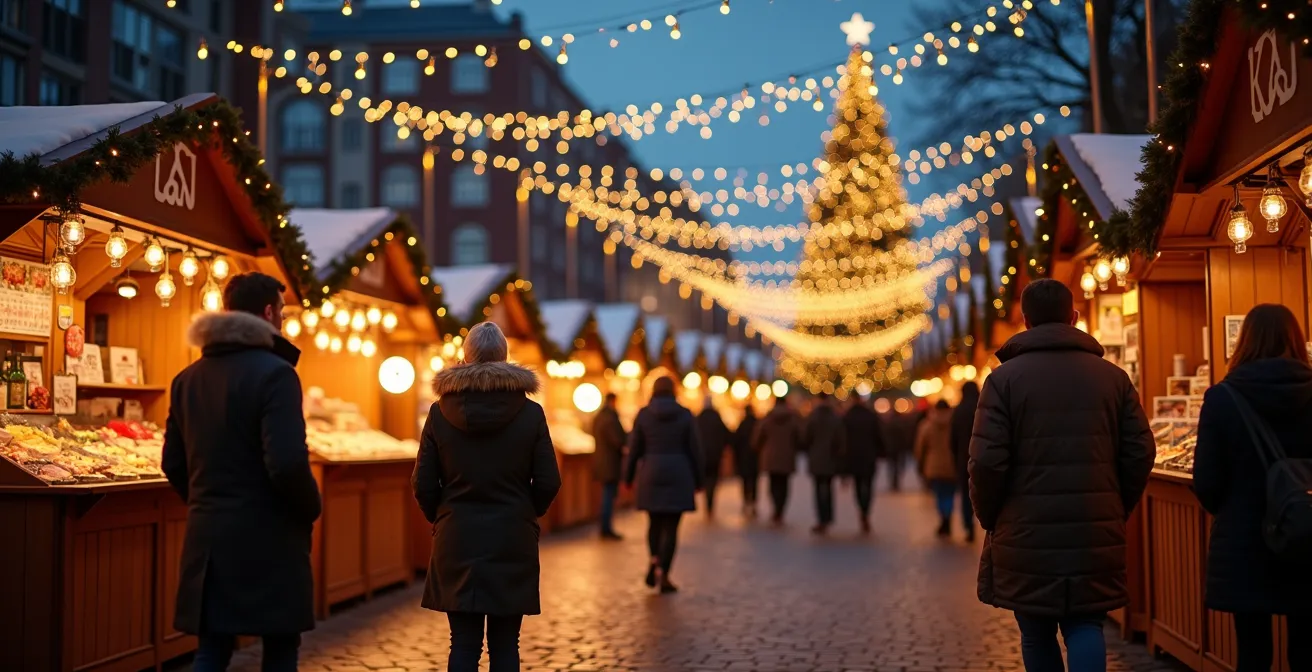
In summary:
- Master a thermal layering system (base, mid, shell) to make the Canadian cold irrelevant.
- Visit the Distillery Winter Village for free before 4 PM on weekdays to avoid the biggest crowds and ticket fees.
- Choose Nathan Phillips Square for a more stroller-friendly and budget-conscious family outing with free ice skating.
- Prioritize insulated, waterproof boots to combat conductive heat loss on cold cobblestone and concrete.
- Save money by eating in nearby neighbourhoods like Corktown or Leslieville before entering the main market areas.
The twinkling lights, the scent of pine and cinnamon, the cheerful buzz of a crowd—Toronto’s winter markets promise a magical holiday experience. Yet for many, the reality is a battle against biting winds, frozen toes, and overwhelming crowds that can quickly extinguish that festive spark. You arrive dreaming of cozy moments but spend most of your time desperately seeking warmth and wondering if that $15 entry fee was worth the shivers. It’s a common frustration for families trying to manage strollers on historic cobblestones and for couples whose romantic walk by the lake is cut short by the brutal cold.
Most guides will offer the usual advice: “dress warm” and “go on a weekday.” While not wrong, this advice barely scratches the surface of what it truly takes to thrive in a Canadian winter environment. It ignores the specific challenges of our city, from the unique wind chill off Lake Ontario to the unforgiving chill of cobblestone streets that seem to suck the warmth right out of your feet. These events are designed to be enchanting, but that enchantment is only accessible if you’re comfortable.
This guide takes a different approach. We believe that conquering Toronto’s winter markets isn’t about simply tolerating the cold; it’s about mastering a strategic system of thermal protection that makes the cold irrelevant. It’s about understanding the “why” behind the cold, not just the “what” of wearing a coat. By treating your warmth as a solvable puzzle and your visit as a strategic mission, you can transform a potentially miserable outing into the genuinely cozy and magical experience you were hoping for.
We’ll break down everything from the science of footwear to the art of timing your visit, giving you a complete blueprint for comfort and enjoyment. This article explores the specific strategies you need to beat the cold, the crowds, and the high prices, ensuring your holiday memories are filled with joy, not shivers.
Table of Contents: How to Master Toronto’s Festive Season
- Why Is Mulled Wine at the Market Priced Over $12 CAD?
- How to Get Into the Distillery Winter Village Without a Ticket?
- Nathan Phillips Square vs. Distillery: Which Market Is Better for Kids?
- The Footwear Mistake That Ruins Your Winter Market Date
- When to Visit the Holiday Tree to Avoid the Instagram Crowds?
- Summer Patios vs. Winter Market: Which Season Offers Better Value?
- The Clothing Mistake That Ruins Romantic Winter Walks by the Lake
- How to Visit the Distillery District Without Falling for Tourist Prices?
Why Is Mulled Wine at the Market Priced Over $12 CAD?
That steaming cup of mulled wine feels like the quintessential winter market experience, a warm hug in a mug. But when you see the price tag—often soaring above $12 CAD plus a deposit for the cup—it can feel more like a cold shock. The reason for this high cost is a classic mix of high demand, captive audience economics, and significant operational overhead. With the Distillery Winter Village attracting more than one million visitors annually, vendors know they can set premium prices for these coveted festive treats.
The price reflects more than just the ingredients. It covers the vendor’s high seasonal rent for a small wooden cabin, staffing costs, and the overall “experience” fee. You’re not just buying a drink; you’re paying for the privilege of sipping it under magical lights in a historic district. While it can be a delightful one-time splurge, relying on expensive drinks to stay warm is an inefficient strategy. A single cup provides only temporary warmth, and the cost for a family can add up faster than a Toronto snowfall.
A smarter approach is to reframe your “warmth budget.” Instead of spending $25 on two drinks, consider that money better invested in a long-term warmth solution like chemical hand warmers or a quality thermos you can fill at home. For a truly delicious and often better-value treat, explore the district’s permanent residents who offer exceptional alternatives:
- SOMA Chocolatemaker: Their Mayan Hot Chocolate is legendary among locals, offering a rich, spicy, and deeply satisfying warmth rated 9/10 by taste testers.
- Cluny Distillery: Known for its Classic S’mores Hot Chocolate, this is a decadent and photo-worthy treat that delivers a perfect 10/10 experience.
- Maisonette Gifts: Seek out their “Drink of the Gods” hot chocolate for a unique and high-quality option.
- Specialty Ciders: Keep an eye out for vendors selling hot apple cider, which can sometimes offer a more budget-friendly and equally festive alternative to mulled wine.
How to Get Into the Distillery Winter Village Without a Ticket?
The single biggest misconception about the Distillery Winter Village is that it always requires a paid ticket. This simply isn’t true. The key to free entry is all about timing. The market implements paid ticketing only during its peak hours to manage crowds. By planning your visit outside of these windows, you can enjoy the entire spectacle without spending a dime on admission. Generally, tickets are only required from Thursday to Sunday after 4:00 PM, and every day during the super-peak period from mid-December through New Year’s Eve after 4:00 PM.
This means that visiting on a weekday morning or early afternoon is completely free. This “pre-peak” window is the golden hour for anyone who dislikes crowds, from families with young children to couples seeking a more relaxed atmosphere. You’ll have more space to wander the cobblestone streets, take photos, and browse the vendor cabins without feeling rushed. The lights are still beautiful as the afternoon light begins to fade, giving you a magical experience at a fraction of the cost and hassle.
This paragraph introduces the table below and explains its value to the user. For instance, it might highlight that understanding the different pricing models across Toronto’s various markets can help families and couples choose the best experience for their budget, as shown in a recent comparison of winter events.
| Market | Entry Fee | Free Times | Peak Hours |
|---|---|---|---|
| Distillery Winter Village | $15 + fees | Before 4pm daily | Fri-Sun after 4pm |
| Evergreen Brick Works | Pay What You Can ($5 suggested) | Always flexible pricing | 11am-5pm Sundays |
| Nathan Phillips Square | Free | Always free | Evening hours |
| Stackt Market Holiday Hills | Free | Always free | Weekends |
The entrance to the Distillery District in the late afternoon often feels like a gateway between two worlds. The public space outside is cast in the cool blue of twilight, while the market inside glows with a warm, inviting golden light, symbolizing the transition from a free, open city space to a ticketed, curated experience.
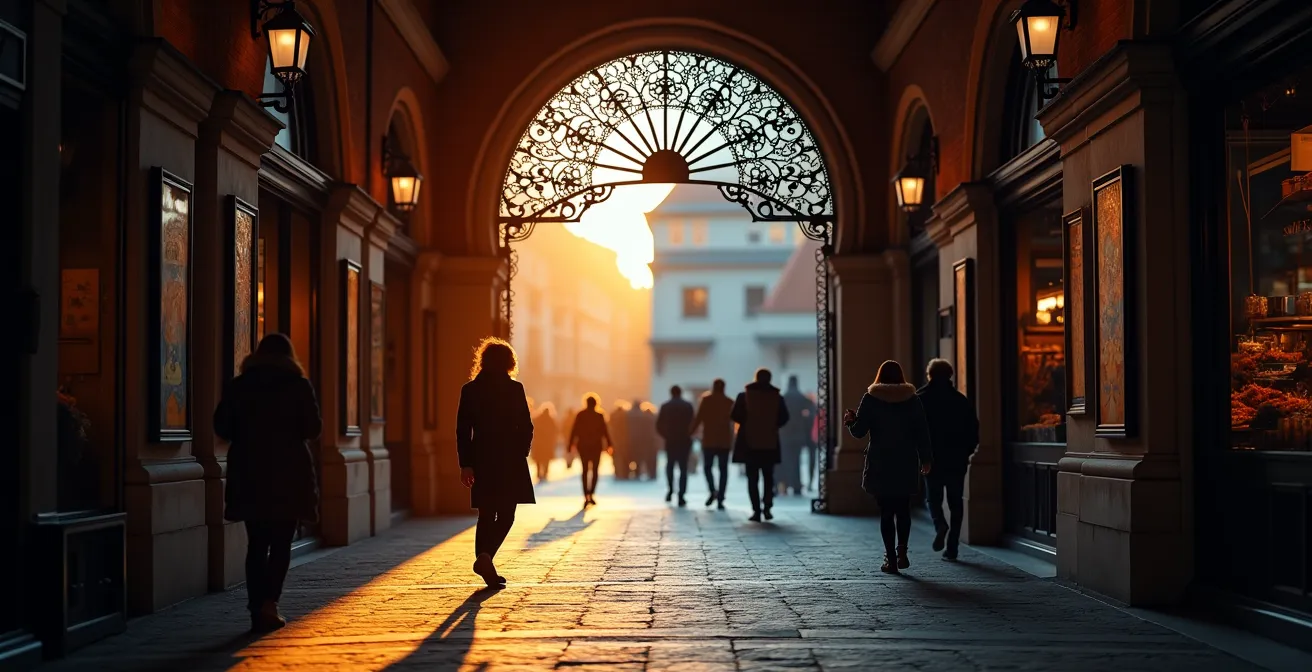
This visual contrast highlights the strategic choice a visitor makes. By arriving before 4 PM, you walk through this gateway freely, enjoying the ambiance before the peak-hour restrictions begin. It’s a simple trick that transforms your entire visit, saving you money and letting you experience the magic on your own terms.
Nathan Phillips Square vs. Distillery: Which Market Is Better for Kids?
When planning a family outing to a winter market, the “best” choice depends heavily on your priorities: atmosphere, budget, or logistics. For families with young children, especially those requiring strollers, Nathan Phillips Square is often the superior option. Its flat, paved surfaces make navigation a breeze compared to the historic, and often uneven, cobblestones of the Distillery District. Furthermore, the proximity to the Eaton Centre and the underground PATH system provides an invaluable network of easily accessible, clean, and free public bathrooms and emergency warm-up zones—a lifesaver for parents.
The main attraction at Nathan Phillips Square is the iconic ice skating rink, which is free to use if you bring your own skates. Even with skate rentals (around $15), it offers a classic Canadian winter activity that provides more engagement for kids than the more passive shopping experience at the Distillery. The Distillery’s kid-focused activities, like the carousel and Ferris wheel, are pay-per-ride and can add up quickly. Combined with the Distillery’s peak-time entry fee, a family trip there can become a significantly more expensive venture.
This table, based on information from guides like Destination Toronto’s official blog, breaks down the key differences to help you make the best choice for your family’s needs and budget.
| Feature | Nathan Phillips Square | Distillery District |
|---|---|---|
| Surface Type | Flat, paved, stroller-friendly | Historic cobblestones, challenging for strollers |
| Warm-Up Zones | Eaton Centre, PATH system nearby | Limited indoor spaces, mostly commercial |
| Main Kids Activity | Free ice skating (rental ~$15) | Pay-per-ride carousel & Ferris wheel |
| Bathroom Access | Multiple free options nearby | Limited, often in restaurants |
| Entry Cost | Always free | $15+ on peak times |
While the Distillery offers a unique, old-world charm, Nathan Phillips Square provides a more practical, accessible, and budget-friendly day out for families. For a happy medium, consider the Evergreen Brick Works Winter Market, which operates on a “Pay What You Can” entry model and offers a blend of artisan vendors and natural space to explore. Ultimately, a successful family trip is less about seeing everything and more about keeping everyone warm, comfortable, and happy.
The Footwear Mistake That Ruins Your Winter Market Date
There is one single mistake that will ruin any winter market visit faster than anything else: choosing the wrong footwear. It’s not about style; it’s about science. You can be wearing the warmest parka in the world, but if your feet are cold, you will be miserable. The problem in Toronto isn’t just the air temperature; while Toronto can experience extreme cold with record lows of -20°C to -25°C, the real enemy underfoot is conductive heat loss. The cobblestones of the Distillery District and the concrete sidewalks of Nathan Phillips Square act like giant ice cubes, constantly drawing warmth away from your body through the soles of your shoes.
Many people think wearing thick wool socks is the solution, but it’s an incomplete strategy. If your boots have thin, uninsulated soles, the cold will penetrate them regardless of your socks. The single most important feature for winter market footwear is a thick, insulated sole that creates a barrier between your foot and the frozen ground. The second is waterproofing. Toronto winters are notoriously slushy, and once your socks get wet, they lose all insulating properties, leading to rapidly freezing feet. Fashionable leather boots or sneakers, even with warm socks, are a recipe for a date night disaster.
Think of your footwear as the foundation of your entire thermal system. If the foundation fails, the whole system collapses. Investing in a proper pair of insulated, waterproof winter boots is the best money you can spend for winter comfort. Brands like Sorel are famous for their warmth, while options like thermal-lined Blundstones offer a stylish compromise that is still functional.
Your Winter Footwear Audit: Key Points to Check
- Insulation Check: Does your boot have a thick, insulated sole designed for cold, or is it just a fashion boot? Cold concrete will always win against thin soles.
- Waterproofing Test: Are your boots truly waterproof or just water-resistant? Walk through a slush puddle to test them—Toronto’s wet snow is unforgiving.
- Sock Material: Are you wearing wool or synthetic socks? Cotton socks absorb sweat, get damp, and will make your feet freeze.
- Warmer Strategy: Have you purchased chemical foot warmers? For maximum effect, place them on TOP of your toes inside the boot, not underneath.
- Function vs. Fashion: Are you prioritizing style over survival? Blundstones with thermal liners or Sorel boots offer both, but function must come first.
When to Visit the Holiday Tree to Avoid the Instagram Crowds?
The giant, brightly lit holiday tree is the heart of any winter market and the main magnet for crowds. Getting that perfect, festive photo without a hundred other people in the background can feel like an impossible mission. The secret isn’t finding a hidden spot, but mastering your timing. The absolute least crowded time to visit is on a weekday morning or early afternoon, before 4:00 PM. Not only is entry to the Distillery free during these hours, but the crowds are minimal, allowing for a much more pleasant experience.
For the truly dedicated photographer seeking that magical shot, the ultimate hack is to go at sunrise on a weekend morning. You’ll be rewarded with beautiful golden hour light, empty cobblestone streets, and the serene magic of the market before the city wakes up. While some lights might not be fully illuminated, the tranquil atmosphere is unparalleled. Another counter-intuitive strategy is to go during a moderate snowfall. Many people are deterred by the weather, but the falling snow adds a layer of genuine magic to photos and creates a cozy, hushed ambiance that you can’t replicate on a clear night.
Beyond timing, think about your positioning. Instead of joining the scrum directly in front of the tree, try these alternative spots and strategies for a unique and less crowded photo:
- Use the elevated walkway at Nathan Phillips Square for a stunning aerial view of the tree and skating rink.
- At the Distillery, find corner spots away from the main thoroughfares to frame the tree with the district’s historic brick architecture.
- Arrive just as the lights turn on in the late afternoon (around 4:30 PM) on a weekday to capture the transition from day to night with fewer people than at 7:00 PM.
- Look for reflections in puddles after a light rain or snowmelt for a creative and artistic shot.
This image captures the ideal scenario: an intimate, quiet moment at sunrise. The couple is the focus, but the magnificent tree provides a dreamy, festive backdrop without the chaos of peak-hour crowds, proving that the early bird gets the best photo.

Ultimately, the best photo is often one that captures a genuine moment of joy. By avoiding the peak rush, you give yourself the time and space to actually enjoy the atmosphere, which will shine through in your pictures far more than a perfectly centered, but stressful, shot.
Summer Patios vs. Winter Market: Which Season Offers Better Value?
Torontonians love their seasonal gatherings, but which offers better bang for your buck: a summer afternoon on a patio or a festive evening at a winter market? When you break it down, summer patios generally offer better financial value, while winter markets trade on a unique, high-value atmosphere that’s harder to quantify. The most obvious difference is the entry cost. Access to a summer patio is free, with your only expense being what you choose to order. In contrast, the Distillery Winter Village charges a premium entry fee during its busiest times.
Drink and food prices also tend to be higher at winter markets due to the temporary nature of the vendors and the “captive audience” effect. A pint on a summer patio typically ranges from $8-$12, while a cup of mulled wine at the market can easily exceed $12. Furthermore, summer in Toronto is filled with countless free activities, from lounging on the beach to exploring parks and attending free street festivals. Free winter activities are more limited, with ice skating at Nathan Phillips Square being the most notable example.
However, the “value” of a winter market isn’t just financial. As Rik Ocvirk, a key figure at The Distillery Restaurants Corp, highlighted, the goal is to create a special, concentrated experience. In a statement about the event, he emphasized its unique appeal:
This will be one of our most exciting years yet… Our programming combines culinary creativity, family-friendly entertainment, and charming design in a way that captures what makes The Distillery Winter Village so special during the holidays
– Rik Ocvirk, Vice President, The Distillery Restaurants Corp
This quote underscores the core value proposition: you’re paying for a curated, magical ‘hygge’ atmosphere that you can’t find on a thousand different patios in July. The concentrated festive charm is a rare commodity, and its price reflects that. The table below, drawing from local sources like BlogTO’s event coverage, summarizes this trade-off.
| Factor | Summer Patios | Winter Markets |
|---|---|---|
| Entry Cost | Free (patio seating) | $15 peak times (Distillery) |
| Drink Prices | Pint $8-12 | Mulled wine $12+ |
| Free Activities | Beaches, parks, festivals | Limited (Nathan Phillips skating) |
| Duration | May-September | November-January |
| Atmosphere Value | Common, widespread | Unique, concentrated ‘hygge’ |
The Clothing Mistake That Ruins Romantic Winter Walks by the Lake
A romantic winter walk along Toronto’s waterfront sounds idyllic, but it can quickly turn into a miserable, shivering ordeal if you make one critical clothing mistake: underestimating the wind. The air temperature may say -5°C, but due to Lake Ontario proximity, the wind chill can make it feel significantly colder, cutting through inadequate clothing in seconds. The biggest error is wearing a bulky but not windproof coat, like a down puffer without a protective shell. While puffers are great insulators, they do little to stop the relentless wind from stealing your body heat.
The solution is not just adding more bulk, but dressing with an intelligent three-part thermal layering system. This system is designed to trap heat, manage moisture, and block wind, ensuring you stay warm and comfortable even in harsh conditions. It’s the same strategy used by experienced Canadian hikers and outdoor enthusiasts, and it’s perfectly suited for a lakeside stroll.
Here’s how the system works:
- 1. The Base Layer: This is the layer directly against your skin. Its job is not to provide warmth, but to wick moisture (sweat) away from your body. A wet base layer will make you cold, no matter what you wear on top. Choose materials like merino wool or synthetic fabrics. Never wear cotton, as it absorbs moisture and stays wet.
- 2. The Mid-Layer: This is your insulation layer. Its job is to trap your body heat. A fleece jacket or a lightweight down jacket (like an Arc’teryx Atom LT) is perfect for this. This layer does the heavy lifting of keeping you warm.
- 3. The Shell Layer: This is your armor against the elements. Its only job is to block wind and water. A thin, waterproof, and windproof jacket is all you need. This outer shell protects the warm air trapped by your mid-layer from being blown away by the lake wind.
Don’t forget your extremities. Mittens are always warmer than gloves because they keep your fingers together. A balaclava or neck gaiter (like a Buff) offers far better face protection from the wind than a simple scarf. For high-quality technical gear, local Toronto stores like MEC or Arc’teryx in Yorkville are excellent resources.
Key takeaways
- The key to warmth is a system: a moisture-wicking base layer, an insulating mid-layer, and a windproof outer shell.
- Proper footwear with insulated soles is non-negotiable to fight conductive heat loss from cold ground.
- Strategic timing is everything: visit markets on weekday afternoons before 4 PM to avoid crowds and entry fees.
How to Visit the Distillery District Without Falling for Tourist Prices?
The Distillery District, especially during the Winter Village, is a marvel of festive design, but its charm can come with a tourist-level price tag. The secret to enjoying its atmosphere without emptying your wallet is to adopt a local’s mindset: you’re there for the ambiance, not necessarily the commerce. The most effective money-saving strategy is the “Eat Near, Stroll In” approach. The adjacent neighbourhoods of Corktown and Leslieville boast a fantastic array of restaurants, pubs, and cafes offering better food at more reasonable prices. Have a full, satisfying meal there first, and then walk over to the Distillery for a post-dinner stroll to soak in the lights and sounds.
Once inside, think like a curator, not a consumer. The district’s high prices are partly due to massive operational costs, including the wages for over 700 seasonal workers. Instead of focusing on purchases, shift your focus to the free experiences. The district is home to numerous world-class art galleries and artisan studios. These spaces are not only free to enter but also provide excellent, quiet warm-up hubs away from the bustling crowds. You can spend an hour appreciating stunning art without any pressure to buy.
By combining strategic timing (visiting during free hours) with a focus on free activities, you can have a full and magical experience for the cost of a TTC fare. Here are the essential tips for a smart visit:
- Eat a full meal in Corktown or Leslieville before you go.
- Always visit during free hours (before 4 PM) to save the $15+ entry fee per person.
- Use the district’s many free art galleries and studios as your personal warm-up lounges.
- Focus your attention on the unique photo opportunities and the incredible architecture rather than the vendor stalls.
- If you do decide to splurge, focus on a truly unique item from an actual artisan maker, rather than a mass-produced souvenir.
Now that you’re armed with a complete system for managing the cold, the crowds, and the costs, you’re ready to experience Toronto’s winter markets as they were meant to be enjoyed. The magic isn’t in the expensive wine or the perfect Instagram shot, but in the shared moments of warmth and wonder. Go out and create your own cozy memories.