In summary:
- Stop being a victim of short turns and ghost buses by learning how to predict them using specific app-based clues.
- Transform your commute by strategically using the TTC’s two-hour Presto transfer to run essential errands for free.
- Understand the critical differences between the 504 King and 501 Queen to choose the faster or more comfortable route based on time of day.
- Learn the unwritten rules of the TTC, from door sensor etiquette to platform positioning, to speed up everyone’s journey.
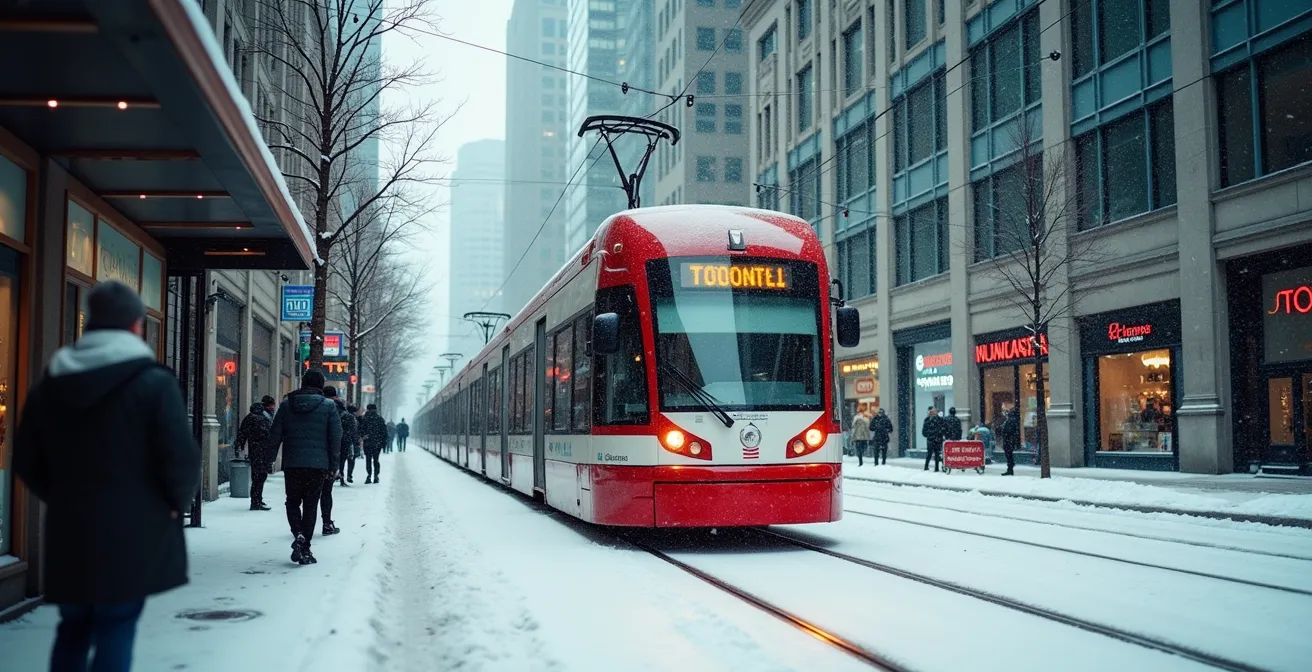
If you live in Liberty Village or Leslieville, the 504 King streetcar isn’t just a transit line; it’s a daily test of patience. You know the feeling: shivering in the cold, watching a packed streetcar crawl past, only for the next one on your app to vanish into thin air. You’ve probably been told to just “leave earlier” or “get a transit app,” but that advice feels hollow when you’re stranded at King and Dufferin yet again. The frustration of dealing with North America’s busiest surface transit route is a shared Toronto experience, built on a foundation of delays, overcrowding, and the infamous “short turn.”
But what if the solution isn’t more patience, but better strategy? What if you could stop being a passive victim of the TTC’s quirks and become an active player who can anticipate its moves? The key to surviving—and even mastering—the 504 King commute is to understand the system’s unwritten rules and exploit its built-in mechanics. It’s about knowing why things go wrong so you can be prepared when they do. This isn’t just another list of generic tips; it’s a playbook for reclaiming control of your commute.
This guide will deconstruct the most common frustrations of the 504 rider. We’ll explore the logic behind maddening short turns, reveal how to turn your Presto card into a free errand-running tool, and settle the King vs. Queen debate once and for all. By the end, you’ll have a toolkit of practical hacks that will change the way you navigate the city.
To help you conquer your daily journey, this guide breaks down the essential strategies and insider knowledge needed to outsmart the city’s busiest streetcar line. Here is a look at the tactics we will cover.
Table of Contents: A Torontonian’s Guide to Conquering the King Streetcar
- Why Do Short Turns Leave You Stranded in -10°C Weather?
- How to Use the Presto Card Transfer Window to Run Errands for Free?
- 501 Queen vs. 504 King: Which Route Gets You Crosstown Faster?
- The Door Radar Mistake That Causes Delays on New Bombardier Trams
- When to Avoid the 501 Line to Dodge the Worst Tourist Crowds?
- How to Use Transit Apps to Predict Ghost Buses?
- How to Bypass the Queen Street Traffic Jam on Saturday Afternoons?
- How to Navigate the TTC Network Like a True Torontonian?
Why Do Short Turns Leave You Stranded in -10°C Weather?
It’s the ultimate moment of betrayal for any TTC rider: after a long wait in the freezing cold, your streetcar finally arrives, only for the driver to announce it’s “turning back” at the next loop, forcing everyone off. This is a short turn, and while it feels like a personal affront, it’s the TTC’s clumsy attempt to fix service gaps. When streetcars get bunched up due to traffic or delays, operators will turn one back to fill a large gap in the opposite direction. The problem is that the official numbers don’t always capture the full picture, as an analysis by transit expert Steve Munro reveals that the real-world frequency of these disruptions is often much higher than reported.
For a commuter, understanding the ‘why’ is less important than knowing the ‘when’. You can’t stop a short turn, but you can often predict it and have a backup plan ready. The key is to stop thinking of your commute as a single, linear journey and start thinking like a strategist. Recognizing the warning signs gives you the power to act before you’re left on the curb. Key short turn loops on the 504 line include Roncesvalles, the Distillery Loop, and Broadview Station. If you are approaching one of these and your transit app shows a large gap in service behind you, your odds of being short-turned just went up dramatically.
Instead of hoping for the best, use this advanced knowledge to make a decisive move. Here are some survival strategies:
- Monitor vehicle bunching on your transit app. If you see two or three streetcars traveling in a tight cluster, the first one is a prime candidate for a short turn.
- Know your nearest warm shelter. At King or St. Andrew stations, the underground PATH entrances are a lifesaver. Have a coffee shop or lobby in mind for other locations.
- Watch for vehicles that suddenly disappear from the app’s map. This is a classic tell-tale sign of a vehicle being taken out of service or turned back.
- Position yourself at major intersections like King/Spadina or King/Bathurst. These hubs offer multiple route alternatives (like the 510 Spadina or 511 Bathurst) if your 504 journey is unexpectedly cut short.
How to Use the Presto Card Transfer Window to Run Errands for Free?
One of the most underutilized features of the TTC is the two-hour transfer window on the Presto card. When you tap your card, you don’t just pay for one ride; you unlock a two-hour window of unlimited travel in any direction on any TTC vehicle—streetcars, buses, or subways. This policy was designed to make the system more equitable and flexible, and it’s a game-changer for strategic commuters. In fact, Metrolinx projected that the two-hour transfer is expected to add 5 million additional customer trips per year, many of which are short, multi-part journeys that were previously too expensive.
For a 504 King commuter, this transforms the line from a simple A-to-B route into a network for productivity. Instead of saving all your errands for the weekend, you can “stack” them along your commute. Need to pick up groceries, go to the bank, and grab a prescription? With a little planning, you can do it all within your two-hour transfer window, effectively for the price of a single fare. The key is to know your stops and have a time budget for each errand. It’s a form of “transit gaming” where you maximize the value of every single tap.
To get started, visualize your route and the essential services located just steps from major stops. The image below shows the simple but powerful action at the heart of this strategy: the tap of your Presto card that starts the two-hour clock.
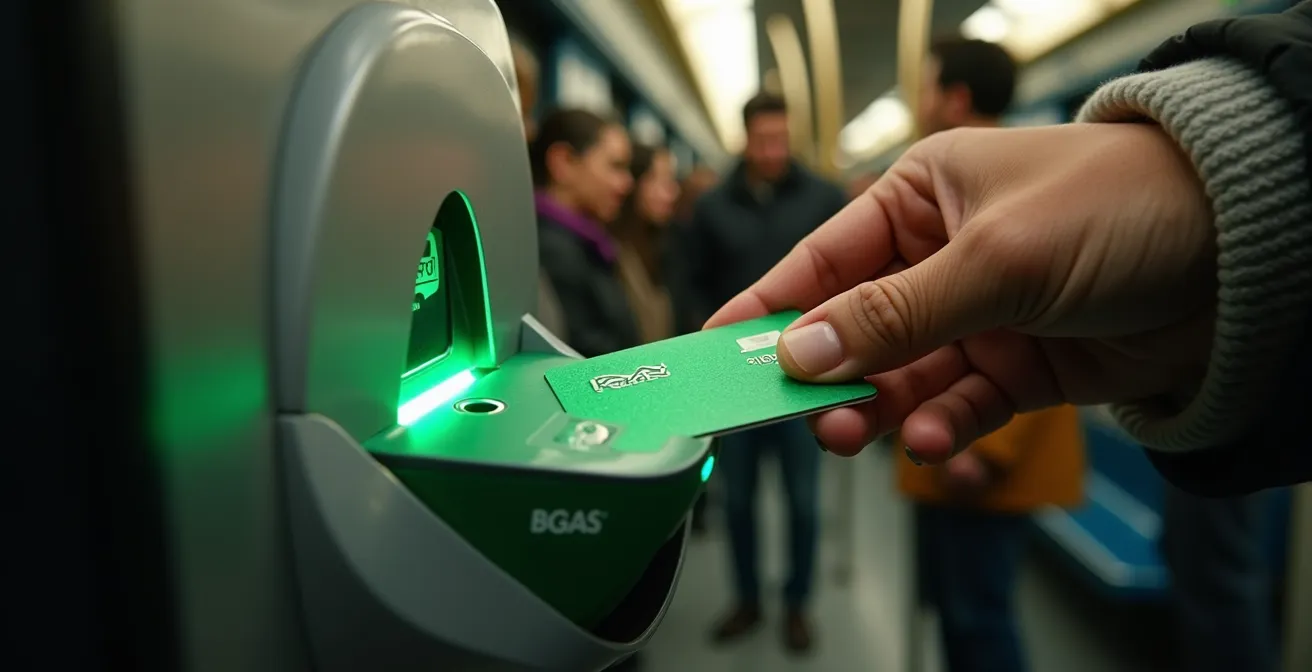
This simple tap is your ticket to a more efficient life. Here’s a practical guide to stacking errands along the 504 King route:
- King/Spadina Hub: Hop off to access Loblaws CityMarket, a TD Bank, and a Shoppers Drug Mart, all within a 3-minute walk. A 20-minute stop is easily achievable.
- King/Bathurst Quick Stop: This intersection features a large LCBO and a Rexall pharmacy directly across the street, perfect for a 15-minute in-and-out mission.
- Liberty Village Grocery Dash: For residents, this is a classic. Exit at Fraser Ave, do a quick shop at the Metro, and be back on the next streetcar within 35-40 minutes.
- The PATH Connection: Tap at King Station, duck into the underground PATH for weather-protected access to dozens of shops and services, and resurface to tap back on within your window.
- A crucial reminder: you must tap your Presto card every time you board a new vehicle, even within the transfer window. This doesn’t charge you again; it just validates your transfer.
501 Queen vs. 504 King: Which Route Gets You Crosstown Faster?
For Torontonians, the King vs. Queen debate extends beyond just nightlife and shopping—it’s a core transit dilemma. The 504 King and 501 Queen streetcars run on parallel east-west spines through the downtown core, but they offer vastly different commuting experiences. A savvy commuter doesn’t have blind loyalty to one line; they choose their route based on time of day, destination, and tolerance for crowds. The common wisdom is that King is for speed and Queen is for scenery, but the reality is more nuanced.
The single biggest factor in this debate is the King Street Transit Priority Corridor. Implemented between Bathurst Street and Jarvis Street, this zone dramatically restricts car traffic, turning King Street into a veritable streetcar expressway. Since its creation, the 504 has seen significant speed and reliability improvements within the downtown core. The 501 Queen, by contrast, has no such priority corridor and must battle with general traffic, making it prone to unpredictable gridlock, especially during peak hours and on weekends. While the 504 King carries a much higher daily ridership, leading to intense crowding, that volume is also what justifies its higher frequency on the 10-minute network.
The following table breaks down the key differences to help you make a more informed choice for your crosstown journey.
| Factor | 504 King | 501 Queen |
|---|---|---|
| Daily Ridership (2022) | 13.5 million annual | Lower than King |
| Transit Priority Zone | Bathurst to Jarvis (faster) | No priority corridor |
| Frequency | 10-minute network | Less frequent |
| Crowding Level | Very high during peak | More comfortable off-peak |
| Best for West End | Roncesvalles route | The Queensway option |
| Best for East End | To Broadview Station | To The Beaches |
Ultimately, the choice depends on your objective. If your goal is to get through the downtown core as quickly as possible, especially during rush hour, the 504 King is the undisputed champion thanks to its priority corridor. However, if you’re traveling off-peak or your tolerance for being packed like a sardine is low, the 501 Queen can offer a more civilized and comfortable—if potentially slower—ride. For destinations further east like The Beaches or west along The Queensway, the 501 becomes the more direct and logical choice.
The Door Radar Mistake That Causes Delays on New Bombardier Trams
You’ve seen it a hundred times: the streetcar is full but not packed, yet the doors refuse to close. A series of insistent beeps echoes through the car, the driver makes a frustrated announcement, and precious seconds tick away. This common delay isn’t a malfunction; it’s a design feature of the modern Flexity Outlook streetcars being misunderstood. The doors are equipped with sensitive infrared sensors and a yellow light strip above them, designed to prevent them from closing on a person or object. The problem is, these sensors can be triggered by a backpack, a shopping bag, or even just a passenger standing too close to the doorway.
This creates a collective action problem. A single person unknowingly blocking a sensor can hold up the entire vehicle, creating a ripple effect of delays down the line. While it’s easy to get annoyed, the solution lies in rider education and awareness. The “door radar mistake” is a shared responsibility. Knowing how the system works empowers you not only to correct your own positioning but also to gently help others understand the issue. When everyone gives the doors the space they need, the entire line moves more efficiently.
The key is to treat the area around the doors as a “no-go zone” unless you are actively boarding or alighting. Look at the interior of the Flexity streetcar below; the wide-open door areas are essential for both passenger flow and sensor operation.
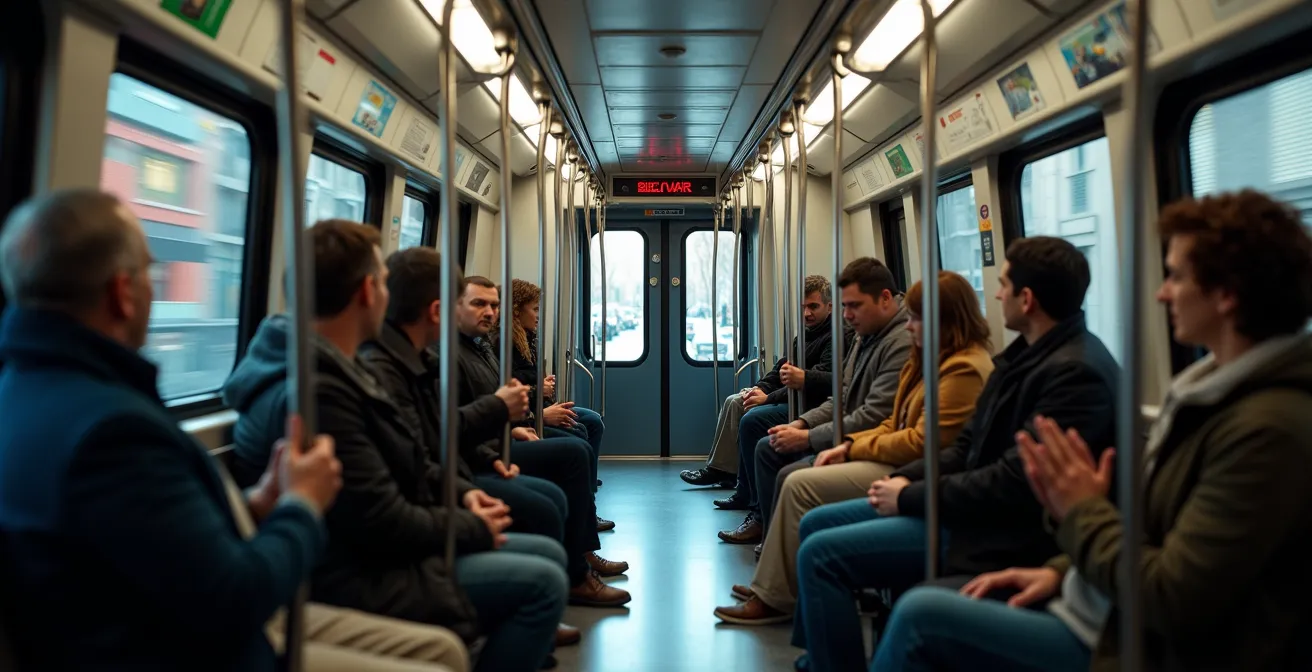
To do your part in eliminating these frustrating micro-delays, adopt this door sensor etiquette as a core part of your transit ritual:
- Stand back: Maintain a distance of at least 30cm (1 foot) from all doors. The infrared sensors detect presence, not just physical contact.
- Move to the middle: Immediately after boarding, move towards the center of the streetcar. Lingering in the doorway is the primary cause of this issue.
- Mind your belongings: Keep backpacks, purses, and shopping bags tucked in and away from the door sensor zones, even if your body is clear.
- Watch the lights: The yellow LED strips above the doors are your guide. If they are flashing, a sensor is being blocked. Someone—maybe you—is too close.
- Be a transit advocate: Politely ask others to “please step in” or point out that their bag might be blocking the door. A friendly nudge can get everyone moving faster.
When to Avoid the 501 Line to Dodge the Worst Tourist Crowds?
While the 504 King is the workhorse of the TTC, the 501 Queen is its celebrity sibling. Its scenic route, stretching over 24 kilometers, has earned it international acclaim. In fact, National Geographic once ranked it the #1 trolley ride in the world in its book “Journeys of a Lifetime.” This recognition is fantastic for Toronto tourism but can be a nightmare for a local commuter just trying to get across town. During peak tourist seasons, the 501 can become agonizingly slow and packed with visitors enjoying the view, treating the streetcar less like public transit and more like a tour bus.
For a savvy Torontonian, this means the 501 Queen is a route to be used strategically. Knowing when it will be overrun by tourists allows you to proactively choose an alternative, like the more business-like 504 King, or even the subway. The key is to think seasonally and be aware of major city events. Summer weekends are the most obvious flashpoint, as crowds head east toward The Beaches. But other events, like the Toronto International Film Festival (TIFF) or the Christmas Market, also have a significant impact on crowding and traffic along both King and Queen streets.
Avoiding the worst of the crowds isn’t about giving up on the 501 entirely; it’s about timing your trips intelligently. Here is a schedule to help you dodge the peak tourist loads:
- Summer Weekends: Avoid the 501 eastbound after 1 PM. The streetcars become packed with beach-bound crowds. The 504 King is a much faster parallel route during these times.
- December Holidays: The stretch of the 501 near the Eaton Centre and Nathan Phillips Square gets swarmed by visitors heading to holiday displays and the Christmas Market.
- TIFF Festival (Early September): Both King and Queen streets in the downtown core become heavily congested. If your journey is long, bypassing the area entirely via the Line 1 or 2 subway is often the fastest option.
- The Sweet Spot: If you love the 501’s scenic route, your best bet is to ride it on weekend mornings before 11 AM. Even in high season, you’ll often find a clear and comfortable ride.
How to Use Transit Apps to Predict Ghost Buses?
The “ghost bus”—or in our case, ghost streetcar—is a uniquely modern form of commuter torture. Your app confidently shows a vehicle arriving in 2 minutes. The 2 minutes pass. The arrival time mysteriously updates to 2 minutes again. This repeats until the icon on the map simply vanishes, leaving you stranded and lied to. This happens when a vehicle’s GPS tracker stops sending data, but the system’s predictive algorithm continues to list its “scheduled” arrival. For the 504 King, where on-time performance is a constant struggle, this is a frequent occurrence. For instance, recent Transit app data shows only 64% of 504 streetcars arrived on time, leaving a large window for ghosts to appear.
You cannot prevent a ghost streetcar, but you can learn to spot one before it wastes your time. The key is to become a transit detective and look for inconsistencies in the data. Don’t blindly trust the first number you see. Cross-reference information, look for movement patterns, and trust your gut when something feels off. Relying on a single official app is often a mistake; crowdsourced data from apps like Transit, or specialized trackers like TransSee, which pull raw data, are often more reliable at showing a vehicle’s true location and status.
Developing the skill to spot a ghost vehicle before it ghosts you is one of the most empowering hacks a TTC rider can learn. It allows you to switch to Plan B—walking, taking another route, or calling a rideshare—before you’ve invested another 10-15 minutes in a false promise.
Your Ghost Bus Detection Checklist
- Cross-Reference Your Sources: Is the arrival time on your app, the platform screen, and the official schedule wildly different? If they don’t align, be suspicious. A ghost is likely.
- Check for Movement: Watch the vehicle’s icon on a real-time map (like in the Transit app or on TransSee). If it hasn’t moved an inch in over three minutes, it’s probably not coming.
- Look for Repeated Delays: Does the arrival time keep pushing back by one or two minutes at a time? This “rolling delay” is a classic symptom of a GPS tracker that has gone offline.
- Analyze Bunching and Gaps: Use a map view to look at the whole line. If you see a massive, unexplained gap in service with no vehicle icon in sight, the “next” streetcar your app is promising might not exist.
- Trust Crowdsourced Data: Prioritize apps that use crowdsourced “GO” data from other riders over those that rely solely on the TTC’s official feed. Real phones on the vehicle provide more accurate locations.
How to Bypass the Queen Street Traffic Jam on Saturday Afternoons?
Saturday afternoon on Queen Street West is a Toronto institution—and a transit black hole. The combination of shoppers, brunch-goers, and general vehicle traffic brings the 501 streetcar to a crawl. For a commuter, waiting 15 minutes to move three blocks is a special kind of agony. In this specific scenario, staying on the streetcar is often the worst possible choice. The savvy Torontonian knows that when Queen Street gridlocks, the best solution is to abandon ship and take to the parallel paths that the city grid offers.
Your first and best option is often the simplest: walk. If your destination is less than four or five blocks away, walking will almost always be faster than waiting for the 501 to inch its way through the congestion. For slightly longer distances, the city’s layout is your ally. Richmond Street (for westbound travel) and Adelaide Street (for eastbound travel) run parallel to Queen and are significantly less congested, making them ideal corridors for walking or cycling. The implementation of the King Street Pilot Project also made the 504 a more reliable alternative, as the increased efficiency on King Street provides a faster-moving option just a short walk south.
For longer crosstown journeys, you need to think in three dimensions. The subway and the underground PATH system are your secret weapons. Instead of fighting traffic at street level, you can use a north-south streetcar (like the 510 Spadina or 511 Bathurst) to connect to the Line 2 subway, arc over the downtown core, and descend back to your destination, bypassing the Queen Street chaos entirely. Here are your go-to bypass strategies:
- The Richmond/Adelaide Weave: Ditch the streetcar and use the parallel streets of Richmond (westbound) and Adelaide (eastbound). They are a walker’s or cyclist’s haven compared to Queen.
- The Subway Arc: For long-distance travel, take a streetcar north to Line 2 (Bloor-Danforth). It feels like a detour, but it’s often much faster than crawling along Queen.
- The Walk vs. Wait Calculator: Your mental rule of thumb should be: if the journey is less than 4 blocks on Queen on a Saturday afternoon, walking is non-negotiable. You will win every time.
- The King Street Alternative: Even with its own crowds, the 504 King’s transit priority corridor keeps it moving far more reliably than the 501. A quick walk south can save you significant time.
- The PATH System Dive: If you’re near Queen or Osgoode station, you can enter the underground PATH system and navigate a significant portion of downtown completely sheltered from weather and traffic.
Key Takeaways
- Short turns and ghost buses are not random acts of transit chaos; they are predictable phenomena if you learn to read the signs on transit apps.
- The two-hour Presto transfer is your secret weapon for productivity, turning a single fare into a two-hour window for free errands along your route.
- The 504 King is definitively faster for downtown travel due to its priority corridor, while the 501 Queen is a scenic alternative that must be used strategically to avoid tourist peaks.
How to Navigate the TTC Network Like a True Torontonian?
Mastering the 504 King streetcar is more than just learning a few route-specific tricks; it’s about adopting a mindset. A true Torontonian commuter understands that the TTC is a complex ecosystem with its own rhythms, flaws, and unwritten rules of etiquette. It’s about moving from a passive passenger to an active participant who anticipates problems, has backup plans, and contributes to a smoother ride for everyone. This expertise is built on a foundation of situational awareness and a deep understanding of how the network functions, especially under stress.
This mindset was forged in the reality of the route’s history. As far back as 2015, the 504 KING was the TTC’s most heavily used surface route, carrying 65,000 passengers on an average weekday and operating far beyond its capacity. Riders reported it was often quicker to walk, a truth that still holds today in many situations. This context isn’t just trivia; it’s the reason why seasoned riders have a “mental backup map” ready at all times. If the 504 is unexpectedly blocked at King and Yonge, they don’t wait—they immediately start walking south to catch the 121 Esplanade bus or north to the subway at King Station without a second thought.
Becoming this type of rider involves internalizing a set of advanced tactics that go beyond simply reading a schedule. It’s about social awareness, strategic positioning, and a bit of calculated gambling.
- The Backpack Down Rule: Before you even board a crowded streetcar during rush hour, take your backpack off. It’s a simple act of courtesy that creates a surprising amount of extra space.
- The Platform Spread: At busy subway interchanges like Spadina or St. George, don’t crowd the doors. Spread out along the entire platform to let exiting passengers off quickly, which speeds up boarding for everyone.
- The Short Turn Gamble: Sometimes, a short-turning streetcar can be a blessing. If it’s turning back in the direction you just came from but is mostly empty, staying on can grant you a guaranteed seat and an express ride back to the start of its run.
- The Weather Protocol: The first sign of freezing rain is your cue to change plans. Streetcar overhead wires are highly susceptible to ice, often leading to the entire line being replaced by shuttle buses. A true Torontonian starts thinking about bus routes or subway alternatives immediately.
- Know Your Shortcuts: Toronto’s ravines and pedestrian paths can be valuable shortcuts between subway stations or around major blockages. Knowing these paths can turn a 15-minute delay into a 10-minute walk.
Armed with these strategies, you are no longer just another frustrated commuter. You have the toolkit to analyze, adapt, and outmaneuver the daily challenges of the 504 King. It’s time to take back your commute and navigate the city with the confidence of a true Torontonian.