
In summary:
- True safety in Toronto requires “infrastructure literacy”—learning to read the unwritten rules of specific streets, not just following generic advice.
- Mastering tactical skills for dealing with streetcars, channelling your route, and securing your bike are non-negotiable for urban survival.
- Start with calmer infrastructure like Harbord or High Park to build confidence before tackling high-volume arteries like Bloor.
- A militant but predictable riding style, where you confidently claim your space, is safer than timidly hugging the curb.
The thought of cycling to work in Toronto can be a mix of exhilaration and pure terror. You picture the freedom, the exercise, the wind in your face. Then, reality hits: a collage of close-passing cars, sprawling construction zones, and the looming presence of a 504 streetcar. The standard advice you hear—wear a helmet, be visible, use bike lanes—feels woefully inadequate. It’s good advice, but it’s the baseline, the bare minimum. It doesn’t prepare you for the specific challenges of Toronto’s streets, like navigating the tight squeeze next to a TTC bus or knowing which bike lanes are actually safe for a beginner.
Most safety guides treat cycling as a monolithic activity. But riding on the Martin Goodman Trail is a world away from a rush-hour commute on Bloor. This isn’t about simply avoiding danger; it’s about proactively managing it. The secret to confident urban cycling isn’t just about knowing the rules of the road; it’s about understanding the city’s unique, unwritten ‘rules of engagement’. It’s about developing an almost militant mindset of proactive defense, where you learn to read driver psychology, decode the nuances of our evolving infrastructure, and assert your right to be on the road safely and predictably.
This guide will equip you with that tactical knowledge. We will dissect the controversies to understand driver friction, master the city’s transit systems from a cyclist’s perspective, and detail the specific, local strategies you need to not just survive your commute, but to conquer it. From choosing the right route to locking your bike like a pro, you will learn to navigate Toronto with the confidence of a seasoned courier.
To navigate this complex environment, we will explore the specific dynamics of Toronto’s streets. The following sections break down the essential tactical knowledge every urban cyclist needs, from decoding local politics to mastering the city’s most challenging routes.
Summary: A Tactical Guide to Toronto Bike Commuting
- Why Do Drivers and Shop Owners Protest New Bike Lanes?
- How to Use Bike Share Toronto Without Paying Overage Fees?
- Bloor vs. Harbord: Which Bike Lane Is Safer for Beginners?
- The Locking Mistake That Gets Your Bike Stolen in Downtown
- When to Switch to Winter Tires for Your Bicycle Commute?
- The Door Radar Mistake That Causes Delays on New Bombardier Trams
- Why Are Cars Banned from High Park on Weekends?
- How to Commute on the 504 King Streetcar Without Losing Your Mind?
Why Do Drivers and Shop Owners Protest New Bike Lanes?
The battle for bike lanes in Toronto is often painted as a simple “cars vs. bikes” conflict, but the reality is rooted in deep-seated perception and economic anxiety. The most common argument against bike lanes is that they remove parking and therefore kill small businesses. This belief, however, often crumbles under scrutiny. It’s a classic example of how a vocal minority’s assumptions can drown out data. The fear is that if a driver can’t park directly in front of a store, they won’t shop there at all. This perspective completely overlooks the diverse ways people travel in a dense urban core.
The evidence overwhelmingly shows that this fear is misplaced. A foundational study on the Bloor Street bike lanes by The Centre for Active Transportation (TCAT) revealed a crucial fact: only 10% of patrons were driving to the area. The majority of customers arrived by foot, bike, or transit. In fact, these patrons visited more frequently and spent the most money per month, dispelling the myth that parking is the lifeblood of downtown business. Further research into the economic impacts confirmed this trend.
So why does the protest continue? It’s about more than just data; it’s about a perceived loss of status and convenience for drivers who have long seen the road as their exclusive domain. For a cyclist, understanding this context is key to on-street de-escalation. Don’t engage in arguments. Instead, practice predictable militancy: ride confidently, use clear hand signals, make eye contact, and maintain your line. Your safe, consistent presence is a more powerful statement than any verbal debate. By understanding the opposition’s flawed premise, you can focus on your own safety rather than getting drawn into unwinnable roadside conflicts.
How to Use Bike Share Toronto Without Paying Overage Fees?
Bike Share Toronto is a fantastic tool for commuters, offering a massive network of over 625 stations and more than 6,850 bikes. But for many new users, the joy of a one-way trip is quickly replaced by the sting of an unexpected overage fee. The system is designed for short trips, with a standard 30-minute ride time (or 45 minutes for annual members) included in your pass. Go even one minute over, and the fees start to add up. The secret to avoiding them isn’t to pedal faster; it’s to master the “dock swap.”
The strategy is simple: if your journey is longer than your allotted time, you simply dock your bike at any station along your route, wait a moment for the system to register the return, and then immediately unlock the same bike (or a different one) to reset your 30-minute clock. This is not cheating; it’s using the system as intended for point-to-point transportation. The key is planning. Before you start a longer ride, use the system map to identify a “swap station” near the halfway point of your trip. This turns a potentially expensive ride into a seamless, cost-effective commute.
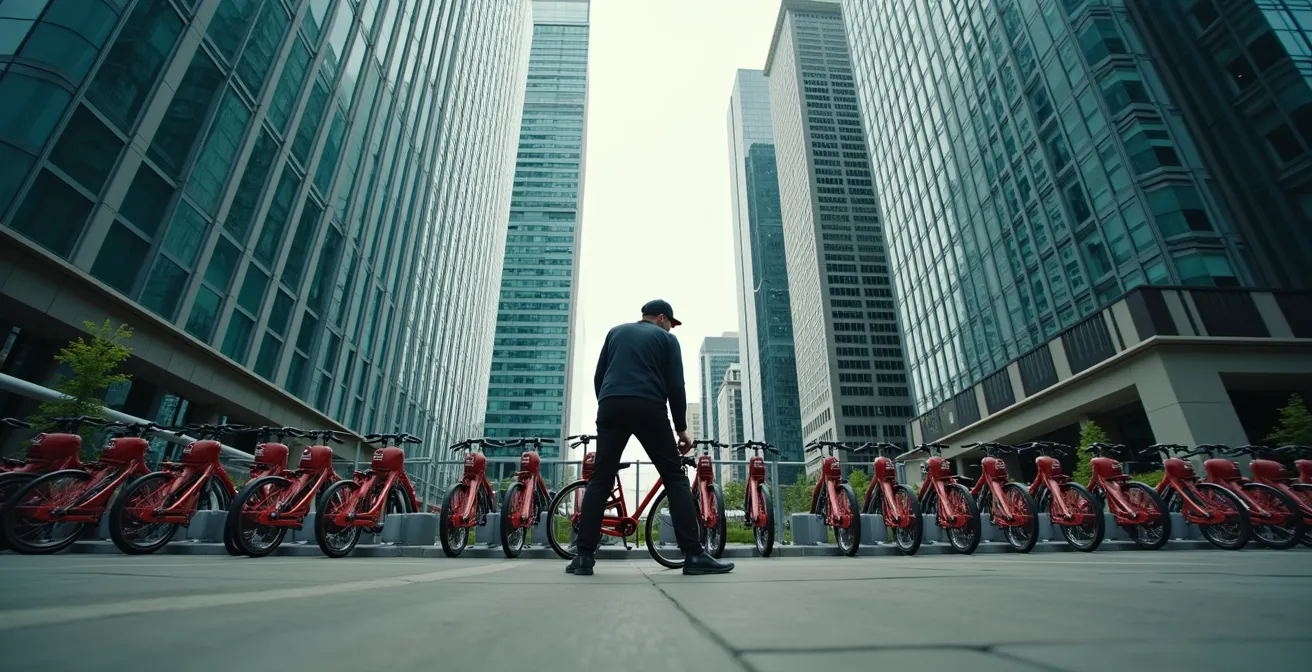
This technique is especially useful during peak hours when you might face a full destination dock. By planning an alternate swap station a block or two away, you can avoid the frantic search for an empty spot while your time ticks away. Think of it as infrastructure literacy for the Bike Share network. Mastering this simple trick transforms the system from a casual tourist tool into a robust and affordable daily commuting solution, freeing you from the anxiety of the ticking clock.
Bloor vs. Harbord: Which Bike Lane Is Safer for Beginners?
Not all bike lanes are created equal, a lesson every Toronto cyclist learns quickly. For those new to the commute, choosing the right route is the single most important decision for building confidence and staying safe. The city offers a variety of infrastructure, and understanding the difference between a major artery like Bloor Street and a calmer route like Harbord Street is crucial. Think of it as a progressive training program: you start on the bunny hill before tackling the black diamond.
Harbord Street is, without a doubt, the ideal training ground for a beginner. It has a relaxed, neighbourhood feel with lower traffic volume and less complex intersections. The bike lanes, while sometimes just painted buffers, are on a street where drivers are generally more accustomed to cyclists and speeds are lower. It’s the perfect environment to practice shoulder checks, signalling, and getting comfortable with sharing the road in a relatively low-stakes setting. It allows you to focus on the fundamentals of urban cycling without the sensory overload of a major thoroughfare.
The following table breaks down the key differences to help you make an informed choice for your skill level. As a beginner, starting on Harbord allows you to build a foundation of skills and confidence that will be essential when you eventually graduate to more challenging routes.
| Feature | Bloor Street | Harbord Street |
|---|---|---|
| Traffic Volume | High-volume commuter artery | Relaxed neighbourhood feel |
| Intersection Complexity | Major multi-lane crossings (Yonge, Spadina) | Calmer residential street crossings |
| Physical Protection | Mix of curbs, planters, and bollards | Simpler painted buffers and bollards |
| Rider Culture | Fast-paced commuters | Students and casual riders |
| Best For | Experienced cyclists, longer east-west travel | Beginners building confidence |
Bloor, on the other hand, is the major league. While its protected bike lanes with curbs and planters offer a higher degree of physical safety, it’s a high-volume, fast-paced commuter artery. The intersections are complex, the drivers can be more aggressive, and the general pace demands a higher level of alertness and confidence. It’s an excellent and efficient east-west route, but for a true beginner, it can be an intimidating and overwhelming experience. By choosing your route wisely, you create a positive feedback loop, making each ride an empowering step forward rather than a terrifying ordeal.
The Locking Mistake That Gets Your Bike Stolen in Downtown
In Toronto, having your bike stolen feels like a rite of passage, but it doesn’t have to be. Most thefts aren’t the result of brute-force attacks on high-end locks; they’re crimes of opportunity that exploit a single, common mistake: improper locking technique. Many cyclists invest in a heavy-duty U-lock but then use it incorrectly, leaving their bike vulnerable. The biggest error is locking only the frame to a bike rack, leaving the expensive wheels unsecured, or locking only the front wheel, which can be easily removed.
The goal of a good locking strategy is to make your bike a less appealing target than the one next to it. This requires a systematic approach. You need a high-quality, Sold Secure Diamond-rated U-lock as your primary defense, especially in high-theft areas. The second crucial component is the technique. The “Sheldon Brown Method” is the gold standard: you pass the U-lock through your rear wheel (inside the rear triangle of the frame), around the bike frame itself, and then around the secure object you’re locking to. This single motion secures your most expensive wheel and the frame simultaneously. A secondary cable can then be used to loop through your front wheel for added security.
Beyond the lock itself, your choice of location is critical. Always choose an immovable object, preferably a city-installed bike ring grouted into concrete, and in a well-lit, high-foot-traffic area. Thieves thrive in seclusion. Following a strict protocol every single time you lock up is the only way to combat the pervasive threat of bike theft in the city.
Your High-Security Bike Locking Protocol
- Choose your anchor: Use only city bike rings that are securely grouted into concrete. Avoid signposts, scaffolding, or anything that can be easily unbolted or lifted.
- Apply the Sheldon Brown Method: Pass your primary U-lock through the rear wheel (inside the rear triangle), the frame, and the bike ring. This secures your frame and rear wheel in one go.
- Use a quality lock: A Sold Secure Diamond or Gold-rated U-lock is the minimum standard for downtown. Cheap locks are an invitation for theft.
- Register your bike: Use the Toronto Police Service’s 529 Garage project. It won’t prevent theft, but it drastically increases the chance of recovery if the worst happens.
- Lock in plain sight: Always choose visible, high-foot-traffic locations for short-term parking. Avoid secluded alleys or leaving your bike overnight in a predictable spot.
When to Switch to Winter Tires for Your Bicycle Commute?
For the dedicated Toronto commuter, the cycling season doesn’t end when the temperature drops. Winter riding can be incredibly rewarding, offering crisp air and surprisingly empty bike lanes. However, it demands a new level of preparation, and the most critical decision is when to switch to your winter tires. Making the change too early can lead to a slow, sluggish ride on dry pavement, but waiting too long is a gamble with black ice that you don’t want to lose. The key is not to watch the calendar, but to watch the overnight temperatures.
The moment temperatures consistently start dipping near or below freezing at night, it’s time to make the switch. This is because the most dangerous condition, black ice, often forms overnight or in the early morning on bridges and in shaded areas, even if the daytime temperature is above zero. Your standard tires will offer zero grip. You have two main options for winter rubber: studded tires or wider, knobby tires. Studded tires are the ultimate defense against ice and are essential if your route is prone to icy patches. For routes that are typically just slushy or snowy, a set of wider, knobby cyclocross or mountain bike tires can provide enough grip while being less sluggish on cleared pavement.

Winter preparation extends beyond tires. You must install full-coverage fenders to protect yourself and your bike’s drivetrain from corrosive salt spray. Upgrading to more powerful lights is also mandatory to compensate for the shorter daylight hours. Finally, familiarize yourself with the city’s network of priority snow-cleared routes, which often include major bike lanes like those on Bloor, Richmond, and Adelaide. Relying on these routes creates a more predictable and safer winter commute, transforming it from a hazardous chore into an invigorating year-round habit.
The Door Radar Mistake That Causes Delays on New Bombardier Trams
Navigating around Toronto’s streetcars is a core skill for any urban cyclist, but the newer Bombardier Flexity Outlook trams introduce their own specific challenges. While they offer a smoother ride for passengers, their sensitive door sensors can create a unique hazard for cyclists known as the “streetcar squeeze.” These doors have a radar that prevents them from closing if an object is too close. A cyclist filtering up alongside a stopped streetcar can inadvertently trigger this sensor, delaying the streetcar and creating a ripple effect of frustration for everyone.
When a tram is unexpectedly held at a stop, impatient drivers behind it often make sudden, aggressive maneuvers to get around it. They may swerve into the bike lane or make an abrupt turn, creating a dangerous and unpredictable environment right where you are. As a cyclist, you must learn to read this situation and react defensively. The law is clear: you must stop two metres behind the open doors of a streetcar or TTC bus. Never try to squeeze past. Anticipate that a delayed streetcar will lead to erratic driver behaviour and take the lane defensively. By positioning yourself in the center of the lane behind the streetcar, you become more visible and prevent cars from attempting a dangerous pass.
According to the Toronto Police Service, cyclists need to use extra caution around obstacles like streetcar tracks, and this extends to the vehicles themselves. Your strategy should be one of proactive defense. Watch for the flashing yellow lights indicating a stop, anticipate impatient drivers, maintain a safe distance, and always yield to boarding passengers. By understanding the technology and psychology at play, you can avoid contributing to delays and protect yourself from the predictable chaos that follows.
Why Are Cars Banned from High Park on Weekends?
For many Torontonians, High Park is the city’s backyard. The decision to ban cars from the park on weekends was a transformative move, turning the park’s winding roads into a sanctuary for pedestrians and cyclists. The primary reason for this policy is safety and the promotion of active transportation. Before the ban, the park’s roads were often treated like a scenic shortcut by drivers, creating conflict and danger for the thousands of people using the park for recreation. By removing vehicle traffic, the city has created Toronto’s largest and most effective safe cycling incubator.
On any given weekend, you’ll see the full spectrum of Toronto’s cycling community. There are young children wobbling on their first two-wheeler, families out for a leisurely pedal, and serious road cyclists training in fast-moving pace lines. The car-free environment provides a safe, low-stress space for new riders to build skills and confidence without the fear of traffic. It’s the perfect place to practice shifting gears, braking, and cornering before venturing onto the city’s more demanding streets. It allows people to experience the joy of cycling in its purest form.
However, this mix of users requires a clear code of conduct. The park isn’t a lawless velodrome; it’s a shared space. Understanding the etiquette is crucial for a safe and enjoyable experience for everyone.
| User Type | Typical Behaviour | Etiquette Rule |
|---|---|---|
| Training Cyclists | Fast pace lines, 30+ km/h | Stay right except to pass; use the full loop. |
| Casual Families | Slow pace, children learning | Be predictable; use the right side of the road. |
| Recreational Riders | Medium pace, sightseeing | Call out passes clearly (“On your left!”). |
| Connections Users | Using park as transit route | Respect speed differentials; be patient. |
By respecting these unwritten rules—slower traffic keeps right, faster cyclists call out their passes, and everyone stays alert for pedestrians and children—High Park functions as a model for how public space can be successfully reclaimed for people. It’s a living demonstration that prioritizing active transport creates a healthier, safer, and more vibrant community.
Key Takeaways
- Rethink “Safety”: True urban cycling safety is not passive; it’s an active, militant skill set based on reading traffic and asserting your space predictably.
- Infrastructure is a Tool: Learn to use different types of bike infrastructure (protected lanes, shared routes, transit corridors) as a “progressive training” network to build skill and confidence.
- Master the Micro-Skills: Success lies in the details—knowing how to lock your bike properly, when to change your tires, and how to use Bike Share without fees are non-negotiable local skills.
How to Commute on the 504 King Streetcar Without Losing Your Mind?
The King Street Transit Priority Corridor is the ultimate test of a Toronto cyclist’s skill and nerve. It’s a dynamic, complex environment that encapsulates every challenge of urban riding. Here, you are not just a cyclist; you are a small, agile vehicle navigating a channel dominated by streetcars, pedestrians, and cars making mandatory right turns. To ride on King Street is to practice the highest form of infrastructure literacy. Losing your mind is optional; mastering the corridor is a matter of tactical awareness and following a strict set of rules.
First and foremost, you must understand your place in the hierarchy: the streetcar is king. Your most critical task is to never impede its progress and to always respect its space. This means always stopping behind open streetcar doors—it’s not just polite, it’s the law, and the fines are significant. You must also learn to navigate carefully around the raised platform islands, using the designated cycling zones and watching for pedestrians who may step out unexpectedly. The corridor’s design forces through-traffic off King, which leads to a constant threat of “right hook” collisions at intersections. You must be hyper-aware at every cross-street, anticipating that any car beside you is likely to turn.
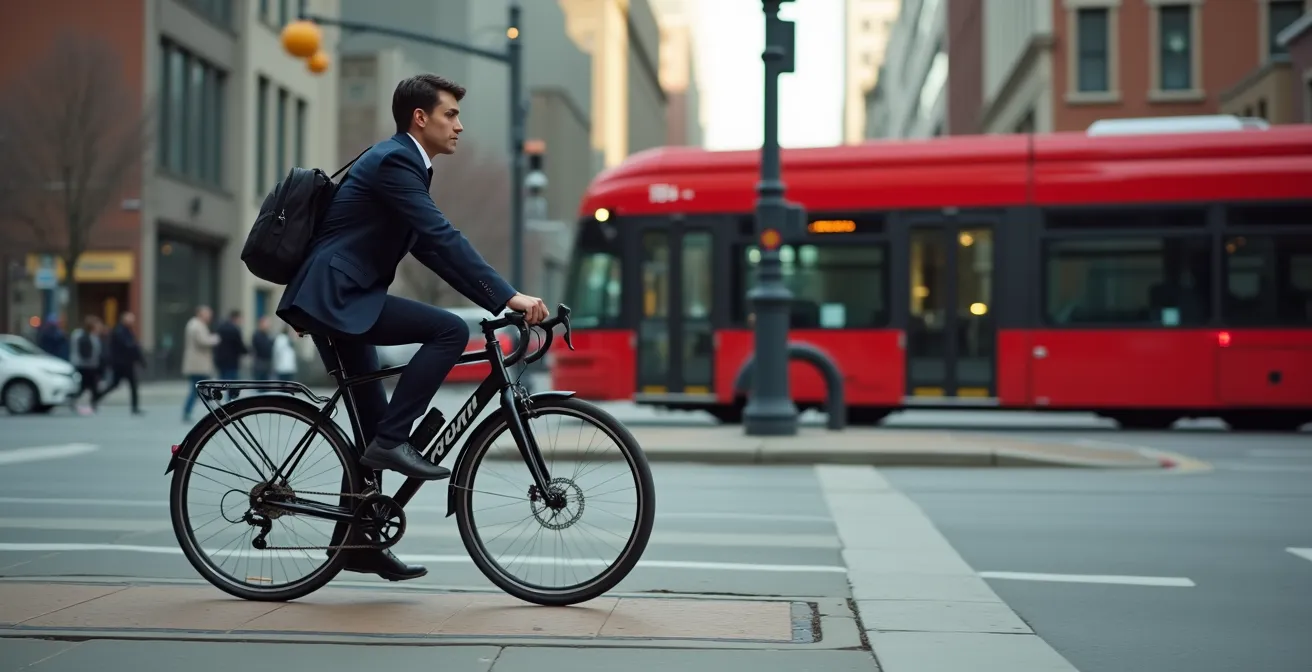
Successfully commuting on King Street is a masterclass in all the principles we’ve discussed. It requires the defensive posture needed around streetcars, the route-planning knowledge to know when to transition to an adjacent bike lane (like at Peter or Simcoe), and the situational awareness to anticipate driver and pedestrian behaviour. It’s not a route for beginners, but by applying a disciplined approach, it can be a surprisingly efficient way to cross the downtown core. It proves that with the right mindset—one of predictable militancy and deep environmental awareness—a cyclist can not only survive but thrive in Toronto’s most challenging transportation artery.
Embracing these strategies transforms you from a vulnerable road user into a confident and capable urban navigator. The next step is to take this knowledge from the screen to the street, one pedal stroke at a time, and start reclaiming your commute.