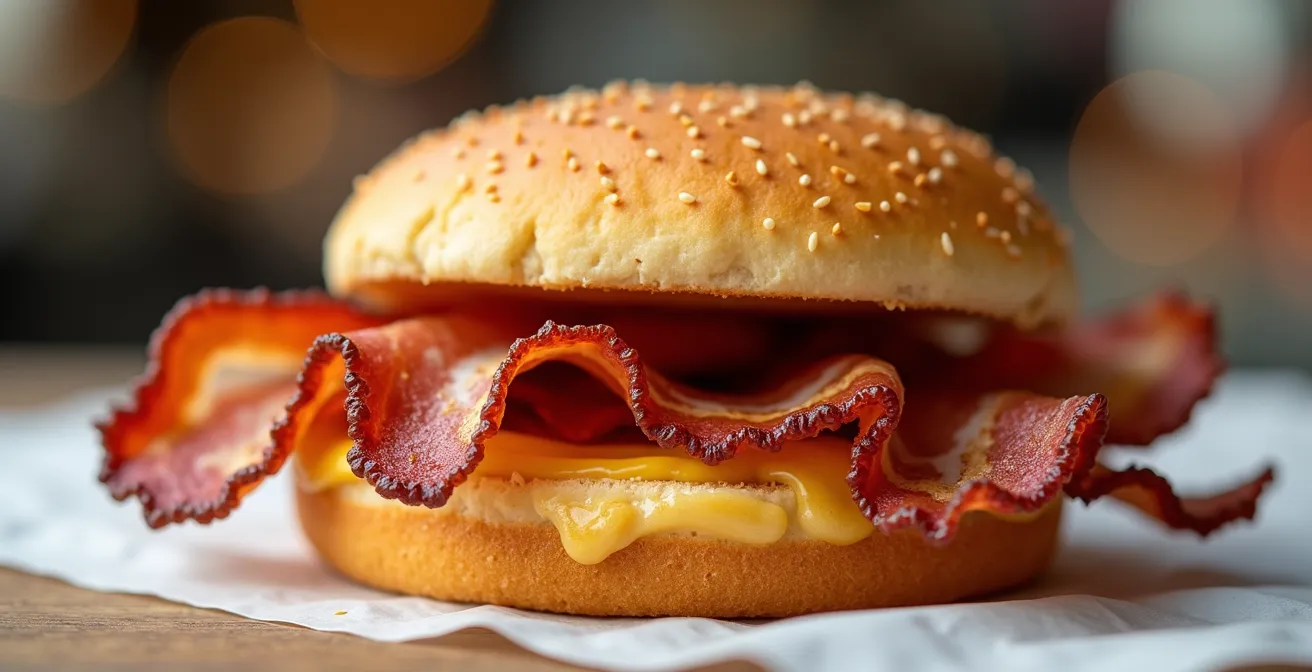
The perfect peameal bacon sandwich is a matter of science and technique, not just fame.
- The quality of a sandwich lies in the thick-cut, properly rendered pork loin and a kaiser roll with the structural integrity to handle the juices.
- Timing is everything; ordering during off-peak hours at St. Lawrence Market drastically increases your chances of getting freshly cooked slices.
Recommendation: Use the 5-point inspection checklist in this guide to assess the meat-to-bun ratio, the ‘bacon smile,’ and condiment quality before you take a single bite.
Walk into St. Lawrence Market, and the smell hits you: the savoury, unmistakable scent of seared pork. For decades, tourists and locals alike have made the pilgrimage, lining up for what is hailed as Toronto’s signature sandwich. Most people will tell you to just “go to Carousel Bakery” and order one. They’ll call it a “must-try” and leave it at that. This is lazy advice. Treating a peameal bacon sandwich like a simple checklist item is an insult to the craft of butchery and the city’s “Hogtown” legacy.
This isn’t just a sandwich; it’s a technical assembly. It’s not made from the fatty belly like regular bacon; it’s carved from the lean, tender pork loin, wet-cured, and rolled in a golden cornmeal crust. Judging it requires more than a hungry stomach; it requires an expert eye. The common wisdom tells you where to go, but it never tells you what to look for. It doesn’t explain why a soggy bun is a cardinal sin or why the curl of the bacon on the griddle is a critical sign of quality.
Forget the tourist traps and the generic praise. We’re going to deconstruct this icon. The real key isn’t finding the longest lineup, but understanding the science behind the sizzle. It’s about assessing the cure, the cook, the construction, and the context. This isn’t a food review; it’s a butcher’s manual for appreciating a piece of Toronto’s history done right.
This guide will equip you with the knowledge to dissect every element, from its historical roots to the final, perfect bite. We will cover the technical details of its preparation, the heated debate between market rivals, and the insider strategies for getting the best possible product. Prepare to look at this sandwich in a whole new way.
Summary: Deconstructing the Perfect Peameal Bacon Sandwich
- Why Is Peameal Bacon Rolled in Cornmeal, Not Peas?
- How to Fry Peameal Bacon Without Drying It Out?
- Carousel vs. Paddington’s: Who Makes the Best Bun on the Market?
- The Sodium Risk of Eating Peameal Bacon Daily
- When Is the Best Time to Order a Sandwich to Get Freshly Sliced Meat?
- How to Choose the Best Peameal Bacon Sandwich at the Market?
- Why Did Sushi Pizza Become a Toronto Staple?
- How to Shop Like a Chef at St. Lawrence Market?
Why Is Peameal Bacon Rolled in Cornmeal, Not Peas?
Let’s clear the air on the biggest misnomer in Canadian charcuterie. Peameal bacon isn’t rolled in peas, and it hasn’t been for a century. The name is a relic, a ghost of a preservation technique born from necessity. The entire practice comes down to one man and the logistics of shipping pork across an ocean. William Davies, a pork curer who came to Canada from England in the 1850s, is credited with developing the method. To extend the shelf life of his cured loins for export back to the UK, he rolled them in a crust of dried, ground yellow peas. This was a practical solution in a world before widespread refrigeration.
William Davies Company’s Historic Transition from Peas to Cornmeal
The original method of using a peameal crust was a functional choice for preservation during transatlantic shipping. However, the landscape of food production changed dramatically after World War I. Improved refrigeration and different agricultural supply chains made the peameal crust obsolete. Cornmeal was more readily available and became the new standard. As William Davies’s company evolved, the name ‘peameal’ stuck due to brand recognition, even as the core ingredient of its crust changed forever.
So, what you see today is a cornmeal crust. This isn’t a “fake” version; it’s the modern evolution of the product. The cornmeal provides a fantastic texture when seared, creating a slight crunch that contrasts beautifully with the tender, juicy loin. The name is a nod to our “Hogtown” history, but the ingredient is pure modern function. As the experts at TasteToronto note, this change has been the standard for generations.
By the early 1900s, his company had expanded into a food store chain and a sizeable pork exporting business, contributing to the popularity of this cured back bacon (which, by the way, began to get rolled in cornmeal following WWI due to availability, and this is still how we see peameal bacon prepared today).
– TasteToronto, The Best Peameal Bacon Sandwiches in Toronto
Understanding this history is the first step in appreciating the sandwich. It’s a product shaped by technology, trade, and tradition. The cornmeal isn’t a substitute; it’s the defining characteristic of the peameal bacon we know and eat in Toronto today.
How to Fry Peameal Bacon Without Drying It Out?
There’s a fine line between a perfectly seared, juicy slab of peameal bacon and a dry, leathery pork coaster. The secret isn’t in a fancy pan; it’s in technique, temperature, and respect for the meat. Peameal bacon is cut from the loin, a very lean muscle. Unlike belly bacon, it doesn’t have layers of fat to keep it moist during a long, slow cook. The goal is a quick, violent sear that creates a crust via the Maillard reaction, locking in the juices before they have a chance to steam away. Amateurs cook it too long at too low a heat, effectively boiling the moisture out of it.
The first rule is the cut. A proper slice of peameal should be thick, at least ¼ to ⅓ of an inch. Anything thinner is destined for dryness. This thickness acts as an insurance policy, giving you a thermal buffer to achieve a good sear on the outside while the inside remains tender. The griddle must be searingly hot. You’re not gently warming it through; you are attacking it with heat. The rendered pork fat is all the grease you need. Forget adding oil or butter; it’s unnecessary and masks the pure flavour of the pork.
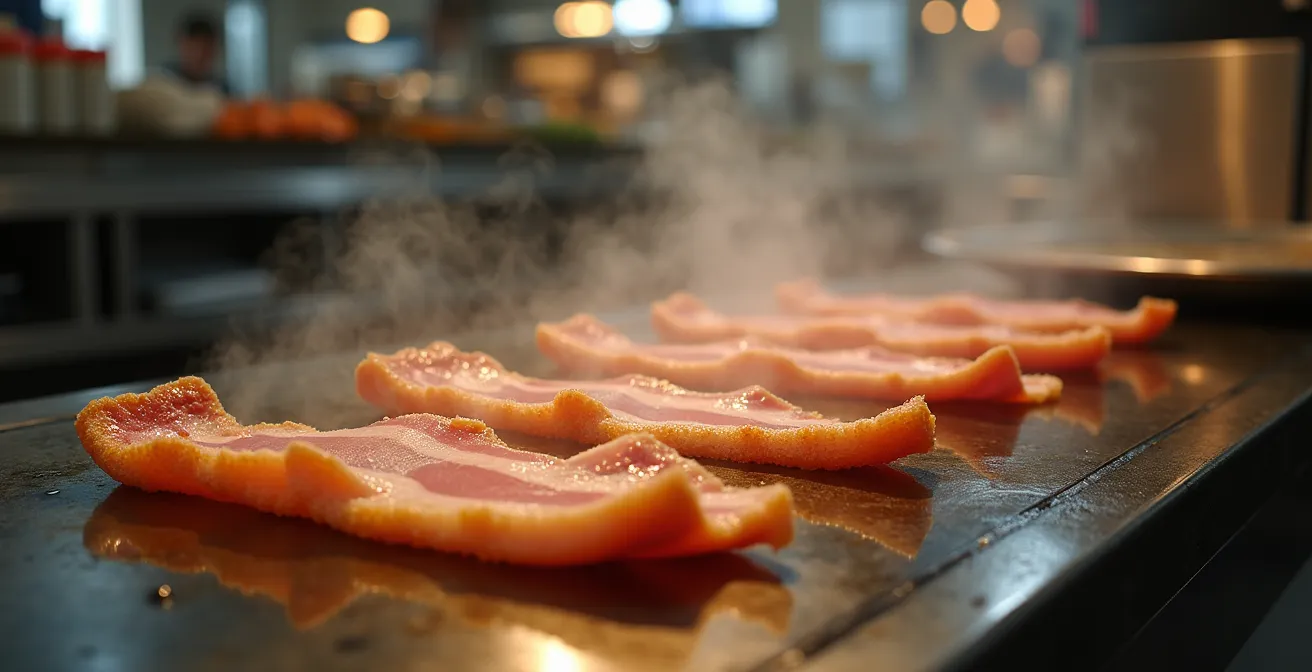
The cooking process should be brutally short: 60 to 90 seconds per side is often all it takes. Lay the slices down and leave them alone. Do not press down on the meat with a spatula. This is the single greatest sin in peameal cookery, as it squeezes out the very moisture you’re trying to preserve. Look for the “bacon smile”—that signature curl that appears at the edges as the thin layer of fat renders and tightens. This is your visual cue that the fat is doing its job, basting the meat while the center remains succulent. When you see that smile, it’s time to flip.
Carousel vs. Paddington’s: Who Makes the Best Bun on the Market?
At St. Lawrence Market, the peameal bacon sandwich war is a two-front battle, fought between Carousel Bakery and Paddington’s Pump. Tourists flock to Carousel, drawn by its “World Famous” sign and the lore that they originated the sandwich. Locals and contrarians often swear by Paddington’s. From a butcher’s perspective, the fame is irrelevant. The only thing that matters is the quality of the components and the final assembly. The debate is less about who is “best” and more about which experience you prefer.
The core product—the peameal bacon itself—is often remarkably similar, sourced from many of the same local pork producers. The real differentiators are the bun, the condiments, and the atmosphere. Both vendors typically use a classic, soft kaiser roll. The key quality marker here is structural integrity. A good kaiser has a crust firm enough to prevent total collapse under the onslaught of bacon juice and mustard, but a crumb soft enough to yield without a fight. Both Carousel and Paddington’s generally deliver on this front, using rolls from quality local bakeries.
The following table breaks down the core differences in the experience, based on what a connoisseur should be looking for:
| Aspect | Carousel Bakery | Paddington’s Pump |
|---|---|---|
| Bun Quality | Soft kaiser roll from local bakery, firm crust prevents collapse | Similar kaiser roll quality with good juice absorption |
| Mustard Selection | 12 different condiments including 5 mustards (2 Kozlik’s varieties) | Standard selection with quality options including Kozlik’s |
| Atmosphere | Classic no-frills ‘Hogtown experience’, takeout counter only | Restaurant seating available, can enjoy with beer |
| Heritage | Original creator since 1960s, ‘World Famous’ designation | Strong competitor with own loyal following |
| Price Point | $6.45 (classic version) | $6.45 (‘Oink on a Kaiser’) |
Ultimately, the choice comes down to personal preference. As noted in a detailed analysis by the Sandwich Tribunal, Carousel has the historical claim, but Paddington’s offers a different kind of comfort. Do you want the pure, stand-up, lean-over-a-garbage-can Hogtown experience? Go to Carousel. Do you want to sit down and enjoy your sandwich with a cold beer? Paddington’s is your spot. The quality of the core product is comparable; the experience is what you’re choosing.
The Sodium Risk of Eating Peameal Bacon Daily
Let’s have a frank conversation. As a butcher, I love cured pork. It’s an art form. But part of respecting the meat is understanding what it is: a preserved food, and preservation means salt. The wet cure that makes peameal bacon so juicy and flavourful is a brine, and that brine is loaded with sodium. While it’s a delicious indulgence, thinking of a peameal bacon sandwich as a daily meal is a fast track to health problems. This isn’t health-food fearmongering; it’s a matter of simple chemistry.
The numbers don’t lie. This isn’t your standard breakfast fare. A 2018 lab analysis of the city’s most famous sandwich revealed some staggering figures. The classic peameal bacon sandwich from Carousel Bakery contains an astronomical 2,520 mg of sodium. To put that in perspective, the recommended maximum daily sodium intake for an adult is 2,300 mg. That means one sandwich delivers more than your entire day’s worth of sodium before you’ve even had a glass of water.
This sodium level puts it in a category far beyond other cured meats. A 100g serving of side bacon, which people often consider salty, contains around 1,717 mg of sodium. Turkey bacon, often marketed as a healthier alternative, still clocks in at 2,285 mg per 100g. The peameal bacon sandwich, in its traditional Toronto form, surpasses them all. It’s a salt bomb by any definition.
Dietitian Shannon Crocker felt the calories and protein would make it a satisfying meal, but the sodium was 10% above the maximum recommended daily limit.
– Shannon Crocker, Laboratory Analysis of Peameal Bacon Sandwich
This doesn’t mean you should never eat one. It means you should treat it with the respect it deserves: as a rich, satisfying, and occasional treat. It’s a celebratory food, a weekend indulgence, a perfect representation of Toronto’s culinary history. It is not, and should never be, a daily staple. Enjoy it, savour it, and then drink plenty of water.
When Is the Best Time to Order a Sandwich to Get Freshly Sliced Meat?
The difference between a transcendent peameal bacon sandwich and a merely acceptable one often comes down to a single variable: freshness. More specifically, how long the cooked bacon has been sitting on the griddle. The vendors at St. Lawrence Market are dealing with massive crowds, and to keep up, they cook large batches of bacon at once. The slices are then held on a warm part of the griddle. Order at the wrong time, and you’re getting bacon that’s been steaming in its own juices for twenty minutes, slowly turning soft and losing that perfect seared texture.
The amateur goes at 12:30 PM, the absolute peak of the lunch rush, and gets whatever is available. The pro knows how to work the system. You must target the “off-peak” windows. The goal is to arrive either just before a rush or right after one, when the vendors are likely cooking a fresh batch. Your prime times are between 11:15 AM and 11:45 AM (before the main lunch onslaught) or between 2:00 PM and 2:45 PM (after the rush has subsided). This is when you’re most likely to get slices straight from the hot zone of the griddle.
For the truly dedicated, Saturday morning is a golden opportunity. The market opens at 5 AM, and vendors are cooking up their first, freshest batches for the weekend crowds. This is when you get the best of the best. Beyond just looking at the clock, use your senses:
- Listen for the sizzle: The sound of a new batch hitting the hot griddle is the clearest auditory cue you can get. If you hear it, get in line immediately.
- Look for the steam: A pile of bacon with a healthy amount of steam rising from it is a good indicator of freshness. A dry-looking pile has been sitting.
- Use the right language: Instead of just ordering, ask the person at the counter, “Anything just came off the grill?” This insider question signals that you know what you’re looking for and often results in them grabbing you the freshest slices.
Timing your order isn’t being picky; it’s a strategic move to ensure you experience the sandwich as it’s meant to be: hot, juicy, with a perfectly crisp cornmeal crust. It’s the difference between eating a sandwich and having a religious pork experience.
How to Choose the Best Peameal Bacon Sandwich at the Market?
You’ve timed your visit perfectly, you understand the history, and you’re standing at the counter. Now comes the final judgment. Choosing the best sandwich is an active process of observation. You need to look at the product with a critical, butcher’s eye. Before you even hand over your money, you can spot the warning signs of a subpar sandwich or the hallmarks of a great one. It’s about looking past the hype and focusing on the physical evidence in front of you.
The first thing to assess is the meat-to-bun ratio. A proper sandwich should be generous, typically loaded with four thick slabs of bacon. It should look substantial, almost difficult to eat, but not so overstuffed that the bun is completely lost. Next, look at the bacon itself. As we discussed, you want to see that “bacon smile”—the curled, seared edges that indicate a perfect render. The surface should have a golden-brown crust from the cornmeal, not a pale, steamed appearance. If the bacon looks flat and wet, it’s been sitting too long.
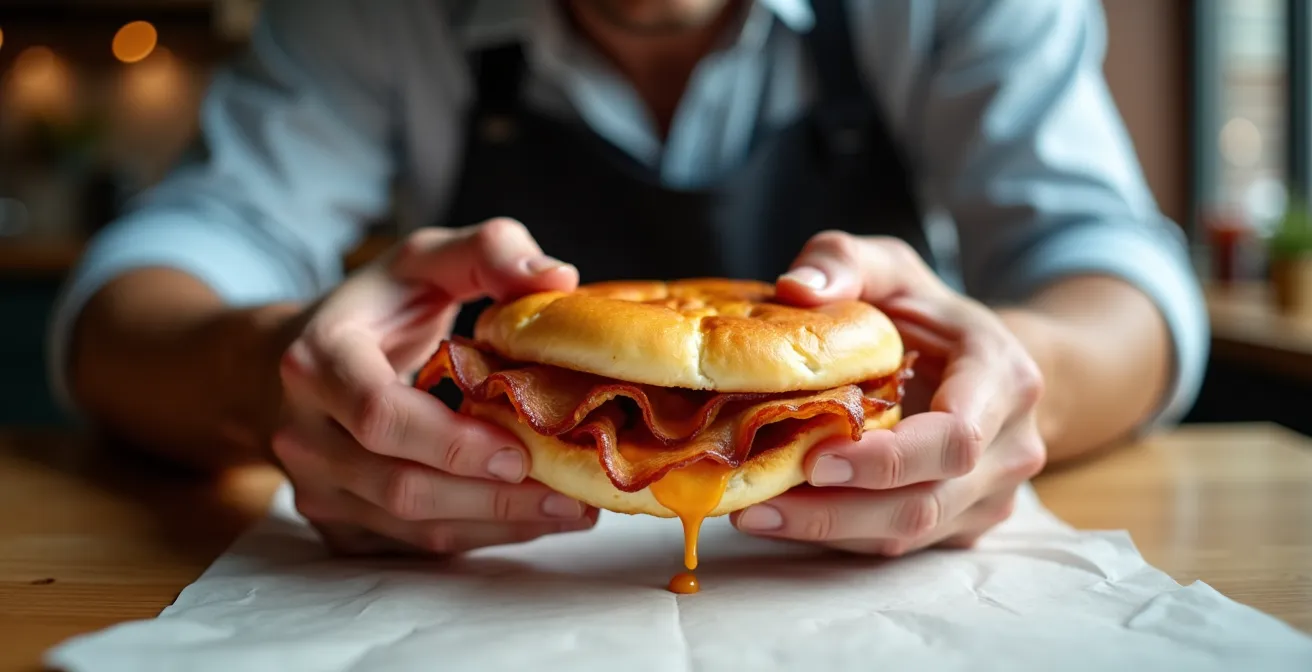
Finally, consider the condiments. A top-tier vendor will offer high-quality, flavourful mustards. Look for local Toronto brands like Kozlik’s Canadian Mustard. The presence of a quality, spicy mustard signals an attention to detail that likely extends to the rest of the sandwich. The perfect first bite should be a symphony of textures and tastes: the saltiness of the pork, the juiciness of the loin, the soft yield of the kaiser roll, and the crisp little pops from the cornmeal crust, all cut through by the sharp tang of good mustard. To avoid disaster, you must adopt the “Toronto Lean”—the mandatory forward-angled posture to prevent drips from hitting your shirt. It’s a rite of passage.
Your 5-Point Sandwich Inspection Checklist
- Bun Integrity: Visually check if the kaiser roll looks robust. Does it appear capable of holding together without disintegrating from the bacon juices and mustard?
- The ‘Bacon Smile’: Look for the tell-tale curl on the edges of the bacon slices. This indicates a proper sear and fat rendering, promising a juicy interior and crisp exterior.
- Meat-to-Bun Ratio: Audit the generosity of the serving. A classic sandwich should have at least 4 thick slabs, creating a hearty but balanced ratio with the bun.
- Condiment Quality: Scan the condiment station. The presence of premium, local options like Kozlik’s mustard over generic yellow mustard is a strong sign of a quality-focused vendor.
- The First-Bite Test: Upon eating, does the experience deliver a perfect mix of salty pork, a juicy interior, a soft bun, and the distinct crisp of the cornmeal crust?
Why Did Sushi Pizza Become a Toronto Staple?
While we’re deep in the heart of Hogtown’s legacy, you can’t talk about Toronto’s iconic foods without acknowledging its modern, multicultural identity. The peameal bacon sandwich represents the city’s industrial, Anglo-Saxon roots. But just a few blocks from the market, you’ll find its spiritual successor and stylistic opposite: the sushi pizza. Understanding this dish is key to understanding the city’s culinary evolution. It shows how Toronto moved from a centre of pork processing to a global hub of food innovation.
The sushi pizza is everything the peameal sandwich is not: delicate, complex, and a product of cultural fusion. It’s a testament to the city’s dynamic food scene where different culinary traditions meet and create something entirely new. It has nothing to do with pork, but everything to do with Toronto’s identity.
Chef Kaizen Endo’s Invention of Toronto’s Sushi Pizza
The dish was famously invented by chef Kaizen Endo in the 1990s. The authentic Toronto version is very specific: it’s not a cold rice cake. It features a deep-fried sushi rice patty that’s crispy on the outside and soft on the inside. This hot, crispy base is then topped with thinly sliced raw salmon, a drizzle of spicy Kewpie mayonnaise, and a sprinkle of tobiko (flying fish roe). This exact combination is a fusion of Japanese technique with North American palates, a perfect symbol of the city’s contemporary food scene. It stands alongside the peameal bacon sandwich not as a competitor, but as a representation of a different, more modern Toronto.
Including sushi pizza in a discussion about a pork sandwich isn’t a detour; it’s essential context. It highlights the delicious paradox of Toronto. This is a city that proudly holds onto its “Hogtown” heritage, celebrating a simple, perfectly executed pork sandwich, while simultaneously creating and championing globally recognized fusion dishes. One represents the city’s past, the other its present and future. A true connoisseur of Toronto’s food scene must appreciate both.
Key Takeaways
- A superior peameal bacon sandwich is defined by a thick cut (¼-⅓ inch), a quick sear on high heat, and a kaiser roll with excellent structural integrity.
- The name is a historical relic; modern peameal bacon is rolled in cornmeal, not peas, a change that occurred after WWI.
- Treat the sandwich as an occasional indulgence, as a single serving can contain over 110% of the recommended daily sodium intake.
How to Shop Like a Chef at St. Lawrence Market?
You’ve learned to judge a peameal bacon sandwich. The final step in your education is to transcend the prepared sandwich and learn to source the components yourself. Shopping like a chef at St. Lawrence Market means bypassing the takeout counters and going directly to the purveyors of raw ingredients. This is how you achieve ultimate control over the final product, creating a sandwich at home that can rival anything you buy. It’s about building relationships and knowing where to find the best of the best.
First, skip the pre-made sandwiches and head to a premium butcher. Stalls like Di Liso’s Fine Meats sell the raw, cured peameal loin. This allows you to slice it to your desired thickness at home—a crucial element of control. Next, seek out an authentic market bakery for your kaiser rolls. The freshness of the bun is non-negotiable. For the final, critical flavour component, go directly to the source: find the Kozlik’s Canadian Mustard stall and select a jar of their spicy, flavourful mustard. This is the authentic taste of Toronto.
The timing of your shopping trip matters as much as the timing of your order. As local market experts will tell you, Saturday morning is the prime time. This is when the city’s top chefs do their personal shopping, and vendors have their freshest, highest-quality stock on display. It’s a vibrant, competitive environment where the best products are snapped up quickly.
Saturday morning is when many Toronto chefs do their personal shopping.
– Local Market Expert, St. Lawrence Market Shopping Guide
More than just buying ingredients, shopping like a chef means building relationships with the vendors. Talk to your butcher. Ask them what’s good that day. They are the ultimate experts and will guide you to the best cuts and seasonal specialties. A chef doesn’t just shop from a list; they shop based on what is freshest and best, guided by the expertise of the people who live and breathe their craft.
Now that you possess the knowledge to judge, critique, and even construct your own perfect peameal bacon sandwich, the next step is to put that knowledge into practice. Go to the market not as a tourist, but as a connoisseur.