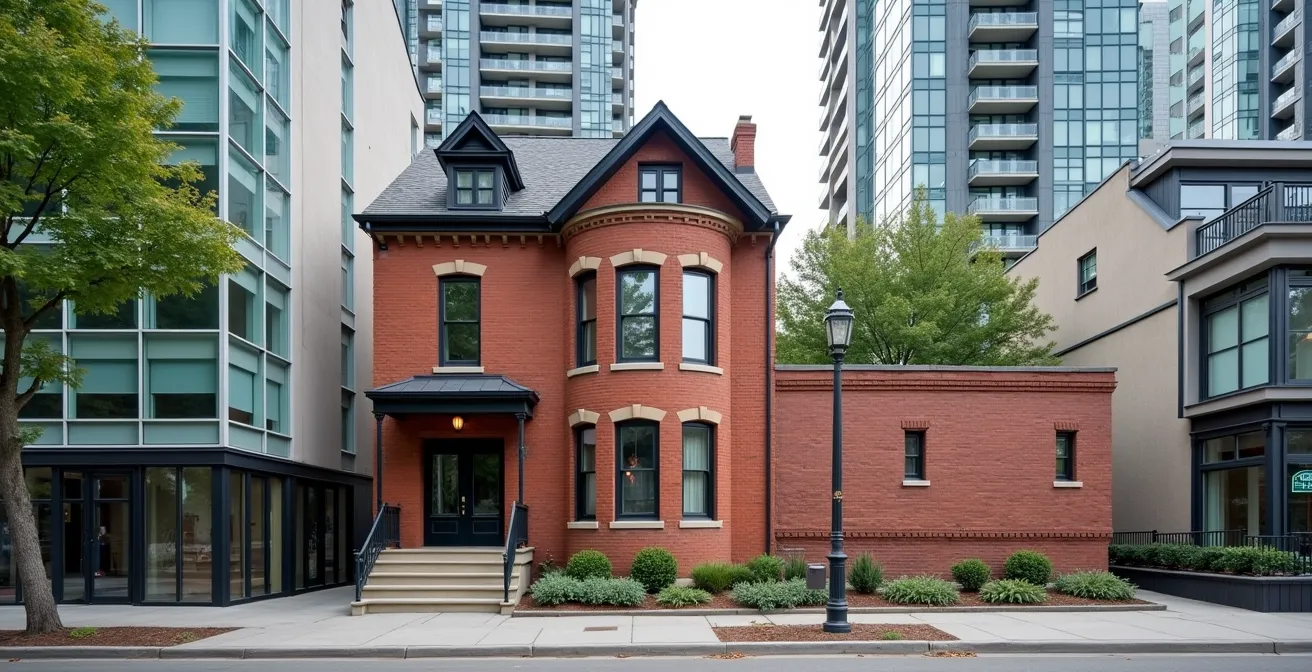
The Toronto Half House is more than a stubborn family’s victory; it’s an accidental monument to the absurdities of urban property law.
- Its “weirdness” comes from a legal and structural stalemate, not intentional design.
- Photographing it successfully means capturing the story of this “architectural scar,” not just an odd building.
Recommendation: To truly appreciate it, explore its history and the surrounding Grange neighbourhood laneways, where the story of Victorian Toronto unfolds.
At first glance, the house at 54 1/2 St. Patrick Street in Toronto seems like a glitch in the urban matrix. A narrow, bay-and-gable Victorian home stands proudly, but where its other half should be, there is only a flat, blank wall. It looks like a digital rendering error, a house literally sliced in two. The common tale whispered among urban explorers is one of defiance—a single family who refused to sell to powerful developers, forcing them to build around their property. While true, this simple narrative barely scratches the surface of the architectural and bureaucratic absurdity that created this landmark.
This is not just a story of a holdout. It is a physical monument to the unintended consequences of property law, the precarious nature of structural interdependence in Victorian architecture, and the fascinating process of forced adaptation. To see the Half House is to see an architectural scar on the city’s fabric, a testament to a conflict that ended not in a victory, but in a bizarre, permanent compromise. For photographers and architecture nerds, the challenge isn’t merely to capture a quirky building, but to document a piece of living history that tells a much deeper story about Toronto’s evolution.
This guide moves beyond the simple folklore. We will delve into the legal and structural drama that led to the demolition, analyze its unique architectural status, and provide a detailed plan for capturing its strange beauty. We’ll explore why this “preservation by circumstance” is a more compelling story than any intentionally weird design and how it serves as a masterclass in the hidden challenges of maintaining Toronto’s historic homes.
To fully grasp this unique piece of Toronto’s heritage, this article breaks down its history, photographic potential, and architectural significance. Explore the sections below to understand the full story of the Half House.
Summary: An Architectural Historian’s Guide to Toronto’s Famous Half House
- Why Was Only Half of 54 1/2 St. Patrick Street Demolished?
- How to Frame the Half House to Emphasize the Missing Half?
- The Half House vs. The Cube House: Which Is Toronto’s Weirdest Home?
- The Structural Risk Myth: Is the Half House Actually Stable?
- When Does the Sun Hit the Exposed Wall for the Best Photo?
- How to Apply for Heritage Grants to Restore Your Brick Facade?
- How to Map a Laneway Photo Walk for Golden Hour Lighting?
- How to Maintain a Victorian Home in Toronto Without Going Broke?
Why Was Only Half of 54 1/2 St. Patrick Street Demolished?
The story of the Half House is a classic Toronto tale of development versus preservation, but with a twist of sheer stubbornness. In the mid-20th century, developers began buying up the row of Victorian houses on St. Patrick Street to make way for a new project. They successfully acquired every property except one: 54 1/2, owned by the Valkos family. Despite repeated and increasingly lucrative offers, the family refused to sell the home they had lived in for decades. This impasse led to a fascinatingly absurd outcome. Instead of abandoning the project, the developers decided to proceed by demolishing everything *around* the Valkos property.
The house at 54 1/2 was part of a “semi-detached” pair, meaning it shared a crucial, load-bearing wall with its neighbour, 54 St. Patrick. The development plan required the demolition of number 54, but not 54 1/2. In a feat of careful—and incredibly risky—deconstruction, workers had to literally slice the building in half along the property line. According to reports from the time, the process was fraught with danger. A single miscalculation could have compromised the structural interdependence of the two homes, potentially causing the collapse of the very house they were trying to preserve. The result is the architectural anomaly we see today: a house whose other half is simply gone.
This act of surgical demolition, born from a stalemate between a determined family and an equally determined developer, is what makes the house a legend. It wasn’t an act of vandalism or a mistake; it was the only logical, albeit bizarre, solution to a legal standoff. The property, with its phantom limb, stands as a monument to this history. Remarkably, despite its odd configuration, a current city assessment reveals the property value stands at $648,000, proving that even half a house in Toronto holds significant worth.
How to Frame the Half House to Emphasize the Missing Half?
Photographing the Half House effectively is about telling its story, not just capturing an oddity. The goal is to emphasize the “missing” part of the structure, transforming a picture of a house into a portrait of an “architectural scar.” The most powerful composition is a low-angle shot from the north side, looking up at the flat, featureless wall. This perspective exaggerates the abrupt vertical line where the other house was severed, creating a surreal sense of void and absence. The contrast between the detailed, 19th-century bay-and-gable facade and the stark, modern stucco of the exposed wall becomes the central subject.
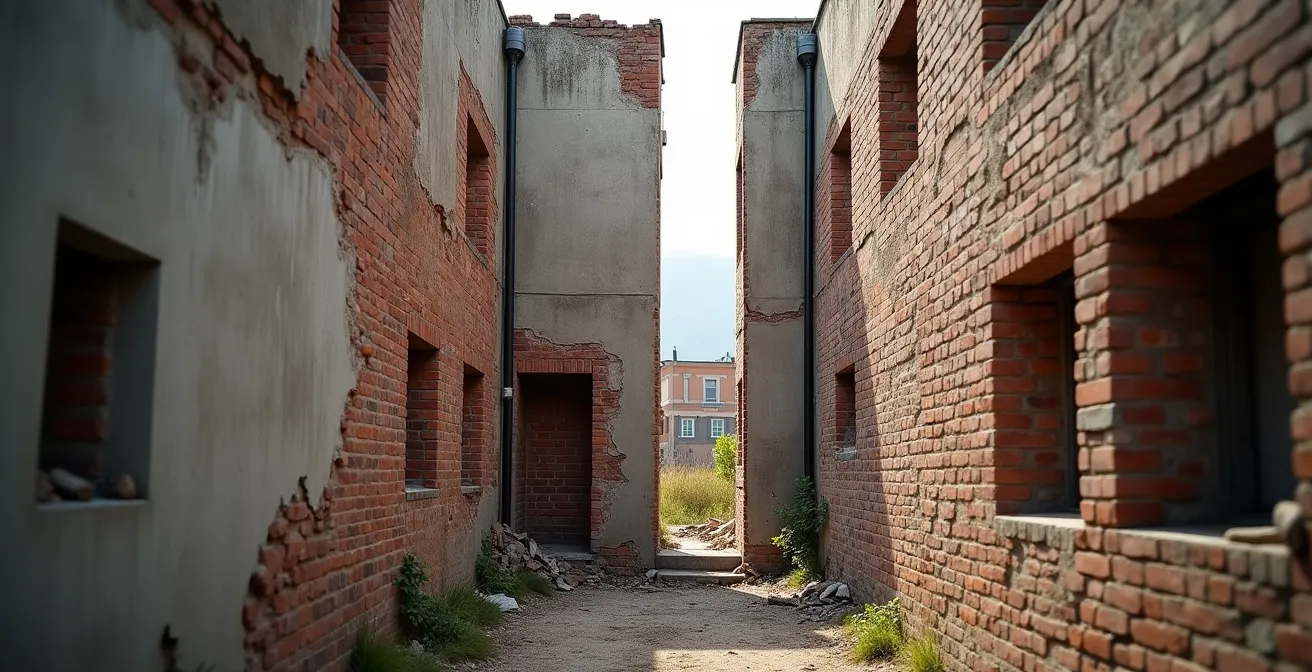
As the illustration above suggests, a dramatic angle is key. Avoid shooting it straight-on from across the street, as this can flatten the image and make it look like a simple narrow house. Instead, get closer and use a slightly wider lens (around 35mm-50mm) to create a sense of scale and drama. The real artistry lies in capturing the tension between what is there and what is not. Frame the shot so the clean edge of the sheared wall acts as a strong leading line, drawing the viewer’s eye up into the empty space where the rest of the building should be. This framing transforms the photograph from a simple snapshot into a commentary on forced adaptation and urban memory.
Your Action Plan: Preparing the Perfect Half House Shot
- Points of contact: List all key angles—a low-angle shot emphasizing the sheared wall, a straight-on composition for the “optical illusion” effect, and a contextual shot showing its juxtaposition with modern neighbouring buildings.
- Collect: Inventory existing photos of the house online to identify overused compositions and discover unique, less-captured perspectives or details.
- Coherence: Confront your planned shot with the house’s story. Are you just capturing a weird building, or are you visually articulating the narrative of the “architectural scar”?
- Memorability/emotion: Pinpoint the unique visual element—the flat stucco void against the ornate brick—and make it the focal point, avoiding a generic photo of a Victorian house.
- Plan of integration: Plan your visit to coincide with the golden hour, specifically when the late afternoon sun illuminates the exposed western-facing wall and creates dramatic textures.
The Half House vs. The Cube House: Which Is Toronto’s Weirdest Home?
When discussing Toronto’s architectural oddities, the conversation inevitably turns to two prime candidates: the accidental icon at 54 1/2 St. Patrick Street and the deliberately unconventional Cube House at 1 Sumach Street. While both are magnets for photographers and urban explorers, their “weirdness” stems from fundamentally opposite origins. The Cube House is a product of artistic intention, an avant-garde statement designed to challenge conventional notions of living space. Its tilted, geometric form is weird by choice. The Half House, however, is weird by circumstance. Its strangeness is not a design feature but the result of a protracted real estate dispute and a subsequent act of forced adaptation.
This distinction is critical from an architectural historian’s perspective. The Cube House represents a proactive architectural movement, whereas the Half House is a reactive solution to a bureaucratic and legal problem. It is a piece of “accidental architecture” whose form was dictated by a property line. As BlogTO once aptly put it, “It’s not an optical illusion. This Toronto house really has been sliced and diced.” This involuntary transformation makes its story arguably more compelling and deeply rooted in the city’s social and economic history.
The following table, based on information from sources like a recent comparative analysis, breaks down the key differences between these two Toronto landmarks, highlighting why the Half House’s peculiar charm is truly one of a kind.
| Criteria | Half House (54 1/2 St. Patrick) | Cube House (1 Sumach St) |
|---|---|---|
| Origin Story | Accidental – Result of partial demolition | Intentional – Artistic architectural statement |
| Construction Era | 1890-1893 Victorian row house | Contemporary avant-garde design |
| Architectural Style | Bay-and-gable Victorian (partially destroyed) | Geometric modernism |
| Weirdness Factor | Forced adaptation from demolition dispute | Deliberate unconventional design |
| Instagram Appeal | High – Optical illusion effect | High – Unique geometric form |
The Structural Risk Myth: Is the Half House Actually Stable?
The very existence of the Half House begs a crucial question: is it even safe? The idea of slicing a 19th-century brick building in half seems structurally reckless. The shared wall in a semi-detached Victorian home is not merely a divider; it’s a critical load-bearing element. The demolition process was an immense structural gamble. As engineering analyses of the event confirm, the demolition required surgical precision to avoid a catastrophic collapse. The successful separation is a testament to the skill of the demolition crew, but survival was just the beginning of the building’s structural challenges.
Post-demolition, the newly exposed wall was a raw, unprotected wound. The original owners quickly faced problems, complaining to city officials about rain seeping into their home. The core of the problem was that this wall was never meant to be an exterior wall. It lacked proper insulation, weatherproofing, and finishing. Arguments ensued over who was responsible for sealing and protecting the new facade. This process of forced adaptation involved reinforcing the wall and covering it with the plain stucco we see today, a functional but aesthetically jarring solution that serves as a permanent scar. The stability of the house today is a result of these post-demolition reinforcements.
Interestingly, city officials have confirmed that such a demolition could still happen today in Toronto. Provided the proper permits are issued, a semi-detached home can be demolished as long as the remaining party wall is repaired, insulated, and the basement is waterproofed to code. The Half House, therefore, is not just a historical anomaly but an extreme example of a still-possible outcome in Toronto’s dense urban landscape, a reminder of the hidden structural interdependence that links so many of the city’s older homes.
When Does the Sun Hit the Exposed Wall for the Best Photo?
Lighting is everything in photography, and for a subject as textural and storied as the Half House, timing your visit is crucial. The key is to capture the interplay of light and shadow on its two distinct faces: the ornate Victorian brickwork and the flat, exposed northern wall. The most dramatic and flattering light occurs during the “golden hour,” the period shortly after sunrise or before sunset. Given the house’s orientation on St. Patrick Street, the late afternoon golden hour is your prime opportunity. During this time, the setting sun in the west casts a warm, angular light across the brick facade, bringing out the rich red tones and creating deep, defining shadows in the decorative carvings.
The optimal time varies by season, as the sun’s angle and position change throughout the year. Here’s a quick guide for photographers:
- Summer (June-August): The best light is typically between 4 PM and 6 PM. The high sun angle creates dramatic, long shadows, emphasizing the building’s form.
- Winter (December-February): Shoot earlier, between 2 PM and 4 PM. The low winter sun casts a beautiful, warm glow that makes the red brick pop, especially if there’s a blanket of snow on the ground to provide contrast.
- Spring/Fall: The golden hour between 5 PM and 7 PM often provides the perfect balance of warm, soft light without the harshness of summer sun.
- Overcast Days: Don’t discount a cloudy day! The soft, diffused light is ideal for capturing even tones across the entire facade without any distracting shadows, allowing the textural differences between brick and stucco to stand out.
For precision planning, use a photographer’s app like PhotoPills with the coordinates 43.6485° N, 79.3935° W. Remember that Toronto’s latitude provides an extended golden hour lasting 45-60 minutes, giving you a generous window to find your perfect shot. This is the magic window to capture the essence of the building’s bizarre history, written in light and shadow.
How to Apply for Heritage Grants to Restore Your Brick Facade?
The unique story of the Half House raises a fascinating question regarding heritage preservation in Toronto: could a property like this qualify for a heritage grant? The City of Toronto’s Heritage Grant Program is designed to help owners of designated heritage properties finance conservation work, including facade restoration. However, the eligibility is complex. Typically, the program supports the preservation of buildings that have been intentionally designated for their architectural and historical significance. The Half House complicates this narrative. As one analysis notes, “This was not intentional preservation; it was preservation by circumstance.”
Built between 1890 and 1893, the original row houses were typical bay-and-gable Victorian structures that are a familiar sight in downtown Toronto. The Half House survives not because of a concerted effort to save it, but as an accidental byproduct of a property dispute. This “accidental” status makes its case for a heritage grant ambiguous. While it is undeniably a historic structure with a unique story, grant committees often prioritize projects that align with a proactive conservation management plan. An owner would need to argue that despite its bizarre origin, the building is now a significant, albeit unintentional, landmark worthy of public investment for its preservation.
This situation serves as a powerful lesson for any owner of a historic Toronto property. As the experts at Protect Your Boundaries Canada state, the building serves as a crucial reminder of the city’s living history. In a feature on the property, they reflect on its importance:
The Half House at 54½ St. Patrick Street reminds us that urban change isn’t always neat or predictable.
– Protect Your Boundaries Canada, A Slice of History: Toronto’s Half House
For a standard Victorian home with a clear heritage designation, applying involves submitting a detailed proposal outlining the conservation work, its adherence to heritage standards, and cost estimates. But for an anomaly like the Half House, the application would first need to be a compelling argument for its own significance.
How to Map a Laneway Photo Walk for Golden Hour Lighting?
The Half House is not an isolated curiosity; it’s the dramatic finale of a journey through one of Toronto’s most architecturally rich areas, The Grange. To truly appreciate its context, a planned photo walk through the surrounding laneways during the golden hour is the perfect approach. This allows you to capture the broader story of Victorian Toronto before arriving at its most famous anomaly. A well-mapped route uses the progression of light to your advantage, starting with wider scenes and ending with the main subject as the light reaches its peak.
Here is a self-guided photo walk designed to end at 54 1/2 St. Patrick Street at the peak of golden hour:
- Start at the Art Gallery of Ontario (AGO): Begin your walk an hour before sunset. The modern architecture of the AGO provides a stark contrast to the historic neighbourhood you’re about to enter.
- Explore McCaul Street’s Laneways (10 min): Head south and duck into the laneways running parallel to McCaul. Here, you’ll find classic Victorian brickwork, fire escapes, and textures bathed in the early golden hour light.
- Pause in Grange Park (15 min): Emerge into Grange Park for wide establishing shots. Capture the historic Grange Manor with the modern city skyline or OCAD University’s “tabletop” design in the background.
- Navigate Beverley Street’s Alleys (20 min): Work your way east through the alleys behind Beverley Street. These narrow passages offer fantastic opportunities for leading lines and capturing unique architectural juxtapositions.
- Arrive at the Half House (30 min before sunset): Your route naturally leads you to St. Patrick Street. You’ll arrive just as the golden hour light is at its most dramatic, perfectly illuminating the house’s western-facing facade.
- Alternative Ending: If light fades or the weather turns, the famous Graffiti Alley is a short walk south, offering a vibrant and equally photogenic conclusion where direct sunlight is less critical.
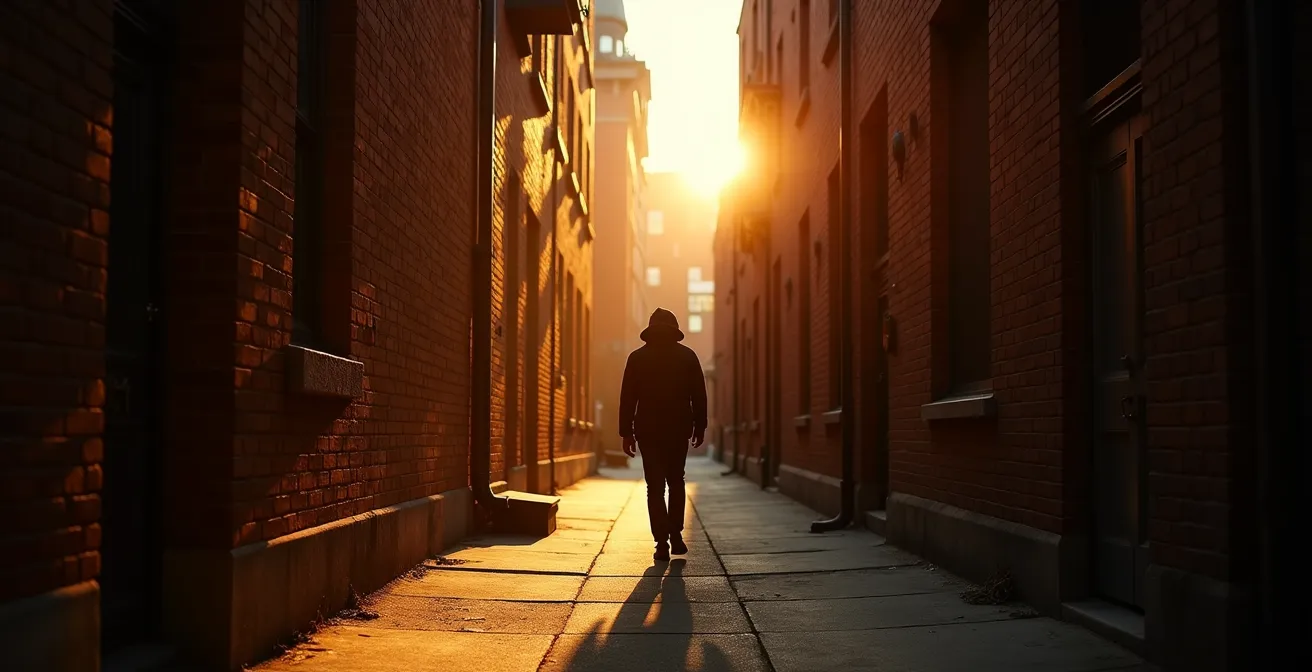
This walk isn’t just about getting from point A to point B; it’s a narrative experience. It builds anticipation and allows you to see the Half House not as a standalone quirk, but as the exclamation point on a sentence written in Victorian brick and mortar.
Key Takeaways
- The Half House is a product of “preservation by circumstance,” not intentional heritage planning.
- Its structural stability is a testament to significant engineering compromises made under duress after its other half was demolished.
- The best photographs tell the story of the “architectural scar” and its forced adaptation, best captured during the golden hour for dramatic effect.
How to Maintain a Victorian Home in Toronto Without Going Broke?
The Half House, in its extreme and bizarre glory, serves as the ultimate cautionary tale for anyone owning or considering buying a Victorian home in Toronto. While most owners won’t face the prospect of their house being sliced in half, the underlying issues it represents are universal: structural interdependence, aging materials, and the constant battle against the elements. The post-demolition complaints from the Valkos family about rain seeping in and arguments over insulation are a dramatic version of the maintenance crises that many owners of older Toronto homes face.
Beyond the typical concerns of knob-and-tube wiring or crumbling foundations, the Half House highlights the critical importance of understanding party walls and property boundaries. In a city of semi-detached and row houses, what your neighbour does can have a direct structural and financial impact on your property. The “Extreme Victorian Maintenance” saga of the Half House’s exposed wall underscores how a seemingly simple boundary line can become a source of massive, unexpected costs. This is the hidden risk of owning a piece of Toronto’s history; these homes are often physically linked in ways that modern houses are not.
However, the story also contains a sliver of hope. Despite its unique structural challenges and bizarre history, the property maintains a significant value, a testament to the desirability of these historic homes and their prime downtown locations. The key to maintaining a Victorian home without going broke is proactive diligence: conduct thorough structural inspections, understand the legal status of any shared walls, and budget aggressively for the inevitable—and often unpredictable—repairs. The Half House is a lesson written in brick and stucco: in Victorian real estate, you’re not just buying a house; you’re inheriting a complex and interconnected piece of the city’s fabric.
Now that you understand the forces that shaped this architectural marvel, the next logical step is to explore the Grange neighbourhood yourself and see these stories written in brick and mortar.