
The real value of authentic Toronto design isn’t just in the object itself, but in the traceable materials, the maker’s skill, and a story you can’t get from a flat-pack box.
- Authenticity is revealed through “material honesty”—the use of identifiable, quality materials like Ontario wood versus anonymous composites.
- A higher price often reflects ethical labour, local workshop overhead, and the designer’s refusal to compromise on quality, not just a brand name.
Recommendation: Shift your mindset from “consumer” to “patron.” Instead of just looking at the price tag, learn to ask about the process, the materials, and the story behind the piece.
You’re standing in a small boutique in the Distillery District, holding a beautifully scented candle. The price tag reads $45. Your mind immediately does the math: you can get three or four candles for that price at a big-box store. Is this a rip-off? Is “local” just a trendy word used to inflate prices? As a textile artist with a studio in this city, I hear this question—and I feel the hesitation behind it. You want to support local creators, to fill your home with meaningful pieces, but you’re afraid of being duped by clever marketing.
The common advice is to “look for ‘Made in Toronto’ labels” or “visit artisan markets.” But that’s not enough. That label doesn’t tell you about the quality of the materials, the hours of skilled labour, or the cost of running a small workshop in a city like ours. It doesn’t protect you from a mass-produced item simply finished or packaged here. The truth is, distinguishing genuine craft from a well-marketed import requires a new way of seeing—what I call the maker’s eye.
This isn’t about shaming you for loving IKEA. It’s about empowerment. It’s about understanding that the alternative to “fast furniture” isn’t just “expensive furniture,” but “valuable furniture.” This guide is my invitation to you, from my workshop to your home. I want to pull back the curtain and show you what to look for, the questions to ask, and the hidden details that scream authenticity. We’ll deconstruct the costs, explore the materials, and give you the confidence to invest in pieces that not only beautify your space but also enrich our city’s creative soul.
To help you navigate this world, this article breaks down the key questions and signs of true local craftsmanship. We will explore everything from the price of a simple candle to the process of commissioning a custom piece, giving you a complete framework for becoming a confident patron of Toronto design.
Summary: A Toronto Maker’s Guide to Spotting True Local Craft
- Why Does a Hand-Poured Candle Cost $45 CAD at a Local Boutique?
- How to Order Custom Furniture from a Parkdale Designer Without Delays?
- Made in Toronto vs. IKEA: Which Sofa Survive a Move Better?
- The Sizing Mistake That Makes “One Size Fits All” a Lie
- When Do Local Designers Clear Out Their Studio Samples?
- Why Does That Thrifted T-Shirt Cost $45 CAD in a Boutique?
- How to Order Custom Jewelry from Local Makers for Special Occasions?
- How to Build a Vintage Wardrobe in Toronto Without Overspending?
Why Does a Hand-Poured Candle Cost $45 CAD at a Local Boutique?
That $45 candle is the perfect starting point to understand the economics of craft. A mass-produced candle uses cheap paraffin wax, synthetic fragrance oils, and automated factory labour. A Toronto maker’s candle tells a different story. The cost begins with superior materials: organic coconut or soy wax, which burns cleaner and longer, and pure essential oils for a complex, natural scent, not a chemical approximation. These materials can cost 5 to 10 times more than their industrial counterparts. The consumer shift towards these products is clear, with the global handicrafts market valued at USD 739.95 billion in 2024 and growing.
Next comes the labour. Each candle is wicked, poured, and finished by hand. This isn’t just about time; it’s about skill. The maker is controlling the temperature, ensuring the fragrance is perfectly blended, and checking for flaws. Then there’s the overhead: rent for a studio space in a city where commercial space is notoriously expensive, insurance, packaging, and marketing. Finally, there’s the vessel itself—often a reusable ceramic or glass piece made by another local artisan, adding another layer of craft and cost.
So, when you buy that $45 candle, you’re not just buying wax and a wick. You’re paying for better, safer materials, the artisan’s time and expertise, a share of their studio rent, and often, the work of a second local creator. You’re investing in a small-scale, ethical supply chain right here in Toronto.
How to Order Custom Furniture from a Parkdale Designer Without Delays?
Commissioning custom furniture from a designer in a neighbourhood like Parkdale is the ultimate act of local patronage. It’s a collaboration. But the fear of delays, budget overruns, and miscommunication can be daunting. The key to a smooth process is process transparency from both you and the maker. It all begins with a clear, shared understanding of the project before a single piece of wood is cut. An experienced designer will guide you, but it’s your responsibility to be prepared.
The first step is homework. Don’t just email with a vague idea. Arrive at the initial consultation with dimensions, inspiration photos, and a clear budget. This respect for the maker’s time sets a professional tone. A good designer will, in turn, provide detailed sketches, material options (like Ontario maple versus walnut), and a transparent quote that breaks down material and labour costs. Most importantly, they will present a contract. This document is your best friend—it should outline the payment schedule, the estimated timeline, and a crucial clause on how potential delays, such as issues with wood suppliers, will be handled.
This dialogue is something you will never have with a mass-producer. It’s your chance to connect with the creative process, understand the material’s origin, and have a hand in the creation of a piece that is uniquely yours. Building this relationship is as vital as the dovetail joints holding your future table together.

As the sketch takes shape, you’re not just approving a design; you’re co-creating. This tactile, collaborative process ensures the final piece perfectly matches your vision and is a hallmark of true custom work. Below is a checklist to guide you through this exciting journey, ensuring your commission is a success from start to finish.
Your Action Plan: Commissioning Furniture from a Toronto Maker
- Meet the makers: Visit studio spaces during events like the DesignTO Festival to see work quality firsthand and establish a personal connection.
- Verify credentials: Check if the designer is an OCAD University alumnus or a member of a professional guild, like the Ontario Wood Custom Furniture Makers, for added credibility.
- Insist on samples: Request specific material samples, especially from Canadian suppliers, before committing with a deposit to ensure you love the look and feel.
- Clarify the finances: Establish a clear payment structure, which is typically a 50% deposit for materials and 50% upon completion, and get it in writing.
- Plan for the unexpected: Before signing the contract, ask about their contingency plans for potential issues like delays from Ontario wood suppliers.
Made in Toronto vs. IKEA: Which Sofa Survive a Move Better?
The true test of furniture quality often comes during a move. This is where the difference between a locally made solid wood piece and a mass-produced particleboard item becomes brutally clear. An IKEA sofa is designed for one thing: to fit in a flat box. Its construction relies on cam-lock fasteners and screws driven into particleboard or low-density fiberboard. These materials are essentially wood dust and glue, and they have very little structural integrity. The first time you assemble it, it’s fine. But every subsequent move, every twist of a screwdriver, weakens the connection points until they can no longer hold.
A sofa from a Toronto workshop, by contrast, is built with longevity in mind. It starts with a frame made of solid Canadian hardwood, like maple or oak. The joints aren’t held together with a handful of screws; they use time-tested joinery techniques like dovetails or mortise-and-tenon joints. These joints are designed to lock together, distributing stress across the entire frame. This construction is inherently stronger and can withstand the torque and pressure of being moved multiple times. The strength of this local industry is significant, with Statistics Canada reporting the furniture manufacturing sector’s GDP at $4.88 billion CAD as of August 2024, demonstrating its vital role.
The difference is about repairability, too. When a particleboard leg joint strips, the piece is often destined for the curb. When a solid wood frame gets a scratch, it can be sanded and refinished. A local maker builds a piece to last for generations, not just until your next lease is up.
The durability isn’t just an abstract concept; it can be quantified. The materials and construction methods directly impact how well a piece of furniture will last, its potential for repair, and its value over time. The following table breaks down these critical differences.
| Feature | Toronto-Made Solid Wood | IKEA Particleboard |
|---|---|---|
| Material Source | Canadian maple/oak from Ontario | Compressed wood particles |
| Joinery Method | Dovetail/mortise-and-tenon joints | Cam-lock fasteners |
| Move Survival Rate | 95%+ with proper handling | 60-70% risk of damage |
| Repairability | Full restoration possible locally | Often irreparable after damage |
| Resale Value | 40-60% of original price | 10-20% of original price |
The Sizing Mistake That Makes “One Size Fits All” a Lie
In the world of fast fashion, “one size fits all” is a manufacturing shortcut, not a customer-centric feature. It’s a lie designed to reduce inventory costs by creating a single, often unflattering, garment meant to vaguely fit a wide range of bodies. This approach completely ignores the beautiful diversity of human shapes. Authentic local designers in Toronto are actively pushing back against this by embracing fit transparency and made-to-order models. For them, clothing is not about forcing a body into a pre-set shape, but about draping fabric on an individual form.
When you shop from a local maker, you have a unique opportunity to engage with the fit. Instead of a tag with a single letter, you get access to the person who designed and patterned the garment. This allows for a much more nuanced approach to sizing. Many Toronto brands offer made-to-order options where they will cut and sew a piece specifically for you based on your measurements. Others, who produce in small batches, provide detailed garment measurements online—not just bust, waist, and hips, but also sleeve length, rise, and inseam. This allows you to compare the garment’s dimensions to a similar piece you already own and love.
The biggest mistake consumers make is trusting the label instead of the measurements. By learning to ignore “S, M, L” and focusing on the actual inches or centimeters, you empower yourself to buy with confidence. The best way to do this is to engage directly with the makers through the following methods:
- Visit designer studios in creative hubs like Sterling Road for in-person try-ons and direct feedback.
- Always request detailed garment measurements (bust, waist, length) to compare with your own well-fitting clothes at home.
- During studio visits, ask designers to explain their intended fit—is it meant to be structured, loose, or draped?
- Take full advantage of made-to-order options, which are increasingly offered by Toronto brands to ensure a perfect fit.
- For a truly personalized experience, schedule appointments during off-peak hours for a one-on-one fitting consultation.
When Do Local Designers Clear Out Their Studio Samples?
One of the best-kept secrets for accessing authentic Toronto design on a budget is knowing when to shop for samples. Studio samples are the prototypes, the runway pieces, the photography models, and the previous season’s stock that makers need to clear out to make room for new work. These are not flawed items; they are an integral part of the design process and are often made with the same high-quality materials and craftsmanship as the final products. Getting access to these sales requires a bit of insider knowledge and strategic timing.
Unlike big-box retailers with predictable quarterly sales, a maker’s clearance schedule is tied to the creative and market calendar of the city. These sales are often small, short-lived events, sometimes announced only to a loyal following. The key is to get on the inside track. The single most effective tool is the designer’s newsletter. Makers almost always give their email subscribers first dibs on sample sales, often 24-48 hours before announcing them on social media. This is a direct line to the best pieces at the best prices.
Beyond newsletters, the rhythm of Toronto’s design events provides a predictable calendar for sales. Knowing this schedule allows you to anticipate when studios will be looking to clear space. Here are the key moments to mark in your calendar:
- February: Look for post-DesignTO Festival clearance sales at participating studios as they offload exhibition pieces.
- May-October: The Toronto Artisan Market at Trinity Bellwoods Park offers direct access to designers who may have samples for sale alongside their main collection.
- October: This is a prime time for pre-One of a Kind Show stock clearing, as vendors make space for their holiday inventory.
- January/February: Furniture showrooms often sell their floor models at a discount after the busy holiday season.
- Always: Sign up for your favourite designers’ newsletters. This is your VIP pass, often granting you access 48 hours before the public.
Why Does That Thrifted T-Shirt Cost $45 CAD in a Boutique?
Walking into a curated vintage boutique in Kensington Market and seeing a t-shirt priced at $45 can feel like a contradiction. Isn’t thrifted clothing supposed to be cheap? This is a fundamental misunderstanding of “curated vintage” versus “thrift.” The price of that t-shirt isn’t for the shirt itself, but for the labour of curation. The shop owner has done the hard work for you, and that expertise has value.
Think of the process. The owner or their team spends countless hours “digging” through bins at vast, unorganized donation centres, often on the outskirts of the city. They are sorting through thousands of stained, torn, and undesirable items to find that one gem. This is a physically demanding and time-consuming job. Once a potential piece is found, the work has only just begun. The item must be professionally cleaned and sanitized. Any flaws—a missing button, a small hole, a loose seam—must be meticulously mended. This requires skill and often specialized tools.
After restoration, the piece is researched. Is it a rare 90s band tee? Is the fabric a unique single-stitch cotton? This knowledge informs the price. Then comes the cost of presenting the item: professional photography for online sales, merchandising in a physical store, and, of course, the high cost of retail rent in a desirable neighbourhood like Kensington or Parkdale. The $45 price tag covers the owner’s expert eye, their time spent hunting, the cost of cleaning and repairs, their historical knowledge, and their business overhead.
How to Order Custom Jewelry from Local Makers for Special Occasions?
Commissioning a piece of custom jewelry for an engagement, anniversary, or milestone birthday is an intimate and personal process. It’s an opportunity to create a future heirloom. Working with a local Toronto maker from a place like the Harbourfront Centre Craft & Design Studio transforms the experience from a simple transaction into a meaningful collaboration. The most critical element for success is time. Unlike buying a piece from a display case, craft takes time, and you must plan accordingly.
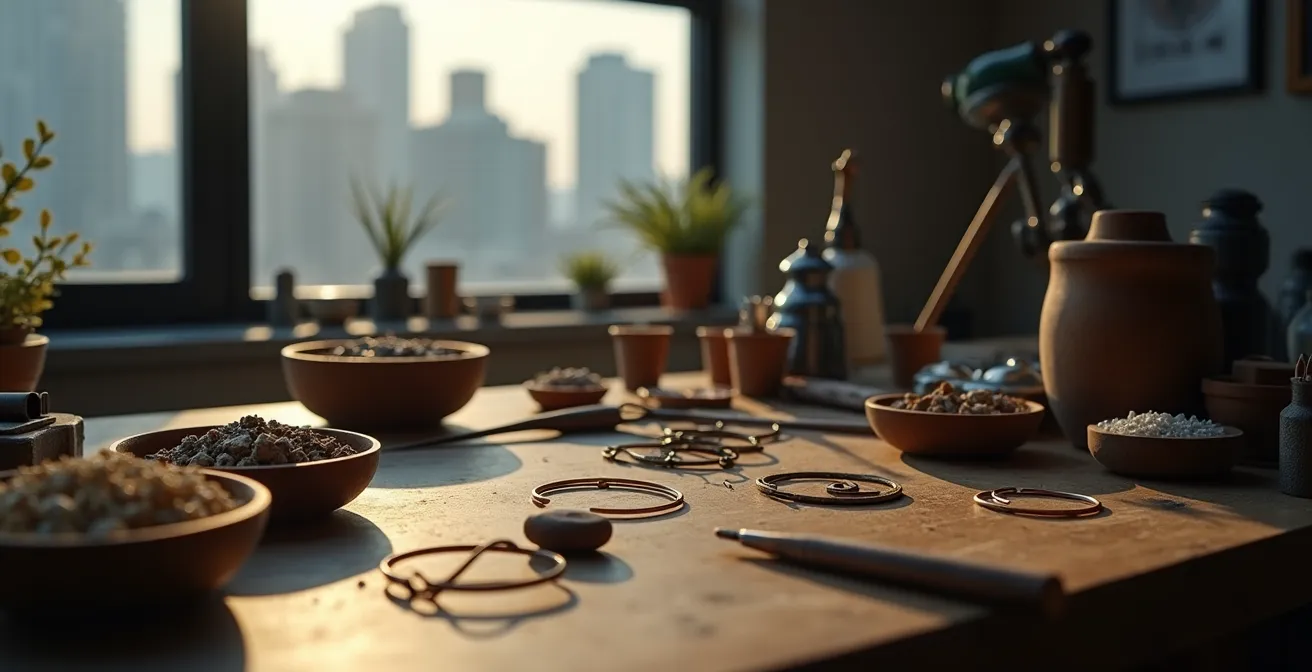
A rushed process benefits no one. Giving your chosen artisan ample time allows for thoughtful design, sourcing of the perfect materials—like Canadian-mined diamonds or unique gemstones—and meticulous craftsmanship without pressure. A typical commission should start four to six months before you need the finished piece. This buffer accounts for design consultations, sourcing, the creation of a wax model for your approval, casting, stone setting, and final finishing. It also respects the fact that you are likely not the maker’s only client. Artisans are small businesses, and a well-planned timeline shows respect for their craft and schedule.
The process is also governed by Canadian law. Your piece must be hallmarked according to the Precious Metals Marking Act, a guarantee of the metal’s purity. This is another detail a true professional will handle, and it’s a mark of authenticity you won’t find in an unregulated overseas piece. Planning ahead ensures every step, from the initial sketch to the final hallmark, is done with the care and precision your special occasion deserves.
To ensure your vision becomes a reality without stress, follow a structured timeline. Here is a step-by-step guide for commissioning custom jewelry in Toronto:
- 4-6 months before event: Begin your research. Explore the work of makers at places like Harbourfront Centre Craft & Design Studio or Made You Look to find an aesthetic you love.
- 3-4 months before: Schedule your initial design consultation with your chosen artisan to discuss ideas, materials, and budget.
- 2-3 months before: Approve the final design, often presented as a wax model, and select your stones, considering options like Canadian-mined or lab-grown gems.
- 6-8 weeks before: This is when the magic happens—casting, setting, and finishing. The piece will also be sent for hallmarking as required by the Precious Metals Marking Act.
- 2 weeks before: Schedule your final pickup. This allows time for any minor sizing adjustments if needed.
Key Takeaways
- True value lies in material honesty and process transparency, not just a “Made in Toronto” sticker.
- The higher cost of local goods directly funds ethical labour, quality materials, and the maker’s creative sustainability in our city.
- Empower yourself by learning to ask questions: “What is this made of?”, “How was it made?”, and “What’s the story behind this piece?”.
How to Build a Vintage Wardrobe in Toronto Without Overspending?
Building a beautiful, sustainable vintage wardrobe in Toronto is not about luck; it’s about strategy. The city offers a rich ecosystem for second-hand clothing, but navigating it without overspending requires understanding the different tiers of the market. The key is to balance cost versus curation. You can choose to spend more money to save time, or spend more time to save money. Having a strategy for each tier is the secret to building a collection you love, affordably.
At the base is “The Dig”—shopping at large, unsorted thrift stores like Value Village in Etobicoke or Scarborough. Here, prices are lowest, but the effort required is highest. You need time, patience, and a sharp eye to sift through racks of mediocre items to find the hidden treasures. The next level up is “Curated Affordable,” found in the independent shops of Kensington Market and Parkdale. Here, owners have done the digging for you. Prices are higher, but you’re paying for their expertise and saving yourself hours of searching. You can browse a rack where every item has been pre-selected for its style and quality.
Finally, there’s “Investment” vintage at high-end consignment stores in neighbourhoods like Yorkville and Rosedale. Here, you’ll find authenticated designer and luxury pieces in pristine condition. The effort is minimal, but the prices reflect the rarity and brand value. A truly savvy shopper doesn’t stick to one tier. They might buy their basic vintage denim during a “dig,” find a unique leather jacket in Parkdale, and save for a timeless designer bag from a Yorkville consignment shop. Understanding this ecosystem allows you to allocate your budget and time effectively.
Navigating Toronto’s vintage scene is a game of trade-offs between price and the level of effort you’re willing to put in. This table outlines the three main tiers to help you strategize your approach.
| Tier | Location | Price Range | Effort Level |
|---|---|---|---|
| Tier 1: The Dig | Value Village Etobicoke/Scarborough | $5-30 | High effort, time-intensive |
| Tier 2: Curated Affordable | Kensington Market/Parkdale shops | $20-80 | Moderate effort, pre-selected |
| Tier 3: Investment | Yorkville/Rosedale consignment | $100-500+ | Low effort, premium curation |
Your next step is to take this knowledge out into the city. Go not just to buy, but to look, to ask questions, and to connect with the incredible makers and curators shaping Toronto’s design landscape. Become a patron of their craft and build a home and wardrobe filled with stories, not just stuff.